


Large dog kennel dimensions: Your Guide to a Safe and Comfortable Fit

Finding the right large dog kennel dimensions is a critical step in ensuring your dog’s safety, comfort, and training success. A well-sized kennel becomes a secure den—a personal sanctuary that calms anxiety. A poorly sized one can cause physical discomfort and behavioral problems. This guide provides the actionable steps to measure correctly and choose wisely.
Why Kennel Dimensions Are So Important for Big Dogs
Generic size charts are a starting point, but they often fail large or uniquely built breeds. Relying on them can lead to significant issues. The only way to get it right is to measure your dog yourself. An incorrect fit can compromise their health, stall training, and create unnecessary stress.
A kennel that’s too small is a serious welfare issue. It restricts movement, leading to stiff joints and potential pain, especially for breeds prone to hip dysplasia. The confinement can also trigger anxiety, leading to destructive behaviors or a lasting fear of the crate.
The Problem with Too Much Space
Conversely, a kennel that's too large creates a different set of challenges, primarily derailing your house-training efforts.
Dogs have a natural instinct to keep their sleeping area clean. If a crate is oversized, a dog may designate one corner for sleeping and the opposite corner as a toilet. This completely undermines the den principle that makes crate training so effective.
Actionable Tip: The goal is to provide enough room for your dog to stand up, turn around, and lie down comfortably—and no more. This precise balance creates a secure, cozy space, preventing them from using one end as a bathroom.
Creating a True Safe Haven
When you nail the large dog kennel dimensions from the start, you provide a powerful, positive tool for your dog's well-being. This secure personal space is essential for several reasons:
- Effective House Training: It leverages their natural denning instinct to keep their space clean.
- Anxiety Reduction: It offers a safe retreat during stressful events like thunderstorms or when you leave home.
- Safe Travel: It keeps them secure and comfortable during car rides or flights.
Taking a few minutes to measure your dog accurately ensures their kennel is a true sanctuary that supports good behavior and a well-adjusted life.
How to Measure Your Dog for a Kennel the Right Way
Forget generic breed charts and weight-based guides. A lanky Greyhound and a stocky Rottweiler of the same weight require completely different kennel dimensions. The only way to ensure a perfect fit is to measure your dog yourself. Follow these two simple steps to get the exact numbers you need.
Measuring Your Dog's Height
First, get your dog's height. Have them stand in a natural, relaxed position—not slouching or stretching.
Measure from the floor straight up to the top of their head. If your dog has erect ears, like a German Shepherd, be sure to include the tips of their ears in the measurement. This ensures they will have adequate headroom and won't need to duck inside the kennel.
Measuring Your Dog's Length
Next, measure their length. While your dog is still standing, measure from the tip of their nose to the base of their tail.
Do not include the tail in this measurement, as its position can vary and will skew the result. You are capturing the length of their body to ensure they have enough room to lie down and stretch out fully.
Pro Tip: If your dog is wiggly, have them stand beside a wall. Make a small, light pencil mark on the wall at the top of their head and another at the base of their tail. After they move, simply measure the distance between your marks. Use treats to reward them for holding still.
Getting these two measurements right is non-negotiable. A miscalculation of even an inch can mean the difference between a comfortable den and a cramped space. In logistics, professionals how to calculate cubic weight for shipping with precision; apply that same attention to detail here. Measure two or three times to confirm your numbers are accurate.
This visual guide shows the ideal fit you're aiming for.
As you can see, the "just right" kennel provides a secure, den-like space. An oversized kennel complicates house-training, while an undersized one is unsafe and inhumane.
Now that you have your dog's exact height and length, you’re ready for the final step: converting those numbers into the perfect kennel dimensions.
Turning Your Dog's Measurements into Kennel Size
You've measured your dog's height and length. Now, it's time to translate those numbers into the ideal large dog kennel dimensions. This is how you ensure the kennel becomes a true safe haven.
The most important step is to add 4 to 6 inches to both your dog's final height and length measurements. This buffer is essential. It provides the necessary space for them to stand fully without hunching, turn around without hitting the sides, and lie down in a natural position.
For example, if your German Shepherd measures 26 inches tall and 38 inches long, you need a kennel with internal dimensions of at least 30 inches high and 42 inches long. This extra room transforms the kennel from a restrictive box into a comfortable retreat.
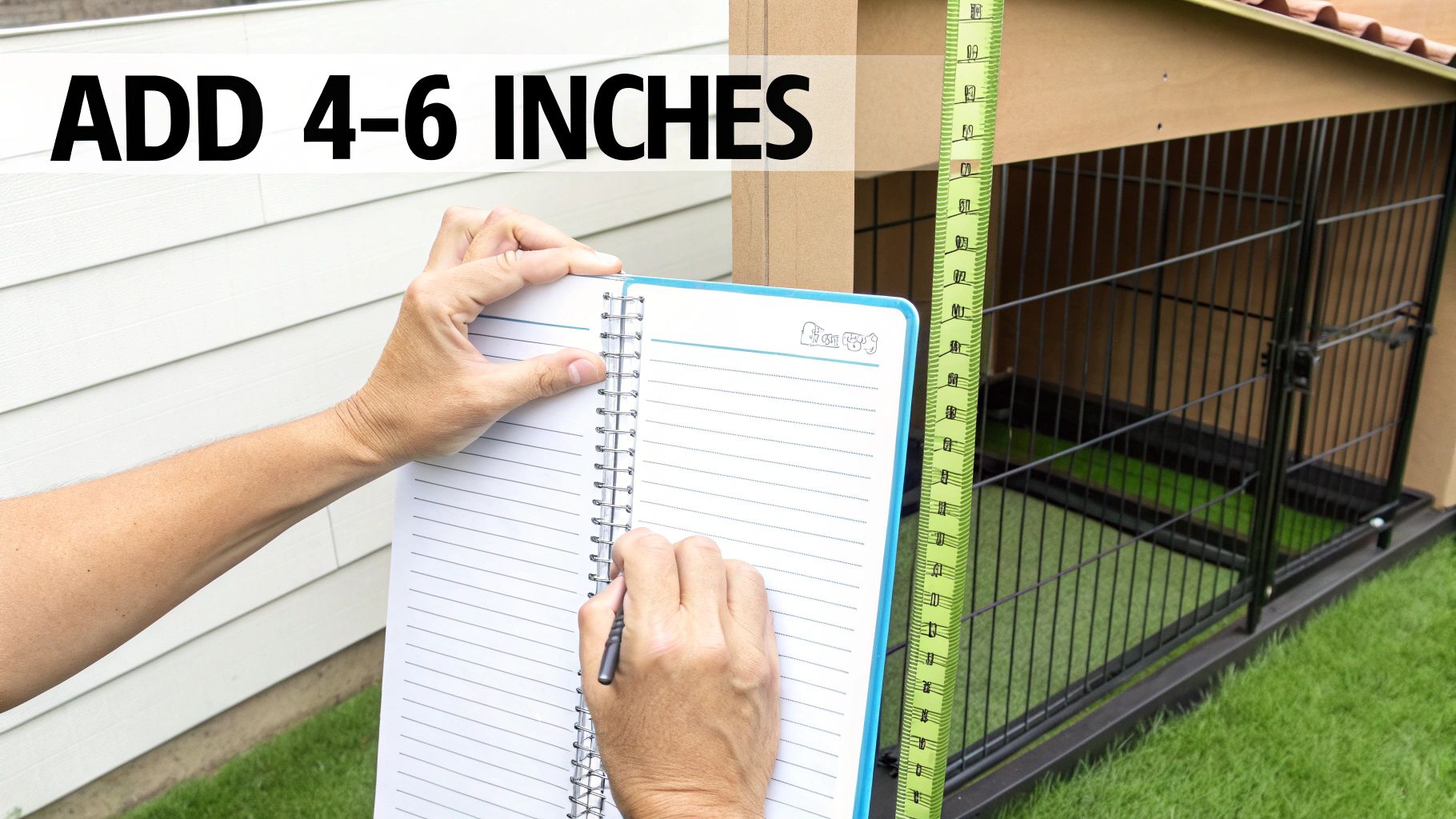
Interior vs. Exterior Dimensions
Here is a critical detail that trips up many owners: always check the interior dimensions. Your calculated size (dog’s measurements + 4-6 inches) refers to the usable space inside the kennel.
Product listings often highlight the exterior dimensions, which include the frame and handles. These tell you if the kennel will fit in your car or home, but not if your dog will fit inside it. Before buying, dig into the product specifications to find the internal measurements.
Actionable Tip: Before you start shopping, measure the space in your car and home where the kennel will go. Compare these numbers to a kennel’s exterior dimensions to ensure it fits your environment, and compare your calculated size to the interior dimensions to ensure it fits your dog.
Putting It All Together
With your ideal internal dimensions calculated, you can now shop with confidence. You'll find that many manufacturers base their sizing on this formula. For example, a kennel marketed for a Boxer will typically fall within the 38-42 inch length range.
This standard is rooted in safety and humane transport guidelines, like those from the USDA, which often mandate a kennel be at least six inches taller than the animal.
To help you get started, here is a reference table for some common large breeds.
Example Kennel Dimensions for Common Large Breeds
This table provides estimated minimum internal kennel dimensions for popular breeds based on average sizes and the "add 4-6 inches" rule.
| Breed | Average Height (Standing) | Average Length (Nose to Tail Base) | Recommended Minimum Internal Kennel Dimensions (L x W x H) |
|---|---|---|---|
| Golden Retriever | 23-24 in | 34-37 in | 38-42" L x 26" W x 28-30" H |
| German Shepherd | 24-26 in | 36-39 in | 42-44" L x 28" W x 30-32" H |
| Labrador Retriever | 22-25 in | 35-38 in | 40-42" L x 27" W x 30-31" H |
| Boxer | 22-25 in | 33-36 in | 38-42" L x 26" W x 28-30" H |
| Siberian Husky | 21-24 in | 32-35 in | 36-40" L x 25" W x 27-29" H |
Remember: This table is a guide. Always prioritize your own dog's specific measurements.
A correctly sized kennel is a powerful training tool that supports house-training and helps reduce separation anxiety. To explore different styles, see our guide on understanding different dog crate sizes. With your measurements in hand, you are fully equipped to choose the perfect kennel.
Features to Look for Beyond Just the Size
Getting the right large dog kennel dimensions is step one. Step two is ensuring the kennel is safe and secure. Once you know the size you need, evaluate the kennel's construction, ventilation, and security features. This is how you choose a high-quality product that will last.
Think of it like inspecting a car's safety features after confirming you fit in the driver's seat. Apply that same diligence to your dog's personal space.
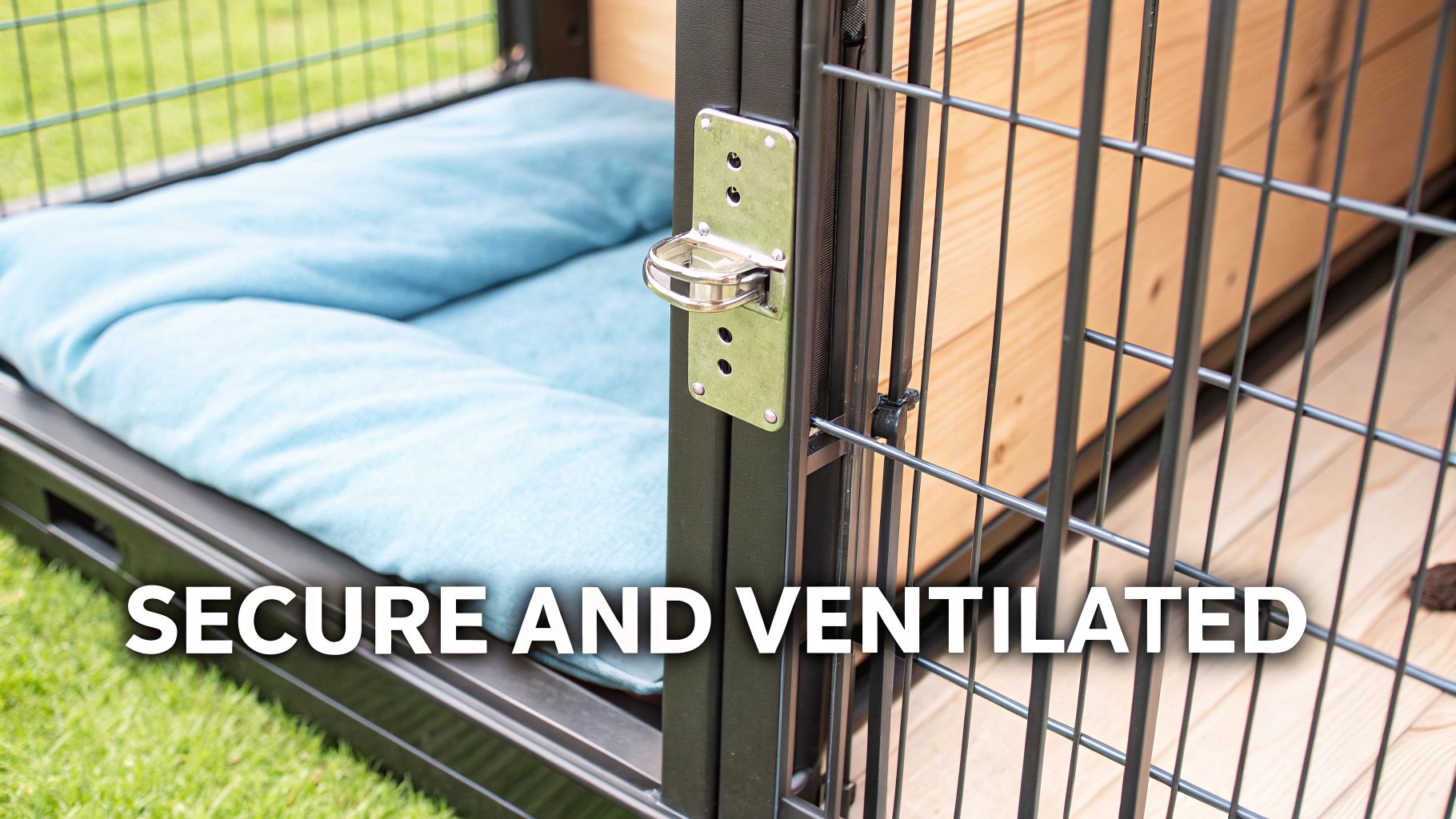
Prioritizing Airflow and Ventilation
Good ventilation is a non-negotiable safety requirement, especially for large breeds prone to overheating. Actionable Step: Look for kennels with ample airflow on at least two sides to create a cross-breeze.
Wire crates excel at this, but many modern plastic kennels also feature well-designed ventilation slots. Proper airflow keeps your dog cool, prevents moisture buildup, and maintains a fresh, healthy environment.
Evaluating Material Strength and Durability
Large dogs are strong, and their kennel must be built to withstand their power. Flimsy materials pose a risk of escape and injury.
- Steel Wire: For wire crates, look for a lower gauge number, which indicates thicker, stronger wire. Inspect the welds to ensure they are smooth and solid.
- Reinforced Plastic: For plastic kennels (required for most air travel), choose heavy-duty, impact-resistant plastic. It should feel sturdy, not thin or brittle.
- Heavy-Duty Options: For escape artists or dogs with severe anxiety, invest in a heavy-duty kennel made from welded steel bars and reinforced frames.
A kennel is an investment in your dog's safety. A determined large dog can bend thin wire or crack weak plastic. Choose durable materials to prevent accidents.
Checking the Latching System
The door latch is a common failure point. A clever dog can quickly figure out a simple slide-bolt latch. Actionable Step: Look for doors with multiple latch points or a mechanism that requires two distinct actions to open (e.g., lift and slide).
Once you've latched the door, give it a firm shake. It should feel solid with minimal play. This simple test can prevent future escapes and give you peace of mind.
For more on choosing a quality kennel, see our guide on choosing the right kennel for your dog.
Considering Comfort and Flooring
While a kennel shouldn't be a playground, a hard plastic or metal floor can be uncomfortable. To make the space more inviting, add a thin, chew-resistant mat that fits the floor snugly.
The bedding should not be so thick that it reduces the internal height you carefully calculated. The goal is to add comfort without compromising the space your dog needs to stand and move freely.
Choosing the Right Kennel for Air Travel
Flying with a large dog requires a kennel that meets strict airline and International Air Transport Association (IATA) regulations. Your home kennel, even a high-quality one, will likely be rejected if it is not IATA-compliant.
First, standard wire crates are prohibited for air travel. You must use a solid-sided plastic kennel. Actionable Step: Ensure the kennel is constructed from heavy-duty plastic and fastened together with metal bolts. Kennels with plastic clips will be denied at check-in.
Key Features of an IATA-Compliant Kennel
Airlines scrutinize several key features. The door must be made of metal with a secure, single-latch system that prevents it from being opened accidentally.
Proper ventilation is also mandatory. The kennel must have ventilation openings on at least three sides (some airlines require four). This ensures adequate airflow in the cargo hold. Always verify your specific airline’s rules well in advance.
Actionable Tip: The number one reason pets are denied boarding is a non-compliant kennel. A week before your flight, review your airline’s pet policy online or call them to confirm every requirement. This includes rules for attachable food and water dishes.
Sizing and Labeling for the Skies
The sizing rules we discussed are even more critical for air travel. There is zero room for error. The large dog kennel dimensions must allow your dog to stand with their head fully erect (without touching the ceiling), turn around, and lie down naturally. Airline staff will physically inspect this, and if the kennel appears too small, it will be rejected.
Proper labeling is the final step. Your kennel must be clearly marked for safe handling.
- Attach "Live Animal" stickers to multiple sides of the kennel.
- Apply "This Way Up" directional arrows to show the correct orientation.
- Securely attach your contact information (name, address, phone number).
- Include your dog's name and any important notes for handlers.
Following these regulations ensures a safer journey for your dog. For more details, consult our guide on airline-approved pet carrier dimensions.
Still Have Questions About Large Dog Kennels?
Even with careful measurements, you may have a few final questions. Here are actionable answers to some of the most common queries about choosing a kennel for a large dog.
What if My Large Dog Is Still a Puppy?
When buying a kennel for a large-breed puppy, purchase one sized for their expected adult dimensions and use a divider panel. This allows you to create a smaller, appropriate-sized space that you can expand as they grow. A divider is also essential for effective house training, as it prevents the puppy from using one end of the kennel as a bathroom. This is the most cost-effective and practical solution.
Is a Wire or Plastic Kennel Better for a Large Dog?
The best choice depends on your dog’s temperament and how you will use the kennel. Both styles are suitable for large dog kennel dimensions but serve different needs.
- Wire Crates: Offer superior ventilation and visibility, making them ideal for confident dogs who enjoy observing their surroundings.
- Plastic Kennels: Provide a more enclosed, den-like environment that can be comforting for anxious or shy dogs. They are also required for most air travel.
For dogs known for escape attempts, a heavy-duty wire or reinforced plastic model is the safest choice for home use.
Actionable Insight: Observe your dog's behavior. A shy Great Dane who felt exposed in a wire crate might thrive in the security of a plastic one. A curious Labrador might prefer the open view of a wire kennel. Match the kennel type to your dog's personality.
Can a Kennel Be Too Big for My Dog?
Absolutely. An oversized kennel undermines house training. If a dog has enough space to create separate sleeping and toilet areas, they will do so, defeating their natural instinct to keep their den clean. The correct size allows them to stand, turn, and lie down comfortably—and nothing more. This encourages them to hold it until you let them out.
How Do I Make the Kennel a Positive Place?
The most important rule is to never use the kennel as punishment. Your goal is to associate the kennel with safety, rest, and rewards.
Introduce the kennel gradually. Toss high-value treats inside with the door open. Feed your dog meals inside the kennel. Place their favorite toys inside. The objective is to build a strong positive association so your dog chooses to enter on their own.
Ready to provide your dog with the safe, comfortable space they deserve? The carriers and kennels from Pet Magasin are designed with your pet's safety and comfort as the top priority, ensuring a perfect fit for home and travel. Find the ideal solution for your furry family member at https://www.petmagasin.com.

Leave a comment