


A Complete Guide to Dog Crate Sizes

Picking the right dog crate is a critical decision for your pet's safety, training success, and overall well-being. When you select the correct size, you tap into a dog's natural denning instinct, transforming the crate from a simple box into a welcoming sanctuary. Get this right, and you’ll give your dog a secure space they willingly retreat to. This guide provides the actionable steps you need to choose the perfect crate with confidence.
Why the Right Crate Size Is So Important
Think of a crate as your dog's personal bedroom, not a cage. Dogs are den animals by nature, meaning they instinctively seek out small, cozy spaces to feel secure. A perfectly sized crate mimics this environment, offering them a private retreat from household chaos and a comforting place to relax. When a dog feels secure in their crate, it significantly reduces anxiety.
Beyond comfort, proper sizing is a powerful tool for house training.
A correctly sized crate is your secret weapon for potty training. It provides enough room for a puppy to stand up, turn around, and lie down, but not enough extra space to establish a "potty corner." This discourages them from soiling their sleeping area.
This simple principle accelerates the potty training process. A crate that's too large allows a puppy to create separate living and bathroom zones, undermining your training efforts and leading to frustration for both of you.
The Foundation of Safety and Security
An appropriately sized crate is also essential for your dog's physical safety, especially during travel. In a car, a snug fit prevents your dog from being thrown around during a sudden stop or sharp turn, drastically reducing the risk of injury. This focus on security reflects a broader trend: the global dog crate market is projected to hit USD 5.0 billion by 2032, driven by the 85% of owners who view their dogs as family members.
Of course, a crate is just one part of a safe environment. Consider pairing it with other essential pet accessories that enhance your dog's well-being. This guide will walk you through the practical steps of measuring your dog and interpreting size charts so you can choose a crate that ensures security and aids in training.
How to Measure Your Dog for a Crate
Guessing your dog's crate size is like buying shoes without knowing the size—you might get lucky, but a poor fit is the more likely outcome. Accurate measurements are the only way to guarantee a perfect fit. Fortunately, the process is simple and removes all guesswork.
Before you grab the tape measure, understand why precision is key. This visual breaks down how the right-sized crate leverages your dog's natural instincts to become a safe space and an effective training tool.
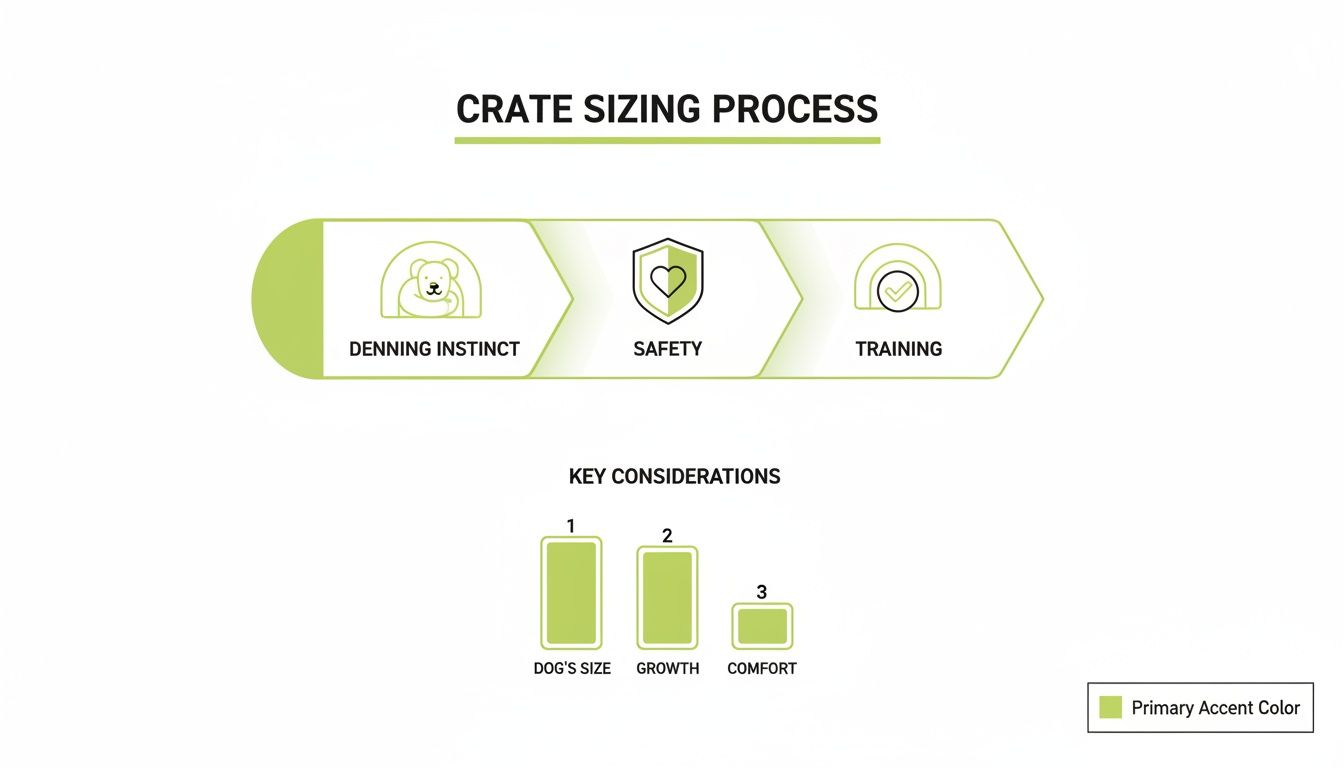
As you can see, a properly sized crate feels like a natural den. This sense of security is what makes it a sanctuary. Here’s how to get the two simple measurements you need to make it happen.
The Two Essential Measurements
To find the perfect crate, you only need two measurements. For accuracy, ensure your dog is standing comfortably on all four paws. Ask a friend to help by holding a treat to keep your dog still.
- Measure the Length: Place the end of a soft tape measure at the tip of your dog's nose and extend it along their spine to the base of their tail. Do not include the tail in this measurement. Record this number.
- Measure the Height: Have your dog sit. This position usually represents their tallest point inside a crate. Measure from the floor to the very top of their head or the tips of their ears if they are erect. Record this number.
These two figures are your starting point. They provide a far more reliable guide than relying on breed or weight estimates alone.
Applying the 2-to-4 Inch Rule
With your measurements in hand, the next step is to add a small buffer for comfort. This is where you apply the “2-to-4 Inch Rule” to ensure a great fit.
The goal is a cozy den, not a giant playroom. Add 2 to 4 inches to both the length and height measurements you just took. This extra space allows your dog to stand up, turn around, and lie down in a natural position without feeling cramped.
For example, if your dog measured 32 inches long and 24 inches high, your target crate size would be 34-36 inches in length and 26-28 inches in height. This small addition makes a significant difference in their comfort.
This principle of precise measurement followed by a calculated buffer is a best practice in many fields. It’s the same logic used when learning how to measure RV gas springs or tackling any project requiring a perfect fit.
By following these three actionable steps—measure length, measure height, and add the buffer—you can shop for a crate with complete confidence, knowing you’re choosing a true safe haven for your dog.
The Ultimate Dog Crate Size Chart
Now that you have your dog's exact measurements, it's time to translate them into a standard crate size. This chart is a practical tool to cross-reference your dog's weight, breed, and your custom measurements with the typical crate dimensions available on the market. It provides a reliable starting point for your search.
How To Use This Size Guide
Using this guide is straightforward. First, find your dog's weight range or breed to identify the recommended crate size. If you have a mixed-breed dog, use their weight as the primary guide.
For puppies, select a crate based on their estimated adult weight and use a divider panel to adjust the interior space as they grow. This "buy once" approach is both economical and practical.
Note that the dimensions listed are typically for the crate's interior. Always verify the specific product details before purchasing, as designs can vary between brands.
Gold Standard Rule: Your own measurements should always be the final decider. This chart is a fantastic starting point, but your dog's unique proportions are what truly matter for getting that perfect, safe fit.
Industry data shows that 42-inch extra-large crates are the most common choice, making up about 35% of sales for popular breeds like Labradors and Golden Retrievers. Small crates (22-24 inches) and medium ones (30-36 inches) account for 25% and 30% of the market, respectively.
Universal Dog Crate Size Guide by Breed and Weight
Use this table to quickly narrow down your options. Match your dog’s weight or breed to the corresponding standard crate dimensions.
| Crate Size Category | Dimensions (L x W x H) | Dog Weight (lbs) | Example Breeds |
|---|---|---|---|
| Extra Small | 22" x 13" x 16" | Up to 10 lbs | Chihuahua, Pomeranian, Yorkshire Terrier, Papillon |
| Small | 24" x 18" x 19" | 11 - 25 lbs | Pug, Boston Terrier, Dachshund, Shih Tzu, French Bulldog |
| Medium | 30" x 19" x 21" | 26 - 40 lbs | Beagle, Corgi, Shetland Sheepdog, Cocker Spaniel |
| Intermediate | 36" x 23" x 25" | 41 - 70 lbs | Australian Shepherd, Border Collie, Basset Hound, Dalmatian |
| Large | 42" x 28" x 30" | 71 - 90 lbs | Golden Retriever, Labrador Retriever, German Shepherd, Boxer |
| Extra Large | 48" x 30" x 33" | 91 - 110 lbs | Great Dane, Doberman Pinscher, Greyhound, Bernese Mountain Dog |
| Giant / XXL | 54" x 37" x 45" | Over 110 lbs | Mastiff, Great Dane (large males), Saint Bernard, Irish Wolfhound |
This chart is an excellent reference, but always prioritize your tape measure—especially for mixed breeds or dogs that are larger or smaller than their breed standard.
Navigating Special Sizing Considerations
Some dogs, such as long-bodied Dachshunds or tall Greyhounds, don't fit standard dimensions. For these breeds, prioritize the measurement that requires the most space—length for the Dachshund, height for the Greyhound—and apply the "2-to-4 Inch Rule" as your definitive guide.
Travel introduces another layer of requirements. Airline regulations are notoriously strict and differ from the needs of a home or car crate. If you plan to fly with your dog, you must comply with their specific rules. To ensure a smooth journey, consult our detailed guide on airline pet carrier size requirements.
By combining this chart with your dog’s precise measurements, you are equipped to select a crate that serves as a safe and comfortable den.
Choosing a Crate Size for Different Needs
The right crate size depends entirely on its intended use. A spacious den for your living room is very different from the secure carrier required for a flight. Matching the crate size to the specific situation is crucial for your dog's safety and comfort.
Think of it like choosing shoes: you need the right type for the right occasion. A roomy home crate is ideal for daily lounging, but that same space can be a safety hazard in a moving car. Here's how to size a crate for the three most common scenarios.
Sizing for a Home Crate
For an everyday home crate, the primary goal is creating a comfortable, secure den. Here, you can opt for a slightly roomier fit where your dog can stretch out and nap.
The most practical approach is to buy a crate that will accommodate your dog's full adult size. To prevent a puppy from soiling a large space, use a divider panel. Most wire crates include a divider, allowing you to adjust the usable area as your puppy grows.
- For puppies: Use a divider to create a snug space with just enough room to stand, turn, and lie down.
- For adult dogs: Ensure enough room for comfortable stretching and sleeping.
This "buy once" strategy saves money and establishes the crate as a permanent, familiar sanctuary in your dog's life.
Sizing for Car Travel
When traveling by car, safety becomes the top priority. A crate that is too large is dangerous, as a sudden stop can cause your dog to slide or be thrown around, increasing the risk of injury.
For car travel, a snugger fit is always safer.
Your travel crate should be just big enough for your dog to stand up and lie down, but not so big they can slide or tumble around. This secure fit works almost like a seatbelt, keeping them stable and safe.
Plastic crates are often preferred for car travel because their enclosed sides can help dogs feel more secure and prevent paws from getting caught. Regardless of the type, always secure the crate in your vehicle using straps or by wedging it firmly in place.
Sizing for Airline Travel
Flying with a dog involves strict, non-negotiable rules. Airlines follow regulations, many from the International Air Transport Association (IATA), to ensure animal safety. The wrong crate size will result in being denied boarding.
Airlines require a carrier to be large enough for your dog to:
- Stand up straight without their head or ears touching the ceiling.
- Turn around easily.
- Lie down in a natural, uncramped position.
To meet these clearance requirements, you will likely need a larger crate for flying than for any other purpose. Always confirm the specific size and material restrictions with your airline before your trip. For more details, read our guide on what to know when choosing a kennel for your dog.
With the global dog crates and kennels market hitting USD 1.8 billion in 2023, the availability of specialized carriers is growing. You can discover more insights about the dog crates and kennels market on datahorizzonresearch.com.
By matching the crate size to the specific need—comfort at home, safety in the car, or compliance in the air—you ensure your dog is always secure.
Common Sizing Mistakes and How to Avoid Them
Choosing the right dog crate is a significant decision. A correctly sized crate provides a safe, comfortable den and simplifies training. By learning from common mistakes, you can avoid the stress and expense of buying the wrong one.
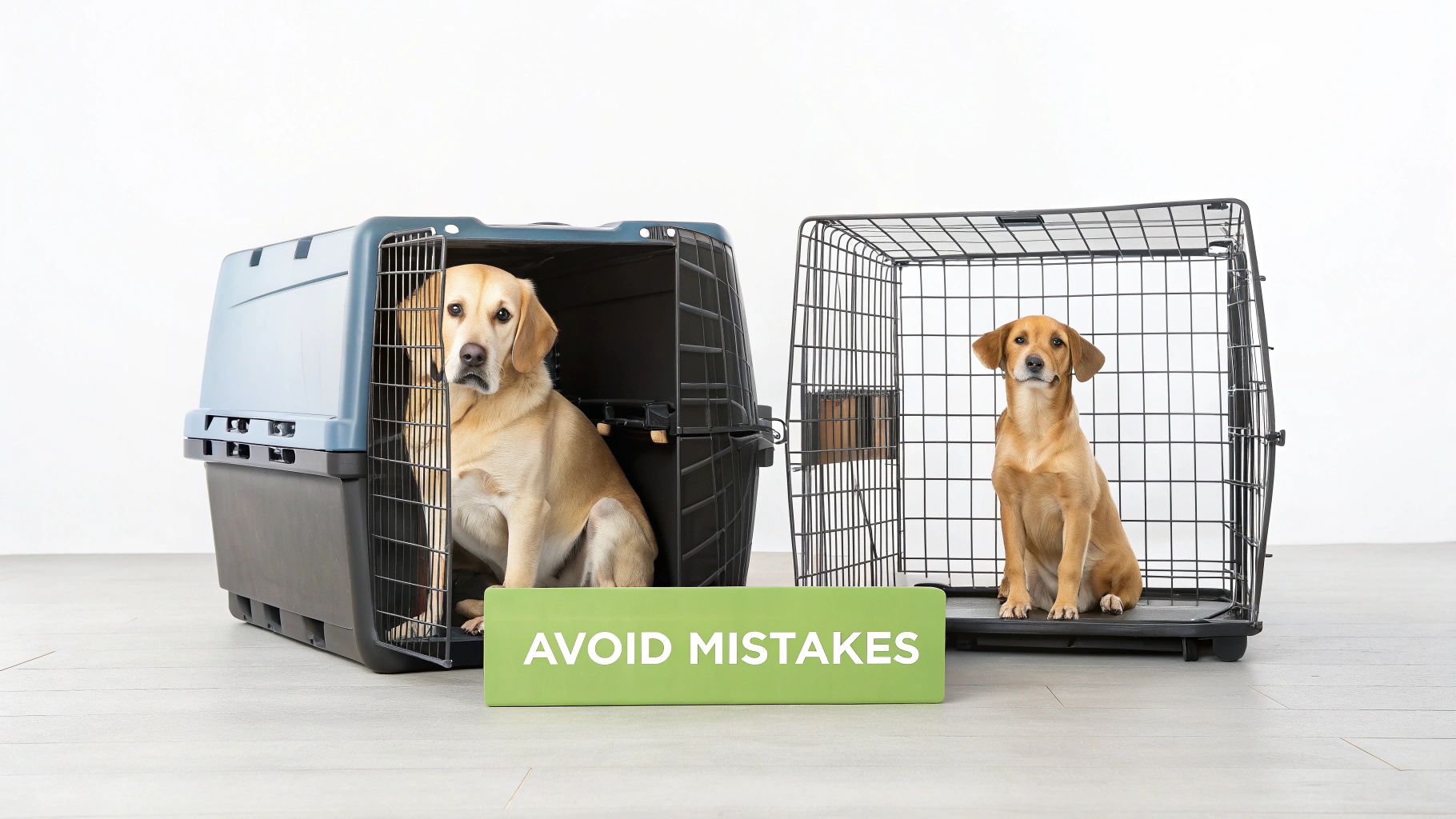
The two most frequent sizing errors are choosing a crate that is too large or too small. One mistake undermines house training, while the other compromises your dog's physical and emotional well-being. Here’s how to avoid both pitfalls.
Mistake 1: The Crate Is Too Big
It’s easy to assume that bigger is better, but an oversized crate can sabotage your house-training efforts. A crate with too much extra space doesn't feel like a cozy den; it feels like a suite with a separate bathroom.
Dogs have a natural instinct to keep their sleeping area clean. If a crate is too large, a puppy will simply use one end for sleeping and the other as a toilet. This teaches them that it's acceptable to eliminate inside, completely defeating the purpose of crate training.
The perfect crate size for a puppy gives them just enough room to stand up, turn around, and lie down comfortably. This taps into their natural denning instinct, making it very unlikely they'll soil their space and teaches them to let you know when it's time to go out.
The solution is simple: use a divider. Purchase a crate that will fit your dog as a full-grown adult and use the included divider panel to reduce the interior space while they are small. For more guidance, review our puppy potty training schedule.
Mistake 2: The Crate Is Too Small
While an oversized crate is a training issue, a crate that’s too small is a welfare issue. A cramped space prevents your dog from moving naturally, leading to physical discomfort and potential health problems.
Confining a dog to a space where they cannot fully stand or stretch out can contribute to joint stiffness and muscle aches. Beyond the physical impact, it can cause significant emotional distress. The crate, intended as a safe haven, becomes a source of anxiety, potentially leading to destructive behaviors.
To prevent this, strictly follow the 2-to-4-inch rule. Ensure there are several inches of clearance above your dog’s head when standing and around their body when lying down. If your dog falls between two sizes, always choose the larger option. A little extra room is far better than not enough.
Your Top Questions About Dog Crate Sizes, Answered
Even with careful measurement, you may still have questions. How do you handle a rapidly growing puppy? Are airline rules really that strict? What if your dog’s measurements fall between two standard sizes? Let’s address these common concerns so you can make your final decision with confidence.
How Do I Choose a Crate Size for a Growing Puppy?
The most practical and cost-effective method is to buy a single crate that will fit your dog's adult size and use a divider panel while they are young. Wire crates are ideal for this, as most come with an adjustable panel.
Position the divider to give your puppy just enough space to stand, turn, and lie down. This prevents them from using one end as a bathroom, reinforcing house training. As your puppy grows, simply move the divider back incrementally until they can comfortably use the entire crate. This "buy it once" approach saves money and avoids the hassle of purchasing multiple crates.
Are There Specific Crate Size Rules for Airline Travel?
Yes, airline regulations are extremely strict and non-negotiable. They are based on International Air Transport Association (IATA) guidelines designed to ensure pet safety and comfort during flights.
IATA rules require that a travel carrier must be large enough for your dog to:
- Stand up completely without their head or ear tips touching the ceiling.
- Turn around without difficulty.
- Lie down in a natural position.
Always double-check the specific crate size and material rules with your airline well before you plan to fly. While many carriers are marketed as "IATA Compliant" or "TSA Approved," the final decision rests with the airline staff on your day of travel.
What Should I Do If My Dog Is Between Two Sizes?
This is a common dilemma with a simple solution: when in doubt, always size up. A crate that is slightly too large is a much better choice than one that is even a little too small.
While a cavernous crate can hinder potty training for a puppy, a few extra inches of space for an adult dog simply adds comfort. A cramped crate, however, can cause physical discomfort and anxiety, making your dog view their den as a punishment rather than a safe space. Prioritize your dog's well-being and opt for the larger size.
Does the Crate Material Change the Size I Need?
No, the required interior dimensions remain the same regardless of whether the crate is wire, plastic, or fabric. Your dog needs the same amount of space to stand, turn, and lie down comfortably, no matter the material.
However, be mindful of how a crate's construction can affect usable space. Some hard-sided plastic kennels have sloped interior walls or molded features that reduce the actual floor area compared to a wire crate with the same external measurements.
Always focus on the manufacturer's listed internal dimensions. The golden rule is constant: ensure your dog has enough room to move naturally.
Choosing the perfect crate is a key step in creating a safe and happy environment for your dog. For high-quality, durable, and thoughtfully designed pet supplies, from travel carriers to grooming tools, explore the collection at Pet Magasin. Find the ideal solutions to make pet ownership easier and more enjoyable at https://www.petmagasin.com.

Leave a comment