
Airline Approved Pet Carrier Dimensions: Quick Guide to Travel-Safe Carriers

Getting the fit right for your pet carrier can mean the difference between a stress-free boarding and a last-minute gate check. Action Step: Measure your carrier’s external length, width, and height against the airline’s published envelope before shopping. Airlines generally allow carriers up to 18 × 11 × 11 inches, a footprint designed to slide neatly under most single-aisle seats.
Quick Answers On Airline Approved Pet Carrier Dimensions
Think of that under-seat space as a custom car seat for your furry friend. Even an extra inch of clearance can prevent your pet from bumping against the carrier walls. Actionable insights:
- Airframe Constraints shape how much floor space and height you really have under the seat.
- Comfort Margin keeps your pet able to stand, turn around, and lie down without feeling cramped.
- Industry Consensus means most carriers cluster around the same dimensions because airlines set very similar limits.
Action: Before you buy, compare your carrier’s external measurements with the airline’s official policy to avoid returns or gate surprises.
For instance, American Airlines caps carriers at 18 × 11 × 11 inches, a spec echoed by United and Delta. Southwest Airlines offers up to 18.5 × 13.5 × 9.5 inches, reflecting the average under-seat envelope in domestic single-aisle jets. Learn more from Travel Ready Pets.
In Cabin Carrier Limits For Major Airlines
| Airline | Max Dimensions (L×W×H) | Max Combined Weight |
|---|---|---|
| American Airlines | 18 × 11 × 11 in | 20 lbs |
| United Airlines | 18 × 11 × 11 in | 22 lbs |
| Southwest Airlines | 18.5 × 13.5 × 9.5 in | 25 lbs |
As you can see, most airlines hover around 18 × 11 × 11 inches. Action: Choose a carrier in this range to cover the majority of U.S. carriers.
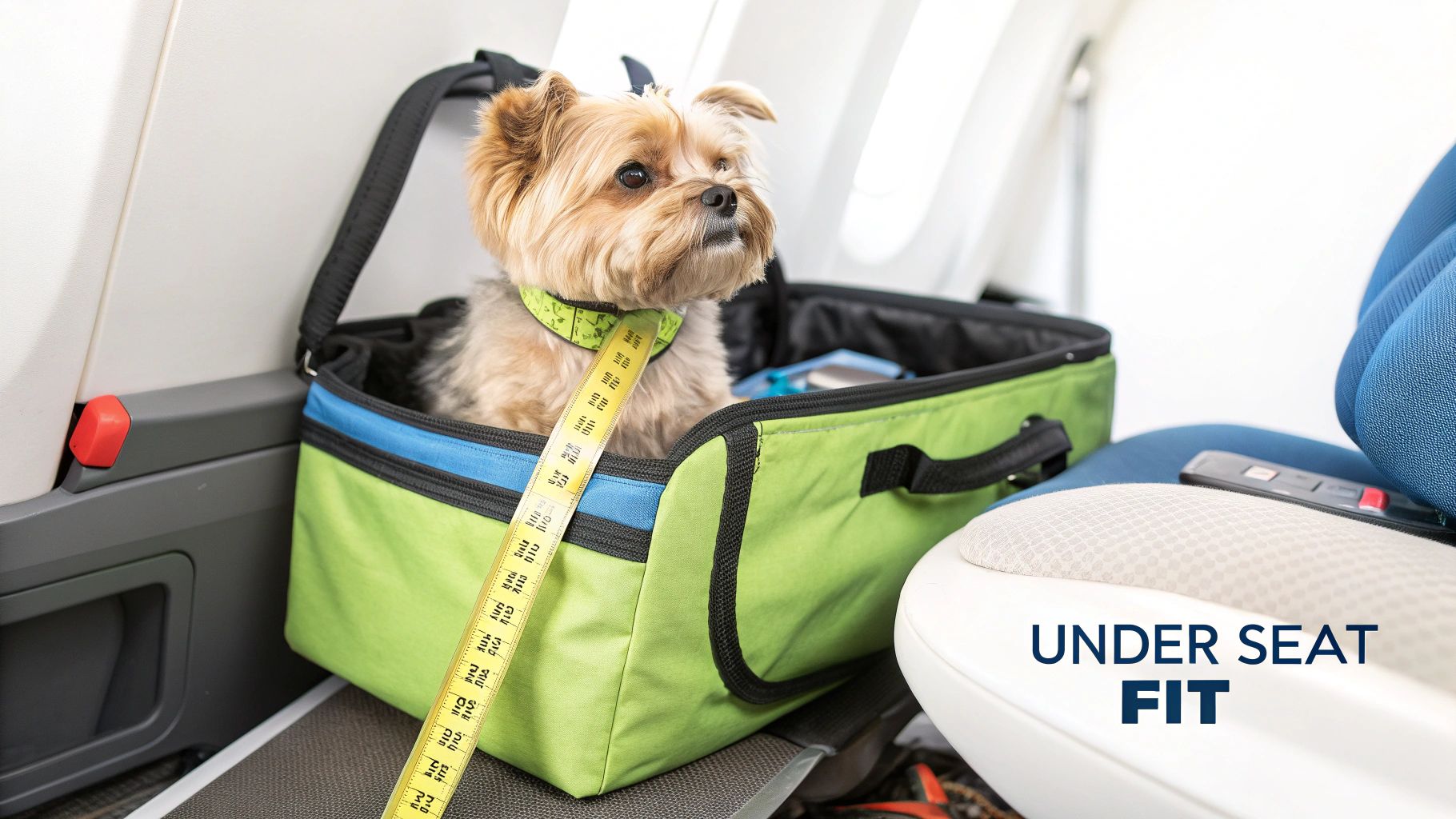
Choosing a carrier with just an extra half-inch can make the difference between a smooth boarding and an unexpected gate-check.
Looking for the perfect fit? Shop our selection of airline-approved pet carriers at Pet Magasin Travel Carriers Collection.
Check Carrier Rules And Certifications
Imagine airline pet carrier policies as a city’s building codes. National guidelines exist, but local ordinances—aka each airline’s rules—take precedence. Action Checklist:
- Review each airline’s official pet policy page for exact dimensions and allowed materials.
- Compare those figures with the carrier’s external and internal measurements on seller sites.
- Call the airline’s customer service to confirm they’ll accept your chosen carrier.
That little IATA Approved badge on your bag? It doesn’t guarantee you’ll board. Unlike cargo kennels, in-cabin carrier labels aren’t universally recognized.
- Some retailers slap the IATA Approved logo on small carriers without any proof.
- Gate refusals often come from vague product descriptions or overstated specs.
- Certain airlines insist on soft-sided carriers only, while others demand specific ventilation patterns.
Detect Misleading IATA Badges
Seeing an IATA logo is just half the story. Since the early 2000s, IATA has published technical requirements for cargo-hold kennels—ventilation, materials, clearances—to boost animal safety, but it does not certify everyday in-cabin bags. Learn more about this history at Simple Flying.
“IATA does not certify small in-cabin carriers; acceptance remains at the airline’s discretion.”
Action Steps to Avoid Surprises:
- Bookmark the airline’s pet policy page.
- Screenshot size and material guidelines.
- Keep notes on allowed carrier types (soft vs. hard).
Key Takeaway: Confirming carrier rules before you travel prevents gate delays and keeps your pet calm.
Example Gate Check Scenario
Sarah thought she was covered—her cat’s bag sported an IATA Approved sticker. At Delta’s gate, though, the mesh side measured 11.5 inches, half an inch over Delta’s 11-inch limit. Result: gate-check, extra fees, and a stressed cat.
Actionable Preventive Measures:
- Measure mesh openings and frame width before purchasing.
- Store proof of carrier specs on your phone.
- Double-check soft-sided allowances with the airline.
Measure Your Pet And Carrier Accurately
Accurate measurements can be the difference between a smooth check-in and a frantic gate-side scramble. Action: Gather a flexible tape measure and follow these steps:
- Measure Nose to Tail Length: Place your pet on a level surface, gently extend its neck, and measure from snout to tail base.
- Measure Shoulder Width: With your pet standing naturally, measure at the broadest point.
- Measure Head Height: Note the highest point when your pet is fully upright.
- Add a 0.5-inch clearance margin on each dimension for breathing room.
Use A Blanket Trick
Laying out a favorite blanket creates a comfort zone that helps your pet stay still:
- Spread the blanket flat and align one edge with your tape measure.
- Reward your pet with treats to reinforce the stay-still behavior.
- Repeat until you can measure quickly and accurately.
Add Clearance Margin
- Place the empty carrier on a flat surface and measure its interior dimensions.
- Compare those figures to your pet’s measurements plus the clearance margin.
- Account for mesh panels or pockets that reduce usable space.
The infographic below visualizes this compliance process, from policy review to final carrier check:
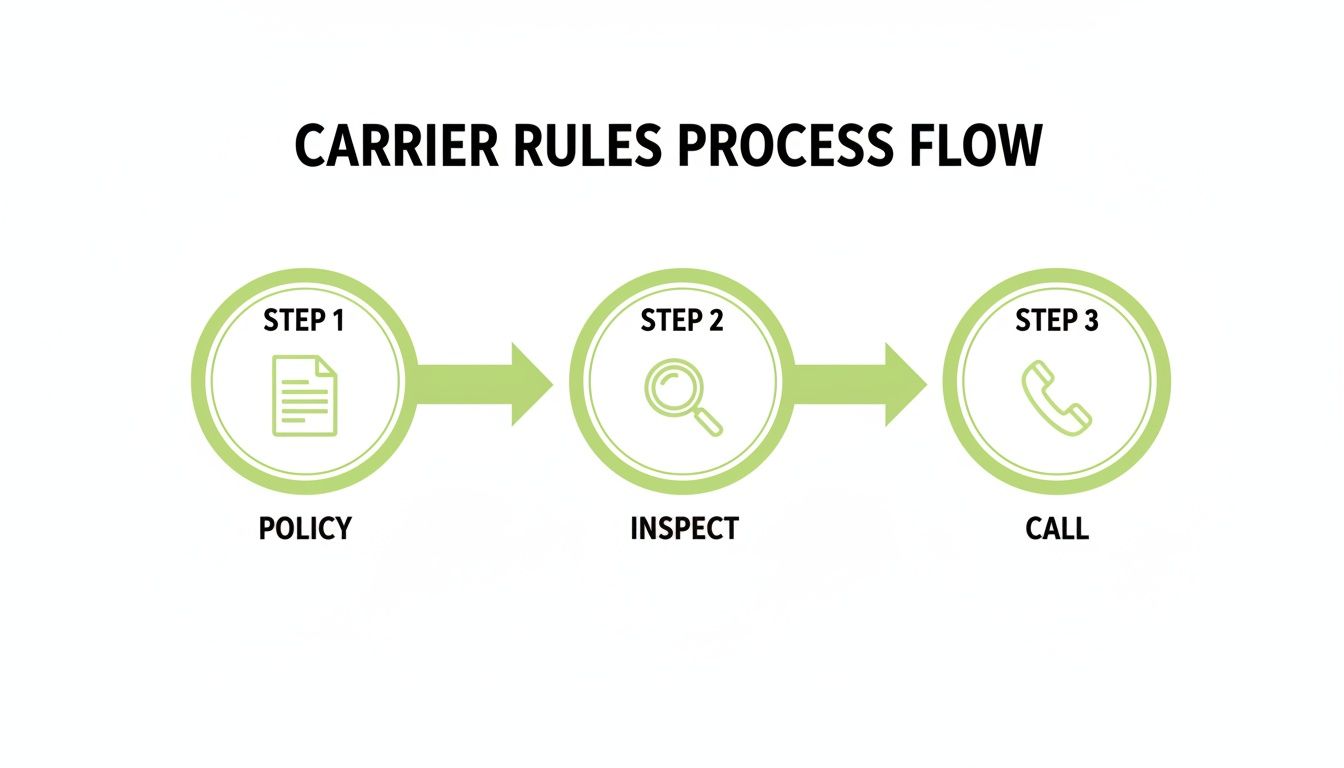
Consistent checks at each step reduce the risk of gate refusal and extra fees.
Finalize Your Measurements
- Place a familiar blanket inside the carrier to keep your pet calm while measuring.
- Note all dimensions on a checklist and save it to your phone.
- Cross-check external measurements against your flight’s airline approved pet carrier dimensions limits.
With precise numbers in hand, you’ll quickly filter carriers by size and find one built for airline travel—no last-minute surprises.
Discover In Cabin Size Limits For Major Airlines
It can feel like threading a needle to fit the perfect carrier under an airplane seat. Action: Consult this rundown of airline approved pet carrier dimensions for key U.S. carriers:
- American Airlines: soft-sided carrier up to 18 × 11 × 11 inches on single-aisle jets; 17.5 × 10.5 × 10.5 inches on Embraer flights.
- United Airlines: 18 × 11 × 11 inches on mainline; regional CRJ and ERJ models often shave off half an inch.
- Delta Airlines: typically 18 × 11 × 11 inches, though A220 cabins sometimes allow a tad more.
- Southwest Airlines: most 737 cabins offer 18.5 × 13.5 × 9.5 inches, while some restrict height to 8.5 inches under certain seats.
Understanding Aircraft Variations
Every plane behaves differently: seat frames, footrests, and pitch can eat into measurable space. Actionable tip: always verify the exact aircraft type for your flight.
| Airline | Max Dimensions (L×W×H) | Notes |
|---|---|---|
| American Airlines | 18 × 11 × 11 in | Mainline; regional smaller |
| United Airlines | 18 × 11 × 11 in | Mainline; regional tighter |
| Delta Airlines | 18 × 11 × 11 in | Standard; varies by aircraft |
| Southwest Airlines | 18.5 × 13.5 × 9.5 in | Most 737 cabins |
Gate-Check Avoidance Checklist
- Check your flight’s exact aircraft type on the airline’s website or app.
- Measure your carrier’s length, width, and height—including straps and pockets.
- Jot down those numbers and compare them to the airline’s published envelope.
- Snap screenshots of your booking confirmation and carrier specs.
- Call customer service if any dimensions feel ambiguous.
Done right, this routine turns potential gate chaos into a calm, organized boarding routine. You might also explore choosing the best airline to travel with pets in our in-depth guide.
Navigate Cargo Kennel Standards And Guidelines
Sometimes your pet can’t ride in the cabin. In those cases, you’ll need a cargo crate—and the rules here are stricter. Follow these Action Steps:
- Verify IATA or airline-specific certification labels.
- Confirm interior dimensions accommodate your pet plus a half-leg clearance.
- Check rated handling weights exceed your pet’s body weight.
- Inspect latches, hinges, and vents before booking.
Major airlines either follow IATA guidance or set their own kennel classes. Each crate carries labels for safe weights and dimension categories. For example, American Airlines Cargo offers an Intermediate kennel with external dimensions of 33 × 22 × 23 inches and a rated handling weight of 300 lbs. Discover more at AACargo Kennel Guidelines.
Understand Kennel Class Categories
| Kennel Class | External Dimensions (L × W × H) | Rated Handling Weight |
|---|---|---|
| Intermediate | 33 × 22 × 23 in (84 × 56 × 58 cm) | 300 lbs |
| Large | 48 × 32 × 35 in (122 × 81 × 89 cm) | 450 lbs |
| Extra Large | 56 × 42 × 40 in (142 × 107 × 102 cm) | 600 lbs |
Manage Seasonal And Temperature Restrictions
Action Plan:
- Check temperature cutoffs at departure and arrival airports.
- Schedule outside embargo windows.
- Confirm your crate’s vents meet weather-specific airflow requirements.
“Observing seasonal embargoes and ventilation requirements protects animal welfare in cargo holds.”
Select The Right Crate And Plan Shipment
- Verify certification labels and weight ratings.
- Photograph all crate dimensions and labels for reference.
- Arrive early at the cargo desk with documentation ready.
By mastering IATA classes, temperature restrictions, and airline-specific rules, you’ll meet every airline approved pet carrier dimension perfectly—setting the stage for a smooth, stress-free journey.
Choose A Carrier And Prepare Your Pet
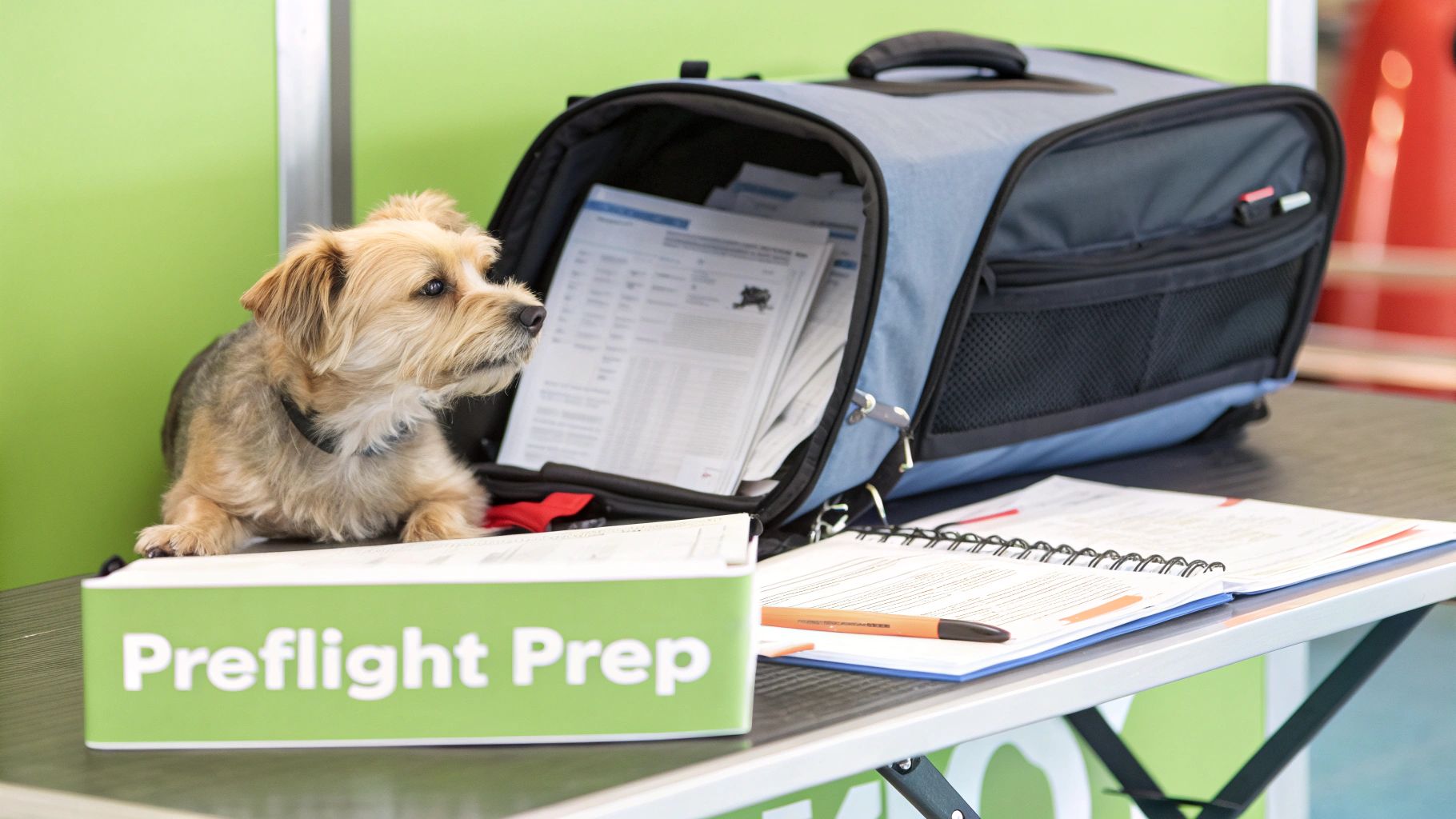
Once you’ve double-checked both your pet’s size and the carrier’s interior dimensions, it’s time to pick the best fit. Actionable Criteria:
- Material type and durability
- Ventilation size and placement (mesh ≥ 50% on one side)
- Closure mechanisms and security (lockable zippers, reinforced seams)
- Under-seat dimension compliance
Evaluate Carrier Features
Soft-sided carriers squeeze into tight spaces easily and hug your pet, while hard-sided carriers offer extra protection. Action: Test at home:
- Place treats inside the carrier.
- Allow your pet to explore for several sessions.
- Gradually increase “sniff-and-settle” time to up to an hour.
“A carrier with reinforced mesh and padded floors can reduce your pet’s anxiety significantly,” notes a seasoned pet travel consultant.
Prepare Pet And Documents
Gather paperwork 5–7 days before travel. Action Checklist:
| Document Type | Details |
|---|---|
| Health Certificate | Issued within 10 days of flight |
| Vaccination Records | Rabies and core vaccines |
| Identification Tag | Visible on the carrier exterior |
| Customs Forms (if applicable) | Filled and signed |
Pack a small bag with:
- A handful of treats
- A favorite toy
- A worn T-shirt for familiar scents
Pre-Flight Routine:
- Feed a light meal 4–6 hours before boarding.
- Offer water until 2 hours before check-in.
- Line the carrier with a familiar blanket.
- Arrive 90 minutes early for pet check-in.
Read also: Choosing the Best Cat Carrier for Airline Travel
Frequently Asked Questions
Bringing your four-legged pal on board raises puzzles around airline approved pet carrier dimensions. Here are the top queries with actionable answers:
How Do I Calculate My Pet’s Clearance Needs?
Measure your pet: nose to tail base, paws to top of head, shoulder to shoulder. Add a ½-inch buffer on all sides. Example: a cat measuring 10 × 7 × 8 inches needs a carrier at least 11 × 8 × 9 inches.
What Counts as External Carrier Dimensions?
Airlines count anything that protrudes:
- Straps and handles
- External pockets
- Wheels or support feet
Action: Measure these bulges—better now than at the gate!
Do Weight Limits Vary by Airline?
Yes. Most cap combined pet and carrier weight between 20 lbs and 25 lbs. Regional jets may impose tighter limits. Action: Check weight allowances for each flight.
Interpreting Airline Rules
Is an IATA Label Sufficient for In-Cabin Travel?
“An IATA badge doesn’t guarantee cabin approval,” warns a pet transport specialist. Always trust the airline’s official dimensions over generic labels.
What If My Carrier Is Slightly Over the Limit?
Even ½-inch over can trigger a gate check and extra charges. Use this snapshot:
| Scenario | Possible Outcome |
|---|---|
| Under Limit | Smooth Boarding |
| Over by ≤ 0.5 Inches | Gate Check With Fee |
| Over by > 0.5 Inches | Possible Denial |
Managing Gate Checks
Action Plan to Avoid Last-Minute Checks:
- Photograph your carrier’s measurements—handle, pocket, and all.
- Save screenshots of your airline’s pet policy.
- Call the airline in advance to reconfirm rules.
- Arrive early at check-in with your pet and carrier ready.
A little prep goes a long way toward stress-free boarding.
Ready to find your ideal travel solution? Shop now at Pet Magasin: Pet Magasin

Leave a comment