
The Essential Guide to Dog Kennels for Pitbulls

Choosing the right kennel for a Pitbull isn't about finding a container; it's about providing a secure sanctuary. Because of their incredible strength and intelligence, a standard wire crate you grab off the shelf just won't cut it—and can even be dangerous.
A proper kennel must be built tough, with escape-proof features, so it can become a true safe space for your dog. This guide will give you the actionable steps to select, size, and safely introduce the perfect kennel for your Pitbull.
Why a Standard Crate Just Isn't Enough for Your Pitbull
The first step is to shift your mindset. A kennel isn't a box for containment; it's a personal den for your dog—a place they choose for comfort, security, and quiet time. This is absolutely crucial when selecting an enclosure for the unique character of a Pitbull.
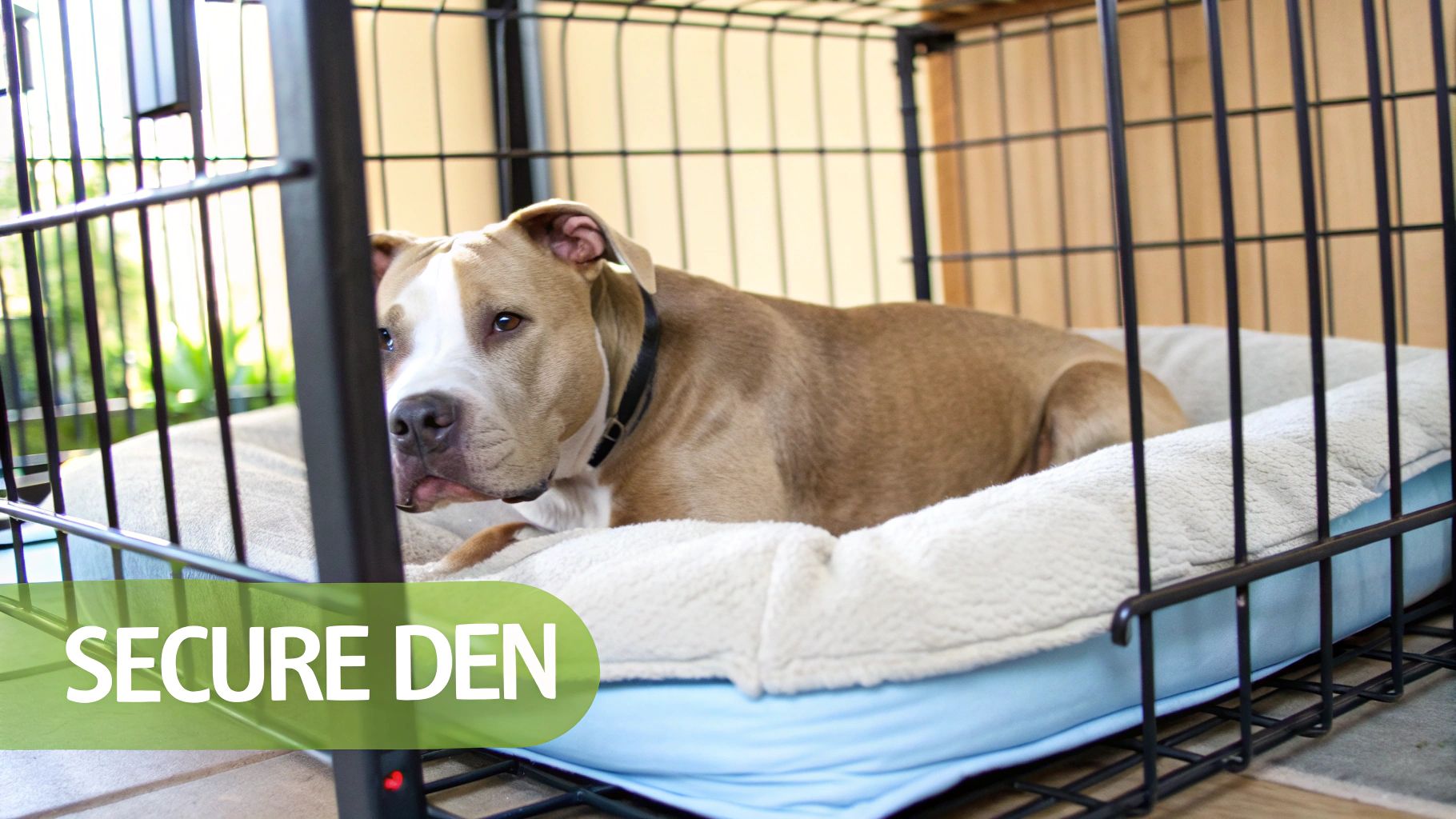
These dogs have a powerful combination of traits that flimsy, standard-issue crates simply can't handle.
- Incredible Strength: A Pitbull's jaw strength and pure muscle can make short work of thin wire or weak plastic. Your action plan must account for this; a determined dog can bend, break, or completely dismantle a standard crate.
- High Intelligence: These dogs are smart problem-solvers. A simple latch or a weak door hinge is just a puzzle they'll eventually figure out. You need a design that outsmarts them.
- Deep Determination: Once a Pitbull decides on something—like getting out of that flimsy crate—their persistence is legendary. The kennel must be built to withstand this focus.
The Dangers of Skimping on a Kennel
Using a standard wire crate for a high-performance athlete like a Pitbull is a direct risk. If they bend or break the bars, they can trap a paw or seriously injure their mouth and teeth. Escapes don't just put your dog in danger; they often lead to a torn-up house.
Actionable Insight: Choosing the right kennel is an investment in your dog's safety and your own peace of mind. Your immediate task is to create a secure environment that respects their power and prevents accidents before they ever happen.
Raising the Bar for Safety
Thankfully, responsible owners are more aware of these needs, and the market is starting to reflect that. Pitbulls, a breed that's often misunderstood, absolutely thrive in secure kennels that can handle their muscular build and energy. The global pet kennels market hit USD 2.8 billion in 2024 and is expected to climb to USD 4.7 billion by 2033, signaling a clear trend toward better, safer enclosures for our pets. You can read more about the growing pet kennels market and what it means for owners.
To get this right, focus on these three non-negotiable action items:
- Select Indestructible Materials: Your baseline is heavy-gauge steel or reinforced aluminum. Don't consider anything less.
- Measure for Smart Sizing: The kennel must be large enough for them to stand up and turn around, but not so big it undermines house-training. We'll show you how to measure correctly.
- Verify Escape-Proof Security: Look for practical features like multi-point locking systems and solid, welded construction.
When you prioritize these elements, you’re not just buying a box. You’re investing in a foundational tool for your dog’s well-being and a calmer life for both of you.
Choosing Kennel Materials That Withstand Real Power
When selecting a kennel for a Pitbull, the material isn't just a detail—it's everything. A standard, flimsy kennel is like a picket fence trying to hold back a freight train. You need the dog equivalent of a bank vault, an enclosure built not just to contain your dog, but to keep them safe and secure. Your first action is to choose materials that serve as your best line of defense against escapes and injuries.
This means looking past the thin wire and plastic models you see everywhere. A powerful dog can chew, bend, or bust through those in no time. The real decision starts with industrial-strength options designed to handle serious force. Only then can you rest easy knowing your dog’s kennel is a true safe space.
Heavy-Gauge Steel: The Gold Standard
For absolute security, heavy-gauge steel is the hands-down winner. You'll see the term "gauge," which simply means thickness—the lower the number, the thicker and stronger the steel. For a Pitbull, your starting point should be 18-gauge steel, but your goal should be something even lower, like 16-gauge. This thickness offers incredible resistance to bending, chewing, and brute force.
Think of it like trying to bend a paperclip versus trying to bend a crowbar. That’s the durability you're aiming for. This solid construction ensures that even the most persistent escape artist can't compromise the kennel's structure.
But the steel itself is only half the story. The finish matters, too. Actionable Step: Insist on a quality, non-toxic powder coating. It prevents rust and corrosion, extending the kennel's life and keeping it free of sharp, dangerous rust flakes that could hurt your dog.
Reinforced Aluminum: A Lighter Alternative
While steel is the undisputed king of strength, reinforced aluminum is a solid runner-up, especially if you need a kennel that's easier to move. We're not talking about flimsy consumer-grade aluminum; high-grade, welded aluminum is worlds stronger and offers fantastic rust resistance, making it great for both indoor and outdoor setups.
Actionable Step: When considering aluminum, look for kennels that specifically mention "reinforced" or "heavy-duty" construction in their product descriptions. This language confirms the frame and bars are built to handle pressure without warping. It’s a great choice for owners who need serious durability without the back-breaking weight of an all-steel kennel.
The true test of a kennel's strength isn't just the metal it's made from, but how well it's all put together. Your next action is to inspect the construction, because weak points will fail long before the steel bars ever do.
Inspecting the Critical Construction Details
An indestructible kennel is more than just a collection of strong parts; it's how those parts are assembled that really counts. Here’s a checklist to use when inspecting a potential kennel.
- Weld Quality: Look closely at every joint. You want to see clean, consistent, and complete welds. Shoddy "spot welds" are a huge red flag—they create weak points that a determined Pitbull will find. A good weld should look like a smooth, continuous bead of metal, not just a few tiny tacks.
- Bar Spacing: Measure the gaps between the bars. They must be narrow enough that your dog can't get their head, muzzle, or paws stuck. A dog who gets trapped can easily panic, leading to a dangerous situation.
- Door and Latch Systems: The door is almost always the weakest link. A simple slide-bolt lock is a puzzle, not a security measure. Your action item is to find escape-proof latching mechanisms like slam latches or systems with dual locking points that engage automatically and securely.
Understanding what makes larger enclosures strong, like durable chain link fence materials, can give you insight into long-lasting construction.
Don't forget the hinges! They need to be welded securely to both the frame and the door, not just bolted on. A determined dog will test every single component. You can learn even more about choosing the right kennel for your dog in our related guide. By focusing on these core elements of material and build quality, you can choose a kennel that provides true safety.
How to Find the Perfect Kennel Size for Your Pitbull
When picking out a kennel for your Pitbull, it’s easy to fall into the "bigger is always better" trap. More room seems like more comfort, but a kennel that’s too big can actually sabotage your house-training efforts.
If you provide a cavernous space, a dog is smart enough to designate one corner as their bathroom and the other as their bedroom, undermining the point of crate training. The goal isn't to give them a studio apartment; it's to provide a snug, secure den that taps into their natural instinct to keep their sleeping area clean.
A perfectly sized kennel feels safe and cozy. Because it’s just big enough for them to be comfortable, they are far less likely to have accidents. This detail makes the entire training process smoother.
The Two-Step Measurement Process
Figuring out the right size is not a guessing game. It’s a straightforward, two-step process. Grab a flexible measuring tape and follow these steps:
-
Measure Their Height: With your dog sitting, measure from the floor straight up to the top of their head (or the tips of their ears, if they're pointy). This number ensures they can sit upright without hitting their head.
-
Measure Their Length: With your dog standing, measure from the tip of their nose to the base of their tail—not the tip. This measurement ensures they have enough room to lie down and stretch out.
With those two numbers, you’re ready for the final calculation.
Applying the Turnaround Rule
The secret to getting the kennel size just right is the "turnaround rule." It’s a simple formula that guarantees your dog has enough space to be comfortable without having too much room for mischief.
Actionable Step: Take your dog's height and length measurements and add 4 to 6 inches to each one. These new numbers are the minimum internal dimensions you should look for in a kennel.
That extra space is what makes all the difference. It gives your Pitbull enough room to stand up, turn around in a full circle, and lie down in a natural position without feeling boxed in. It’s the perfect sweet spot between a tight squeeze and a wide-open space. For a deeper dive, check out our complete guide on large dog kennel dimensions.
From raw steel to the final locking mechanism, the quality of a kennel comes down to its construction. A secure kennel is built with intention at every stage.
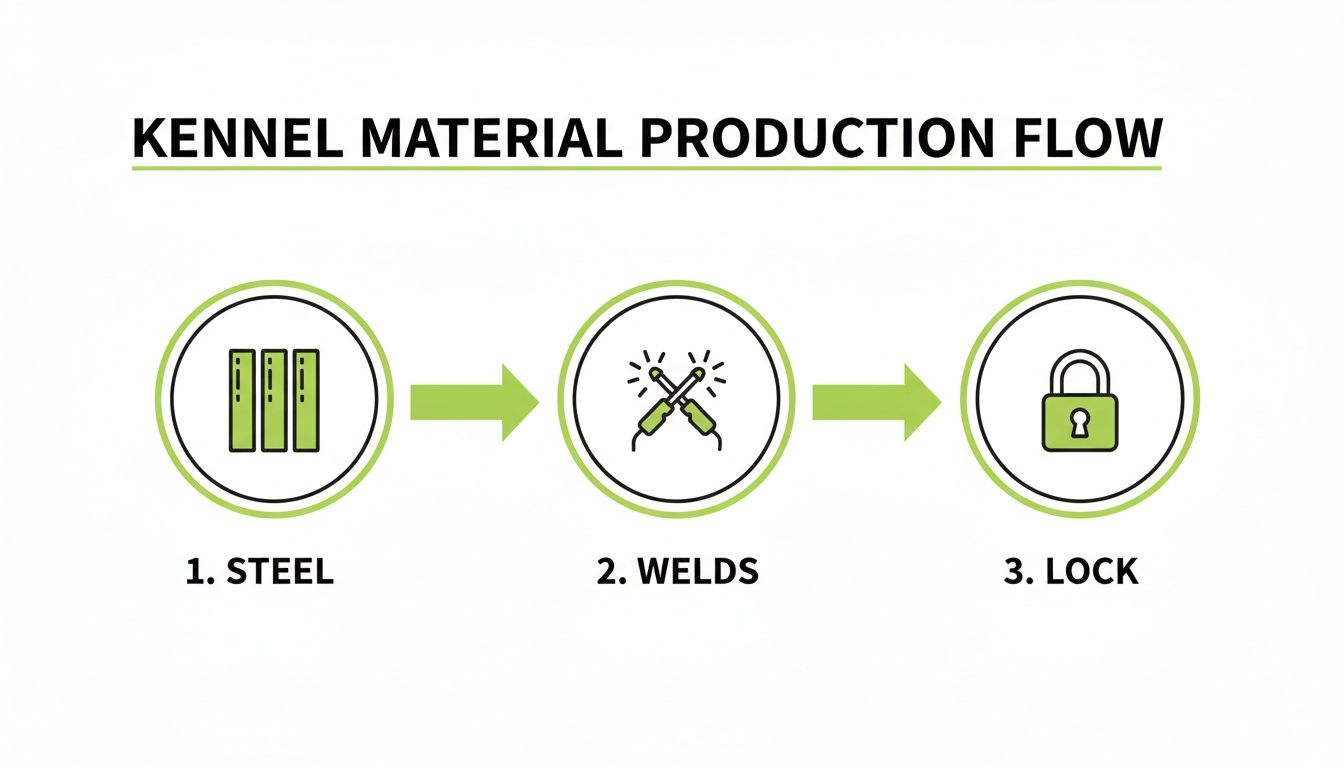
This process shows just how important every step is—from the choice of material to the quality of the welds and locks—in creating a kennel that’s truly safe and secure.
Sizing for Growth and Breed Characteristics
When choosing a kennel, be sure to account for your Pitbull’s unique, powerful build. These dogs are known for their muscular frames and broad chests, so they need a kennel that accommodates their width just as much as their length and height.
It's a big reason why owners are shifting their buying habits. As of 2023, Pitbulls make up about 20% of the 90 million pet dogs in the U.S., and owners are getting savvy about their needs. To keep these strong dogs safe and comfortable, sales for extra-large crates have shot up by 25% since 2020.
Actionable Step for Puppies: If you're starting with a puppy, you have two practical options. You can buy a smaller kennel now and upgrade later, or you can purchase a larger kennel that includes a divider panel. A divider is a fantastic tool—it lets you shrink the usable space and then expand it as your pup grows. This is a smart, cost-effective way to get the sizing right from day one.
Key Safety and Security Features You Cannot Overlook
For a Pitbull kennel, brute strength is only half the battle. Real safety lies in the design details. A truly secure kennel is more than a steel box; it's a smartly designed space built to anticipate how a powerful, intelligent dog thinks and acts.
Your task is to think like your dog. Get down on their level and look at every latch, corner, and gap as a potential hazard.
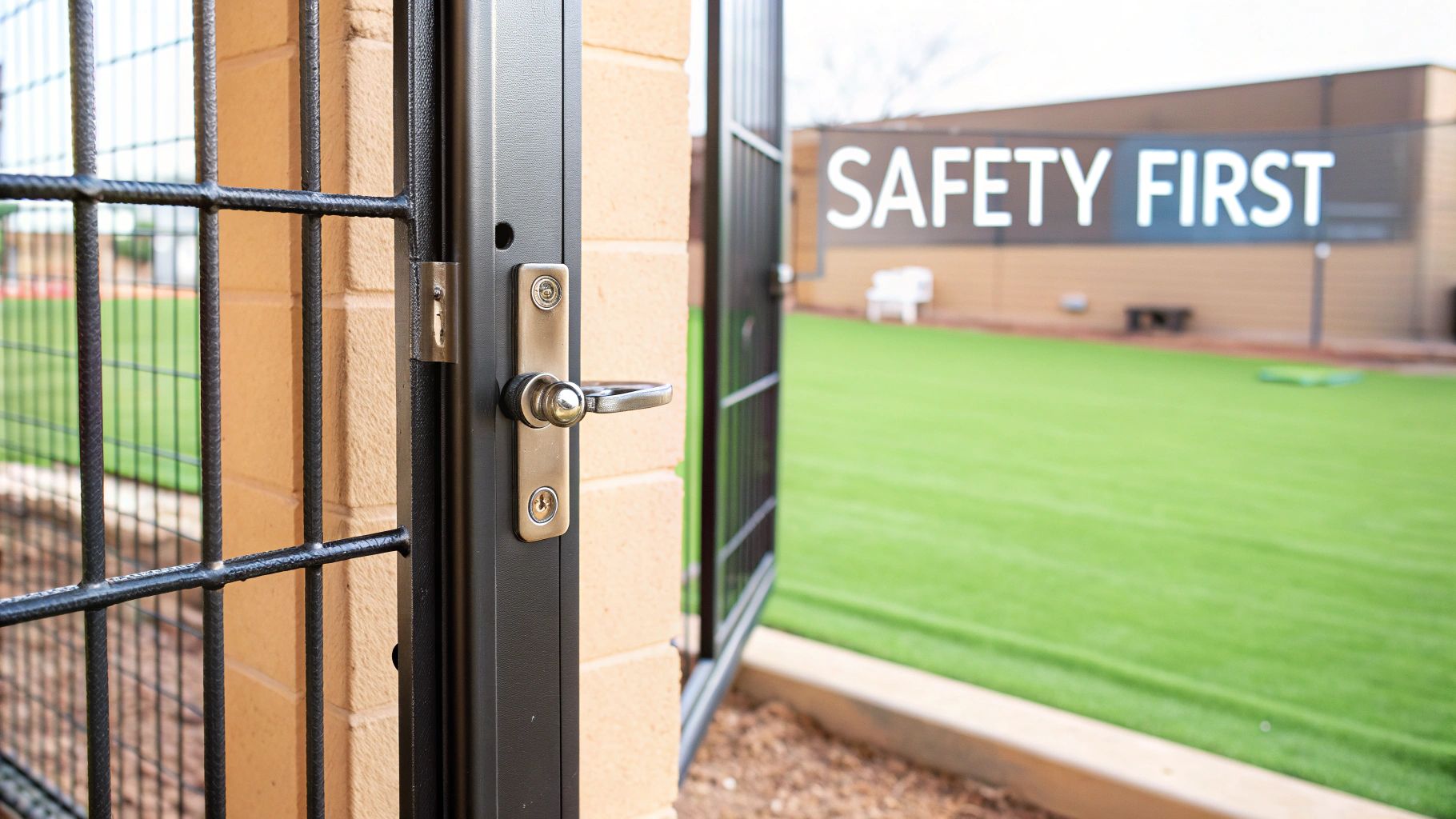
This detailed thinking separates a genuinely safe kennel from one that just looks tough. A clever dog will test every weak point, so knowing what to look for is essential.
Escape-Proof Latching Systems
Let’s be honest: the door latch is usually the first thing to fail on a cheap kennel. A basic slide-bolt lock is a puzzle for a bored Pitbull. You need to look for something more robust.
- Slam Latches: These spring-loaded latches lock automatically the moment you shut the door. This is a game-changer because it eliminates the simple human error of forgetting to slide the bolt.
- Butterfly Latches: This style of latch requires a two-step "lift and turn" motion that a dog simply can't mimic. It’s an extra layer of security that provides real peace of mind.
These aren't just fancy locks; they're engineered specifically to outsmart an animal. They are a non-negotiable feature for any Pitbull owner.
A kennel's security is only as strong as its weakest point. For most standard crates, that weak point is a simple, easily manipulated latch. Your most important safety action is to prioritize an escape-proof lock.
Hazard-Free Interior and Solid Construction
Once the door is secure, it's time to inspect the inside. A safe space needs to be smooth and completely snag-free to prevent injuries. Actionable Step: Run your hand along all interior surfaces—the bars, corners, and floor—to feel for anything that could cause harm.
Here’s your inspection checklist:
- No Sharp Edges: Every metal edge must be rounded off or ground down smooth. No exceptions.
- No Protruding Bolts: Hardware should not stick out into the living area where a collar could get caught or a dog might chew on them.
- Solid Welds: As mentioned earlier, fully welded construction is far superior to kennels held together with nuts and bolts. A strong dog can worry bolts loose, compromising the structure. A welded frame is one solid unit.
This demand for better construction is making waves in the pet industry. The dog kennel market is expected to grow with an 8.4% CAGR through 2031, mostly because owners of powerful breeds are demanding tougher options. With Pitbulls in an estimated 18% of U.S. homes, this consumer push has already helped cause a significant 55% drop in kennel-related incidents since 2018. You can dig into more pet industry growth projections to see how the market is shifting.
The Importance of Proper Ventilation
Finally, don't forget about airflow. A kennel can be as secure as a bank vault, but it's no good if your dog can't breathe comfortably. Good ventilation is critical for preventing overheating.
Actionable Step: Look for designs with openings on all four sides to allow for cross-breeze. Avoid solid-walled kennels, which can trap heat and humidity, creating a stuffy and unhealthy environment. Great airflow helps your Pitbull regulate their body temperature and ensures their den is a safe, comfortable place to relax.
An Actionable Guide to Crate Training Your Pitbull
Even the toughest kennel is useless if your Pitbull hates it. If they see it as a punishment, you're signing up for a long, frustrating battle. The real goal is to reframe that kennel from a cage into their own personal den—a cozy retreat they choose to go to.
This process comes down to positive reinforcement. Pitbulls are smart and eager to please, making them perfect for this training. It’s never about force; it’s about convincing them the kennel is the best spot in the house.
Making the First Introduction Positive
The first time your Pitbull sees their new kennel, it must be a relaxed, no-pressure situation. Start by setting it up in a high-traffic area, like the living room, where the family hangs out. This immediately connects the kennel with happy, normal life, not isolation.
Leave the door wide open and make the inside as inviting as possible with a soft bed, a favorite blanket, and a couple of good toys. Don't push them in. Just let their natural curiosity do the work.
Actionable Step: Casually toss a few high-value treats near the kennel, then just inside the entrance, and finally all the way to the back. Let your dog wander in and out on their own terms. This sends a clear message: great things happen in and around this space. Repeat this game several times over a couple of days until they start going in eagerly.
Building Positive Associations with Food
Once your Pitbull is comfortable going in and out, use mealtime to build on that positive association. Start by placing their food bowl just inside the kennel with the door open so they don't feel trapped.
As they get used to that, slowly move the bowl further back with each meal. Soon, they'll be stepping all the way inside to eat. Once they’re happily eating inside, you can try closing the door for just a few seconds while they're eating, then opening it right as they finish.
This is a huge step because it teaches them that the door closing isn't something to fear. The trick is to keep these first closed-door sessions incredibly short.
Actionable Tip: Never use the kennel as punishment. Sending your Pitbull to their crate for misbehaving will instantly undo all your hard work and teach them to associate their "den" with fear and anxiety.
Gradually Increasing Their Time Inside
With a solid foundation in place, you can start asking them to stay inside longer. Begin with very short periods. Use a consistent, happy command like "Kennel up!" and toss a special treat inside.
When they go in, close the door and stay in the room with them for maybe 30 seconds. Then, let them out before they have a chance to get worried. From there, slowly increase the time—to a minute, then five, then ten—as long as they stay relaxed.
If they start whining, you've likely pushed too fast. Next time, just back it up to a shorter duration where they were successful and build up more slowly. Consistency is everything. For a deeper dive, learn the fundamentals of how to crate train a puppy, since many of the same ideas apply.
Here’s your action plan for common training bumps:
- Whining or Barking: It’s tempting to let them out the second they make noise, but that just teaches them that barking works. Instead, wait for a brief moment of silence before you open the door. This shows them that being calm is what gets them what they want.
- Signs of Stress: Pacing, heavy drooling, or frantic scratching are signs of real anxiety. If you see this, stop and go back to the beginning to build those positive feelings more slowly.
- Refusing to Enter: If they’re suddenly hesitant, take a step back. Make the kennel irresistible again with a brand-new toy they only get inside the crate or a puzzle feeder filled with something extra tasty.
By following these steps, you can help your Pitbull see their kennel not as a cage, but as their own personal sanctuary—a place where they can feel safe, comfortable, and totally relaxed.
Keeping Your Pitbull's Kennel Clean and Safe
Getting a tough, escape-proof kennel is a great first step, but it's only half the battle. The other half is keeping it clean. Your Pitbull's kennel is their personal den; just like our homes, it needs regular upkeep to prevent bacteria from making it an unhealthy place.
Making this a core part of your routine is non-negotiable for their health. The easiest way to stay on top of it is to create a simple, consistent schedule with quick daily checks and a more thorough weekly deep clean. This approach stops small messes from turning into big problems.
Your Practical Cleaning Schedule
Daily habits don't have to be a major time-suck, but they make a massive difference. Here is your daily action plan:
-
Daily Checks (2-3 Minutes):
- Remove any leftover food or debris to prevent pests.
- Shake out bedding to remove fur and allow it to air out.
- Wipe up any slobber or spills with a pet-safe wipe.
- Visually inspect latches and bars for any new dings, dents, or signs of wear.
When it comes to the weekly deep clean, you’ll need to carve out more time. This is your chance to really go after the grime and germs.
A clean kennel is a direct reflection of a healthy environment. An unclean space can contribute to skin issues, parasites, and even respiratory problems, turning a safe den into a source of stress and illness.
For your weekly routine, pull everything out—bedding, toys, bowls—and give it all a good wash. Actionable Step: Use a pet-safe disinfectant to scrub down every interior surface, paying close attention to corners where gunk accumulates. Let it air dry completely before reassembling.
This is also the perfect time for a structural check. Test the hinges, give the bars a good wiggle, and make sure every lock clicks securely into place. A powerful dog can put stress on welds and latches over time, so you can't afford to skip these inspections.
For a great guide on keeping your outdoor areas clean, check out this ultimate guide on artificial turf for dogs. By making these simple habits part of your week, you guarantee your dog's kennel stays the safe, pristine haven it was meant to be.
Your Top Questions About Pitbull Kennels, Answered
Picking out the right kennel for a Pitbull brings up a lot of questions. It's completely normal to want to get every detail right, especially with such a smart and powerful breed. Let's tackle the most common concerns with direct, actionable answers.
Getting straight answers will help you make a choice you feel good about.
Is It Cruel to Keep a Pitbull in a Kennel?
No—as long as it is used correctly. A kennel should never be a punishment or a place for long-term confinement. When you introduce it the right way, it becomes a safe, personal den for your dog, tapping into their natural instinct to seek out a secure space.
For a Pitbull, having this "home base" can be incredibly calming. It gives them a quiet spot to retreat from a busy household and can even help soothe anxiety. The key is to build positive associations from day one with treats, favorite toys, and praise. It’s about transforming it from a "cage" into their own private sanctuary.
A kennel isn't about locking your dog away; it's about giving them a structured, secure environment where they can truly relax. This is a game-changer for breeds like Pitbulls that thrive on routine and security.
How Long Can a Pitbull Safely Stay in a Kennel?
How long a dog can comfortably stay in their kennel depends on their age and training, but here are some solid guidelines to follow:
- Adult Dogs: A well-adjusted adult Pitbull can usually handle being in their kennel for up to 4-6 hours at a time. Pushing it past eight hours regularly is not recommended, as they need to stretch, relieve themselves, and interact with you.
- Puppies: Young pups have small bladders and need frequent breaks. Actionable Rule: Use the "one hour per month of age" rule. A three-month-old puppy needs to be let out at least every three hours.
Remember, these are maximums. The goal is to keep kennel time to a minimum and make the time you spend together count.
What Should I Do If My Pitbull Tries to Escape?
An escape attempt is a red flag that something isn't right. This behavior usually stems from separation anxiety, boredom, or feeling trapped. First, ensure the kennel is truly indestructible and escape-proof. A determined dog can get seriously hurt trying to break out of a flimsy crate.
Once safety is covered, create an action plan to address the "why."
- Restart Crate Training: Go back to square one. Make the kennel the best place on earth with high-value treats and special toys they only get inside.
- Increase Exercise: A tired Pitbull is a happy Pitbull. Ensure they get plenty of physical and mental stimulation before kennel time. A long walk, a good run, or a vigorous game of fetch can work wonders.
- Consult a Professional: If you suspect serious separation anxiety, it might be time to call in a pro. A certified dog trainer or your veterinarian can give you specific strategies to help your dog feel more secure when you're not around.
Whatever you do, don't punish your dog for trying to escape. That will only make their anxiety worse. The solution is to build their confidence and make the kennel a place they want to be.
At Pet Magasin, we know that your pet’s safety and comfort are everything. That’s why we design durable, high-quality products to support them through every stage of life. Explore our range of pet supplies to find the perfect solutions for your best friend. https://www.petmagasin.com

Leave a comment