
What Size Dog Can Fly in Cabin: The Complete Guide

The common in-cabin benchmark is an 18 x 11 x 11 inch soft-sided carrier, but the true answer is whether that carrier, with your dog inside, fits fully under the seat in front of you. There isn't a universal dog breed or fixed weight that guarantees cabin approval.
You may be checking a carrier beside an open suitcase, measuring your dog while wondering whether a few extra pounds will end the trip. At the airport, that uncertainty can become a frustrating surprise: a dog who seems small enough at home may not fit beneath the specific aircraft seat assigned to your flight.
The useful question isn't, “How big is my dog?” It's, “Can my dog travel comfortably in an airline-approved carrier that fits the available under-seat space?” That shift explains why the same dog can be accepted on one flight and refused on another.
The Question Most Owners Ask the Wrong Way
A family arrives at check-in with a small dog, a compliant-looking carrier, and the confidence that the airline's weight limit is on their side. The dog weighs less than the posted allowance, but the agent checks the carrier against the aircraft information and says it won't fit under the seat. The problem isn't necessarily the dog's weight. It may be the carrier's height, length, or shape.
Owners naturally search for a breed answer or a pounds answer. Those shortcuts feel practical, but they produce contradictory advice because airlines don't use one global definition of “small dog.” One carrier may publish a maximum soft-sided footprint, while another may allow a different shape on a different aircraft.
Start with the container
The FAA's guidance on flying with pets treats an in-cabin pet container as carry-on baggage. If an airline permits pets, the container must fit under the seat, remain stowed during taxi, takeoff, and landing, and avoid blocking the aisle. That requirement describes the physical problem more accurately than a breed chart does.
A dog may be short but long-bodied. Another may weigh little but have a tall chest. A carrier can meet a label's advertised dimensions while its rigid frame, wheels, handles, or overfilled sides prevent it from sliding into the available space.
Practical rule: Measure the dog, then measure the carrier you will actually take to the airport. Don't rely on the carrier's product title or your dog's breed.
The rest of the decision follows from that rule. You need to understand why under-seat geometry controls acceptance, compare your airline's published dimensions, measure your dog against the carrier's interior, and verify every aircraft on a connecting itinerary. Those steps won't guarantee an airline agent's approval, but they greatly reduce the chance of discovering a fit problem at the gate.
Why the Under-Seat Rule Beats Any Weight Number
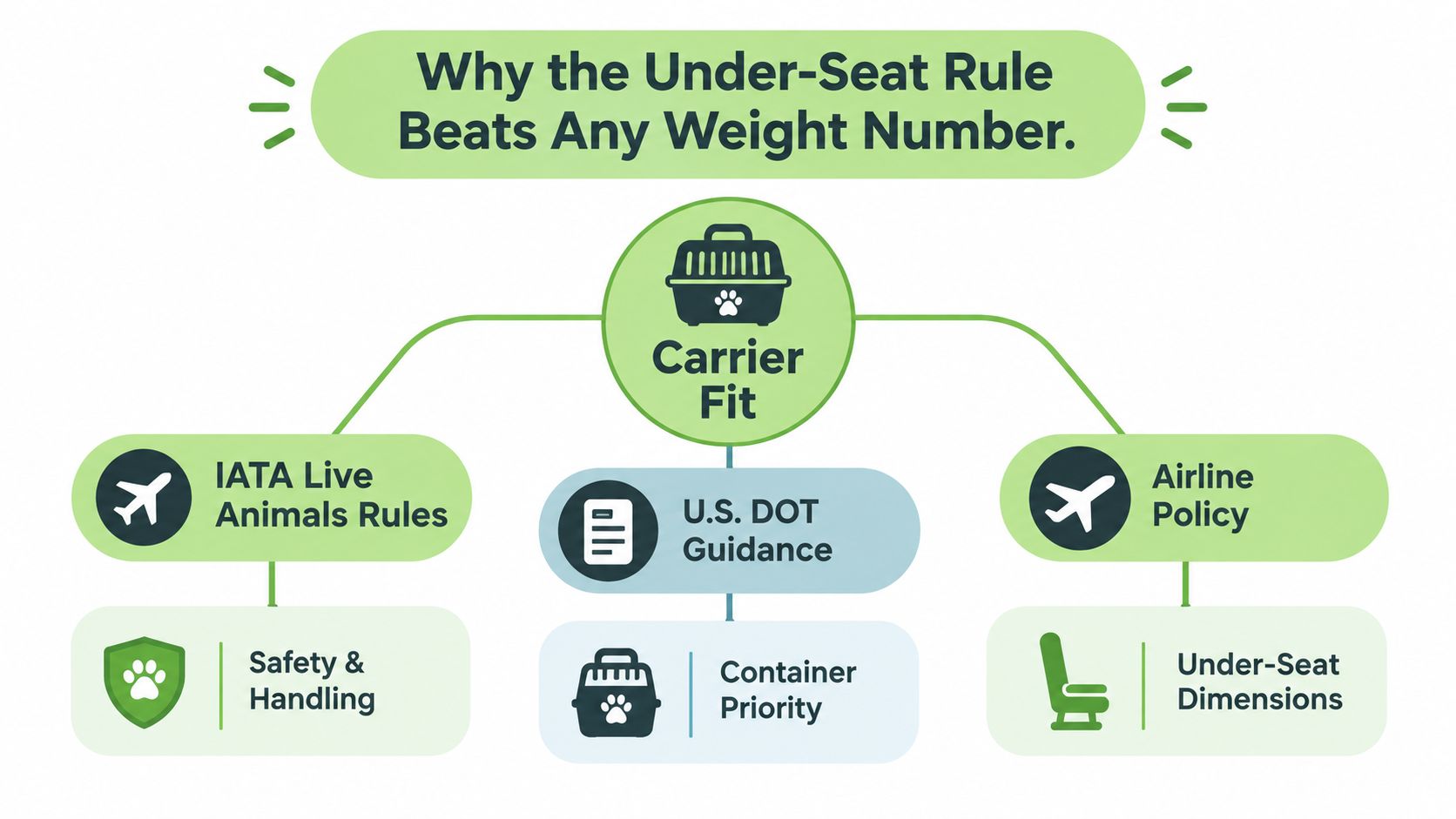
Airlines need a rule that works across different aircraft, cabins, and seat layouts. A container dimension gives staff something they can inspect, while a dog-weight limit alone says little about whether the animal can remain safely under the seat.
The U.S. Department of Transportation's pet travel guidance notes that many airlines impose size and weight restrictions and require pets to remain in a carrier under the seat. The International Air Transport Association's live-animal guidance also centers the compliant container, including enough room for the animal to stand, turn, sit, and lie down comfortably.
Why airlines publish dimensions
Many U.S. carriers use a soft-sided benchmark around 18 x 11 x 11 inches. American Airlines lists that size for soft-sided carriers, and Delta recommends the same dimensions, according to its published pet information and the American Airlines pet policy. United also lists 18 x 11 x 11 inches in the verified airline guidance.
That footprint is practical, not universal. Under-seat space changes with aircraft design, seat structure, and cabin position. Air Canada, for example, uses aircraft-dependent cabin measurements of 16 x 17 x 8 inches or 17 x 16 x 8 inches on routes where the carrier occupies under-seat space.
A combined limit of about 20 pounds for the pet and carrier is a common U.S. benchmark noted by American Airlines and the American Kennel Club, but it isn't the primary test. A lighter dog can still fail if the carrier doesn't fit, while a heavier combination may be excluded by an airline that uses a stricter weight cap.
Comfort remains a separate test
The carrier must satisfy two conditions at once. Its exterior must fit the aircraft's available space, and its interior must let the dog stand, turn, sit, and lie down comfortably. IATA's container requirements make that welfare principle central to enclosure selection.
That is why a soft-sided bag can be more practical than a rigid crate for an in-cabin journey. Flexible sides may compress slightly around the under-seat edges, but they don't erase the airline's maximum dimensions or create comfort inside the bag. A carrier that fits only when the dog is curled tightly isn't a suitable solution.
For a closer look at choosing an in-cabin carrier, compare this guide to in-cabin pet carriers. The key decision remains simple: fit comes first, comfort comes next, and weight becomes a policy detail after those conditions are met.
Carrier Size Limits Across Major Airlines
Airline charts are useful only when you treat them as starting points. A published maximum tells you the largest carrier the airline may accept, not the exact opening beneath your assigned seat.
The clearest confirmed examples include American Airlines at 18 x 11 x 11 inches for soft-sided carriers, Delta's recommended 18 x 11 x 11 inches, and United's 18 x 11 x 11 inches. Southwest is more specific: its own pet carrier may measure 15 x 10 x 10 inches, while another approved carrier may measure 18 x 10.5 x 10 inches, as stated in its pet-carrier requirements. Frontier publishes a soft-sided maximum of 18 x 14 x 11 inches.
| Airline | Soft-Sided Max (inches) | Hard-Sided Max (inches) | Combined Weight Cap (lbs) | Counts as Carry-On |
|---|---|---|---|---|
| American Airlines | 18 x 11 x 11 | Aircraft and route dependent | About 20 | Policy dependent |
| Delta | 18 x 11 x 11 recommended | Aircraft dependent | Airline dependent | Policy dependent |
| United | 18 x 11 x 11 | Airline dependent | Airline dependent | Policy dependent |
| Southwest | 18 x 10.5 x 10, or 15 x 10 x 10 for its carrier | Not listed in verified data | Airline policy dependent | Policy dependent |
| Alaska Airlines | Verify with airline | Verify with airline | Verify with airline | Verify with airline |
| JetBlue | Verify with airline | Verify with airline | Verify with airline | Verify with airline |
| Spirit | Verify with airline | Verify with airline | Verify with airline | Verify with airline |
| Frontier | 18 x 14 x 11 soft-sided | Verify with airline | Verify with airline | Policy dependent |
| Air Canada | 16 x 17 x 8 or 17 x 16 x 8, aircraft dependent | Verify with airline | Airline dependent | Policy dependent |
| British Airways | Verify with airline | Verify with airline | Verify with airline | Verify with airline |
| Lufthansa | Verify with airline | Verify with airline | Verify with airline | Verify with airline |
| Air France | Verify with airline | Verify with airline | Verify with airline | Verify with airline |
| Qantas | Verify with airline | Verify with airline | Verify with airline | Verify with airline |
The table deliberately leaves unverified entries open. Airline policies change by route, cabin, aircraft, and availability, and unsupported numbers are more dangerous than an incomplete chart. European carriers may express their limits as a combined pet-and-carrier weight, while U.S. airlines often emphasize under-seat dimensions.
Hard-sided bags deserve special caution. A rigid box can't flex around seat supports, so an apparently acceptable length and width may still fail because the height or shell shape meets an obstruction. Before buying, use the airline's current policy and compare it with a carrier-size requirements guide, then contact the airline with the exact flight and aircraft if the dimensions are close.
How to Measure Your Dog and the Carrier Correctly
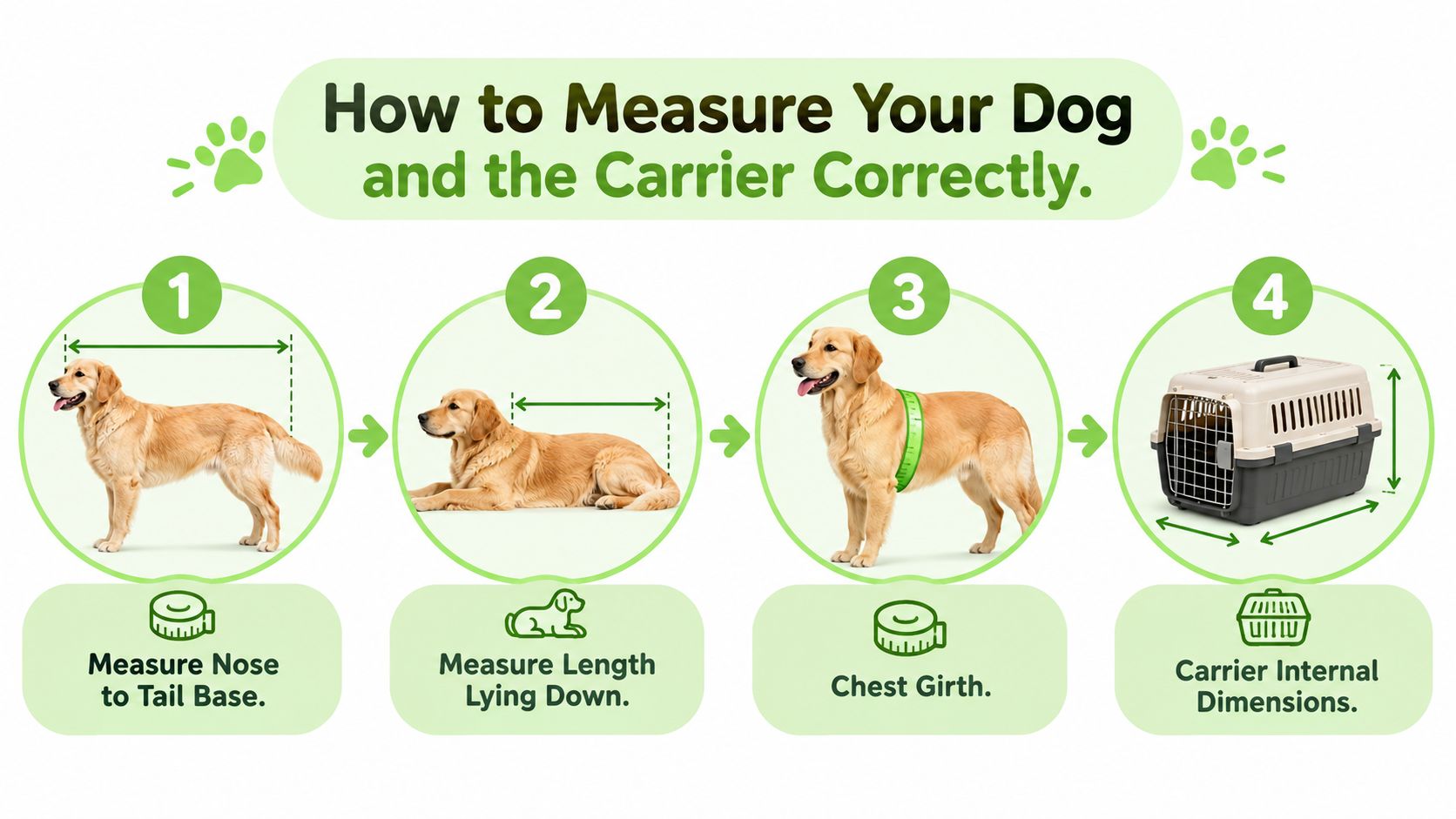
A tape measure is more useful than a breed estimate. Measure your dog when standing naturally, without stretching the neck or pressing down the coat.
Measure the dog first
Record these measurements:
- Length: Measure from the nose to the base of the tail. Don't include the tail itself.
- Standing height: Measure from the floor to the top of the shoulders, or the highest point the dog naturally reaches while standing.
- Width: Measure across the widest part of the chest or body.
- Resting length: Measure the space your dog occupies while lying in a normal position.
The goal isn't to squeeze the dog into a container that technically closes. The dog should have room to change position and lie comfortably, consistent with IATA's enclosure guidance.
Compare interior and exterior numbers
Use the carrier's interior dimensions to assess comfort. Product listings often emphasize exterior measurements, but padding, seams, frame supports, and rounded corners reduce usable space inside. Add about two inches in every direction as a practical comfort check, then confirm that the resulting carrier still meets the airline's published exterior maximum.
Next, measure the carrier from the outside exactly as it will travel. Include wheels, handles, rigid base panels, zipper bulges, and any frame that doesn't fold. A soft-sided bag may compress at the top, but it shouldn't require force that distorts the door or traps the dog.
Write the measurements in your phone notes alongside the airline, flight number, aircraft type, and policy page. Check the airline before purchasing because one carrier's accepted dimensions may be too large for the next leg.
Measure the carrier with the dog inside during a calm practice session, then test it beneath a low, firm surface at home. A measurement that works on paper can fail when a handle or stiff seam catches.
If the dog can't stand naturally, turn around, or settle into a normal lying position, choose a different travel plan rather than a smaller carrier. Correct measurements today can prevent a denied boarding decision tomorrow.
Exceptions That Can Change the Answer Overnight
The same dog and carrier can receive different answers on two legs of one itinerary. Under-seat space varies by aircraft, and some cabins or seats don't provide the usable space a pet carrier needs.
American Airlines notes that some premium-cabin aircraft may have no under-seat space for a pet carrier. Delta also explains that maximum kennel dimensions depend on the aircraft because under-seat space varies. That makes aircraft verification essential, especially when a booking combines a mainline flight with a regional connection.
| Scenario | Standard Rule | Exception or Restriction | Action Required |
|---|---|---|---|
| Mainline economy cabin | Carrier fits fully under the seat | Seat structure may reduce usable space | Confirm the aircraft and assigned cabin |
| Regional aircraft | Same carrier rules apply in principle | Smaller or differently shaped under-seat areas may reject the carrier | Check every segment separately |
| Premium cabin | Carrier normally uses under-seat space | Some aircraft have no suitable under-seat area | Ask the airline before selecting the cabin |
| Connecting itinerary | Pet must be accepted on each leg | One carrier or aircraft may use a different limit | Verify both airlines, aircraft, and route |
| International arrival | Airline accepts the pet for travel | Destination entry rules may require additional procedures | Check destination authority requirements |
| Short-nosed dog | Standard carrier fit still matters | Airline health or breed clauses may apply | Ask the airline and veterinarian before booking |
| Emotional support animal | Standard pet policy generally applies | Emotional support status doesn't create a general carrier exemption | Confirm whether the dog qualifies as a trained service dog |
Route rules can override cabin approval
A dog may satisfy the airline's cabin dimensions and still fail the destination's entry requirements. The United Kingdom's DEFRA rules, European pet documentation systems, and Australia's biosecurity controls each create destination-specific obligations. Those rules aren't interchangeable, so a carrier approval at departure doesn't equal permission to enter the country.
Breed-related restrictions can also affect the decision, particularly for brachycephalic dogs or dogs that may face health concerns during air travel. Don't assume that a soft-sided carrier solves a medical or route restriction.
Emotional support policies cause another common misunderstanding. Emotional support animals generally travel under ordinary pet rules, while trained service dogs are handled under separate accessibility requirements. A service-dog exception isn't a workaround for a pet that doesn't fit a carrier, and international rules can differ.
For a connecting trip, ask the airline three direct questions: Is the pet space available on every leg? What aircraft operates each segment? Will the carrier fit beneath the seat in the cabin I selected? Get the answer for the exact flight, not just the airline brand.
Pre-Flight Checklist for Stress-Free Cabin Travel
Good preparation starts before the airport. Cabin pet spaces can be limited, so confirm availability before finalizing your plans and choose a direct route when the schedule allows.
One week before
- Confirm pet availability: Ask whether the airline has accepted a pet reservation for every flight segment.
- Check the aircraft: Review the aircraft assigned to each leg and ask about under-seat dimensions if your carrier is near the limit.
- Gather documents: Collect vaccination records, health paperwork, and destination entry documents required for the route.
- Practice the carrier: Let your dog enter voluntarily, rest inside, and experience short calm sessions rather than introducing the carrier on departure day.
- Review the policy: Save the airline's current pet page and write down the maximum carrier dimensions.
The carrier should feel familiar, not like a surprise enclosure. An absorbent pad can protect the base, and a small familiar toy may help if the airline permits it. Keep the interior uncluttered so the dog retains usable space.
The day before and at the gate
- Recheck the booking: Confirm the pet reservation, aircraft, cabin, and connection details.
- Test the carrier: Place it beneath a firm, low surface at home and check that the dog can settle comfortably.
- Prepare water: A frozen water bowl can help keep water available longer, if permitted by the airline.
- Ask your veterinarian about sedation: Don't sedate your dog unless your veterinarian specifically approves the plan.
- Arrive early: Allow time for document review and a physical carrier check.
- Secure the carrier: Close every latch and keep the carrier stable while moving through the airport.
- Stow it correctly: At boarding, place it under the seat in front of you and keep it there during taxi, takeoff, and landing.
Keep the leash attached while transferring the dog, but don't leave loose equipment where it can tangle inside the carrier. Speak calmly and follow the crew's instructions. For additional calming preparation, see how to keep a dog calm on a plane.
Bringing It All Together for Your Next Trip
The answer to what size dog can fly in cabin isn't a breed label. It starts with a carrier that fits fully beneath the seat, with 18 x 11 x 11 inches serving as a common soft-sided benchmark for several U.S. airlines. Your dog must also be comfortable inside that carrier, and the airline may apply a combined pet-and-carrier weight rule.
The most reliable workflow is straightforward:
- Measure nose to tail base, standing height, width, and normal lying position.
- Select a carrier that provides about two inches of additional room in each direction.
- Compare the carrier's exterior dimensions with the airline's current limit.
- Confirm the aircraft type, cabin, pet availability, and every connecting leg.
- Recheck destination entry requirements before you travel.
A dog can clear one flight and be refused on another because the under-seat geometry changes. Before booking, open the official pet policy for your airline, enter the exact flight numbers you plan to take, and ask the carrier to confirm the dimensions for every aircraft on the itinerary.
Pet Magasin offers airline-approved soft-sided pet travel carriers along with practical travel accessories for owners preparing dogs for cabin journeys. Visit Pet Magasin to compare carrier options, then match the product's actual dimensions with your airline's policy and your dog's measurements before you book.

Leave a comment