


In Cabin Pet Carrier Guide: Choosing the Right One

You're standing at the jet bridge with your pet carrier tucked under one arm, watching the gate agent glance toward the bag. Your dog or cat is quiet inside, but you're suddenly wondering whether the carrier is too tall, whether the mesh is adequate, and whether the aircraft's under-seat space will match the airline's website.
That anxiety comes from a real problem. An in-cabin pet carrier isn't judged only by its label or advertised dimensions. It must fit a particular under-seat space while allowing your pet to remain safely contained, ventilated, and able to move naturally. The right choice is therefore a posture-and-compliance decision, not a size question.
Flying with a Pet Starts Before the Airport
The smoothest airport experience usually begins several days before departure. A traveler who waits until check-in to discover a carrier problem may have no practical way to fix it, while someone who checks the details early has time to change the bag, confirm documents, or reconsider the flight.
Confirm the live policy
Airline rules are specific to the carrier, route, and sometimes aircraft. IATA guidance says cabin transport is subject to airline policy, and the container must fit beneath the seat while remaining clearly marked and properly ventilated. Check the airline's current pet page rather than relying on an old booking email or a retailer's “airline-approved” description. Confirm the permitted species, carrier dimensions, documentation, placement rules, and any applicable fee directly with the airline.
The airline's published maximum is only the starting point. A bag that matches the listed box may still be difficult to slide into a tight seat structure, especially when its interior padding and frame reduce usable space.
Add the pet to the reservation
Don't assume that buying your own ticket automatically reserves a place for your pet. Cabin pet capacity is limited by flight, so contact the airline during booking or immediately afterward and ask for confirmation that the animal is attached to the reservation.
Keep the confirmation accessible with your travel documents. If your itinerary changes, verify the pet reservation again, because a rebooked flight may have different cabin availability or a different aircraft.
Arrange veterinary paperwork
Many airlines and destinations require health documentation, and the timing can matter. The planning notes for this trip should include a veterinary appointment for the health certificate most airlines require within 10 days of departure, but you should confirm the exact requirement with your airline and destination before scheduling the visit.
Bring vaccination records, identification details, and the planned itinerary to the appointment. Ask the veterinarian whether your pet has any condition that could make cabin travel uncomfortable, particularly if the animal has breathing, heart, or anxiety concerns.
Practice the carrier at home
A carrier should be familiar before it becomes part of a noisy airport routine. Leave it open in a calm area, place a familiar blanket inside, and reward voluntary entry. Once your pet settles, close the zippers briefly, carry the bag around the home, and build up to short outings.
Practical rule: The first closed-carrier session shouldn't happen at airport security.
A calm practice session can also reveal practical faults. You may notice that a shoulder strap pulls the frame sideways, a zipper catches, or the floor becomes unstable when the bag is lifted. Those are small discoveries at home, but stressful problems at the gate.
Airline Rules and Carrier Dimensions
A carrier can match the airline's website and still fail to slide beneath your assigned seat. The published measurements describe an approved envelope, while the aircraft determines the space you receive. Treat the carrier as a posture-and-compliance problem: it must fit the cabin structure and still give your pet usable room.
IATA's in-cabin guidance describes a container that sits under the seat and permits a soft-sided cabin carrier. Spacer bars are not required, built-in food and water containers are optional, and ventilation openings must stay clear. IATA's operational guidance for in-cabin pet transport explains why the under-seat footprint shapes the carrier design.
For a familiar reference point, American Airlines lists 18 x 11 x 11 inches for a soft-sided carrier, equal to 46 x 28 x 28 cm. Its hard-sided maximum is 19 x 13 x 9 inches, or 48 x 33 x 22 cm. American Eagle lists a tighter hard-sided limit of 16 x 12 x 8 inches, according to Pet Magasin's airline-approved carrier dimensions guide.
Read the three measurements correctly
Length controls how far the bag reaches beneath the seat. Width affects whether it can pass between seat supports and surrounding structures. Height is often the tightest constraint because the carrier must clear the under-seat space after it rests on the cabin floor.
A soft bag may bend slightly, but flexibility is not permission to treat the maximum as a target. Padding, seams, frame rods, and a rounded top can reduce the usable interior or stop the bag from compressing at the point where clearance is tight.
| Airline | Max L x W x H (in) | Soft-Sided Allowed | Max Pet Weight |
|---|---|---|---|
| American Airlines | 18 x 11 x 11 soft-sided, 19 x 13 x 9 hard-sided | Yes, with separate soft and hard limits | Airline-specific |
| Air Canada | Airline and aircraft-specific | Flexible soft-sided carrier required for cabin travel | Airline-specific |
| ITA Airways | Up to 21.7 x 15.7 x 9.1, equivalent to 55 x 40 x 23 cm | Yes | 12 kg on domestic flights, 8 kg on other flights, including carrier and food |
| Common airline benchmark | About 17 to 18 x 10 to 11 x 8 to 11 | Soft-sided commonly required or preferred | About 7 to 9 kg, with some airlines allowing up to 10 kg |
The ITA Airways dimensions and weight limits are included in the IATA guidance cited above. FlyTripInfo's airline carrier size and weight guide summarizes the compiled industry range for carrier envelopes and combined weight caps.
Treat aircraft type as part of the rule
A published maximum describes what the airline may accept generally. The actual seat frame can leave less room on a regional jet or on an aircraft with a different under-seat arrangement. As a result, a carrier may satisfy the website's dimensions yet resist boarding-time placement.
Do not rely on an unspecified “extra 1 to 2 inches” of compression. Some soft-sided bags flex, but acceptance remains at the airline's discretion, and the carrier must fit fully beneath the assigned seat. If your route uses a smaller aircraft, ask whether that specific aircraft has tighter clearance.
Sizing the Carrier to Your Pet
The carrier has two boundaries. The outside must fit the aircraft, while the inside must support your pet's posture. IATA's measurement approach links the container to the animal's body rather than treating one generic bag size as suitable for every small dog or cat. IATA's container requirements describe dimensions based on length, shoulder width, standing height, and bedding allowance.
Measure a standing pet
Place your dog or cat squarely on a flat surface. Measure from the tip of the nose to the base of the tail, then measure from the floor to the top of the head or ears, using whichever is taller.
For width, measure across the shoulders or the animal's widest point. A second person can steady a nervous pet while you hold the tape level. Record the results rather than relying on breed labels, because two animals with similar backgrounds can have noticeably different bodies.
Protect posture, not just comfort
Your pet should be able to stand, sit erect, lie naturally, and turn around normally inside the carrier. Those requirements make the internal floor and usable height more important than the product's marketing category.
Add practical room around the measurements for movement and breathing, but don't buy a carrier so large that it fails the airline's under-seat limit. The correct bag is the smallest one that preserves natural movement without pressing mesh or padding against the animal's face.
Check the interior floor
Compare your pet's measurements with the carrier's usable interior, not only the exterior box printed on the packaging. Quilted walls, curved corners, rigid seams, and thick floor pads all reduce the space your pet receives.
A carrier can therefore meet an airline's external limit while leaving too little room inside. Before buying, use the manufacturer's internal measurements where available, then place the pad or liner inside and measure again. The Pet Magasin pet carrier size chart can help you organize the comparison.
If you're estimating future needs for a puppy, measure with adult size in mind and ask your veterinarian about expected growth. A wiggly puppy may look small today but outgrow a carrier before the trip. For broader planning around ownership costs, budgeting for small breed dogs offers useful context, but it shouldn't replace the physical measurement you take at home.
Soft-Sided or Hard-Sided Carrier
Soft-sided and hard-sided carriers solve different problems. The soft option prioritizes flexibility in a cramped cabin, while the hard option provides a stable shell that's easier to wipe clean and less likely to collapse under pressure.
| Feature | Soft-Sided | Hard-Sided |
|---|---|---|
| Under-seat fit | Flexible walls can adapt to tight clearances | Rigid dimensions cannot compress |
| Structure | May use an internal frame or rigid insert | Solid shell maintains shape |
| Cleaning | Usually depends on removable pads and washable fabric | Smooth surfaces are generally easier to wipe |
| Cabin acceptance | Commonly required or preferred by airlines | Airline and aircraft restrictions can be stricter |
| Typical use | Cabin travel and multi-airline itineraries | Car travel, cargo-style backup, or travelers seeking a firm enclosure |
Why soft carriers usually fit more cabins
A flexible carrier can yield slightly around seat supports and uneven under-seat contours. That advantage matters when the listed maximum is close to the aircraft's actual clearance. Air Canada requires a flexible, soft-sided carrier under the seat and doesn't permit hard plastic windows on backpack carriers, according to Air Canada's cabin pet requirements.
Soft doesn't mean shapeless. Look for a reinforced frame or rigid insert that preserves the roof and floor while allowing the sides to adapt. The trade-off is that a bag may lose its form after repeated carrying, especially if it's loaded with a heavy pet and moved through crowded terminals.
Where hard-sided carriers make sense
A hard-sided carrier gives an anxious pet a defined, den-like boundary and offers more protection from external pressure. It's also useful as a car-travel carrier or backup for cargo-style transport, where construction requirements can differ from cabin rules.
For cabin use, verify the lower height first. A rigid carrier cannot be pushed under a seat if the aircraft's clearance is smaller than the bag. It may also fail if the airline permits a general hard-sided dimension that doesn't match the specific aircraft.
For most cats and small dogs flying in the cabin, a soft-sided carrier with a firm base and stable frame is the practical default. Choose hard-sided when protection and rigidity matter more than flexibility, and confirm that the airline and aircraft accept it before departure.
Comfort, Ventilation, and Safety Features
A carrier can pass a dimension check and still be a poor travel environment. During delays, boarding, taxiing, and turbulence, your pet depends on the bag's ventilation, floor, closures, and interior support.
Airflow needs more than one window
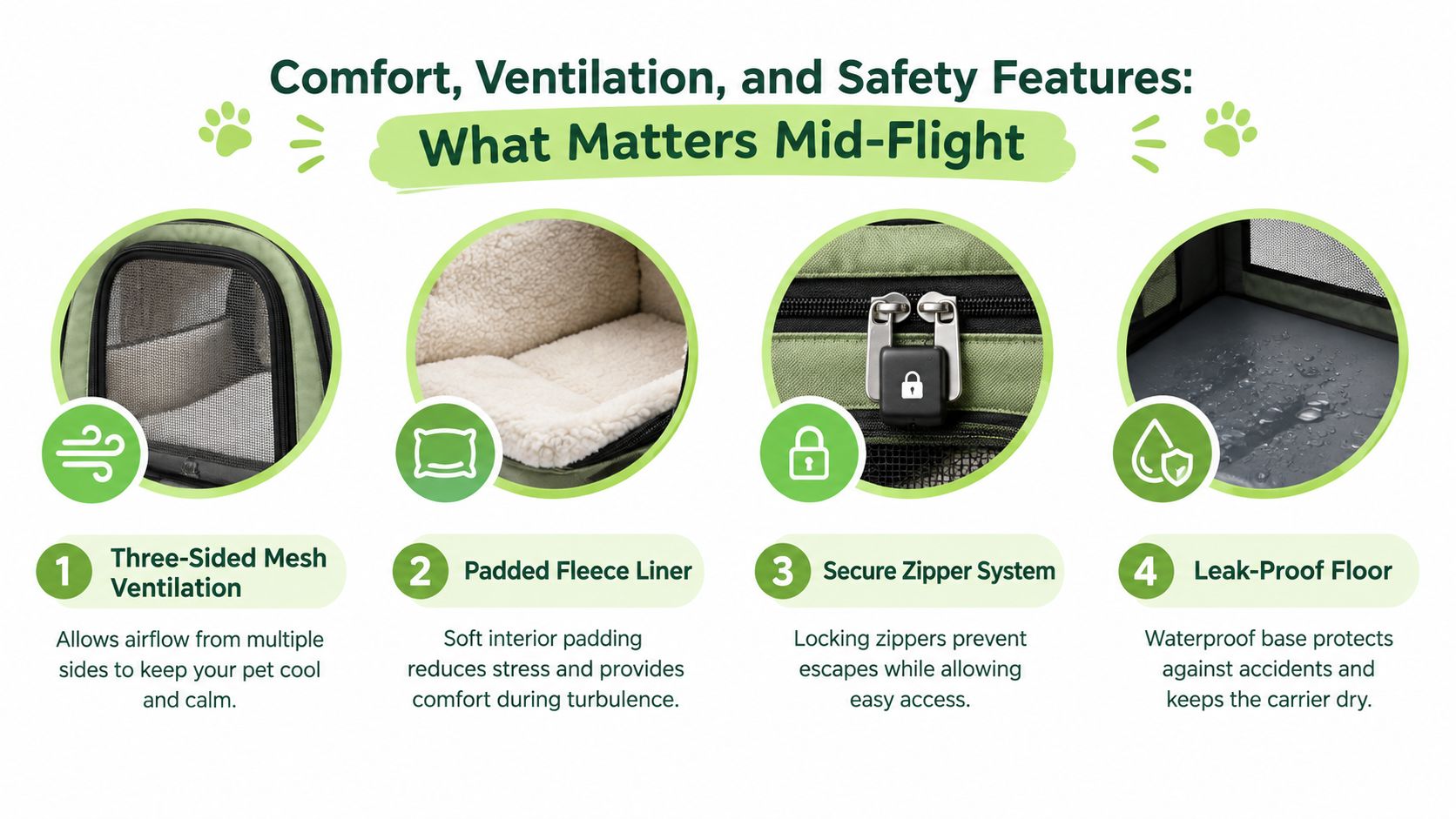
Mesh on multiple sides lets air move through the carrier when one panel is close to a seat wall or your clothing. Three-sided ventilation is especially useful for a nervous cat or a dog that becomes warm while being carried through a busy terminal.
Check that the mesh is exposed after the carrier is placed under the seat. IATA requires ventilation openings to remain unobstructed, so don't select a design where a decorative flap or internal pocket covers the main airflow area. Air Canada's cabin guidance also emphasizes that the pet must have enough room to stand, turn around, and lie down inside the flexible carrier.
Padding should support, not crowd
A fleece liner can make an unfamiliar bag feel more predictable and reduce sliding when the aircraft moves. It shouldn't raise the floor so much that your pet's head presses into the roof or the bag no longer fits beneath the seat.
Choose a removable, washable pad and carry a spare absorbent layer. A nervous animal may create a mess during a delay, and cleaning the liner is easier than cleaning the entire carrier or the seat area.
Closures and the floor prevent avoidable problems
A zipper that opens under tension can undo every other safety feature. Look for zipper pulls that can be secured together, strong seams around the entry, and a frame that doesn't twist when you lift the bag.
Test the base before travel by placing an absorbent liner inside, adding a little water, and tipping the bag carefully over a suitable washable surface. The floor should contain the moisture rather than allowing it to reach your clothing or the aircraft seat area.
Here's a short demonstration of the design features that matter during cabin travel:
Packing and Travel Day Checklist
Travel day feels easier when the carrier has one job and the carry-on has another. Keep the animal's immediate environment simple, then place documents, spare supplies, and cleanup items where you can reach them without opening the carrier.
Inside the carrier
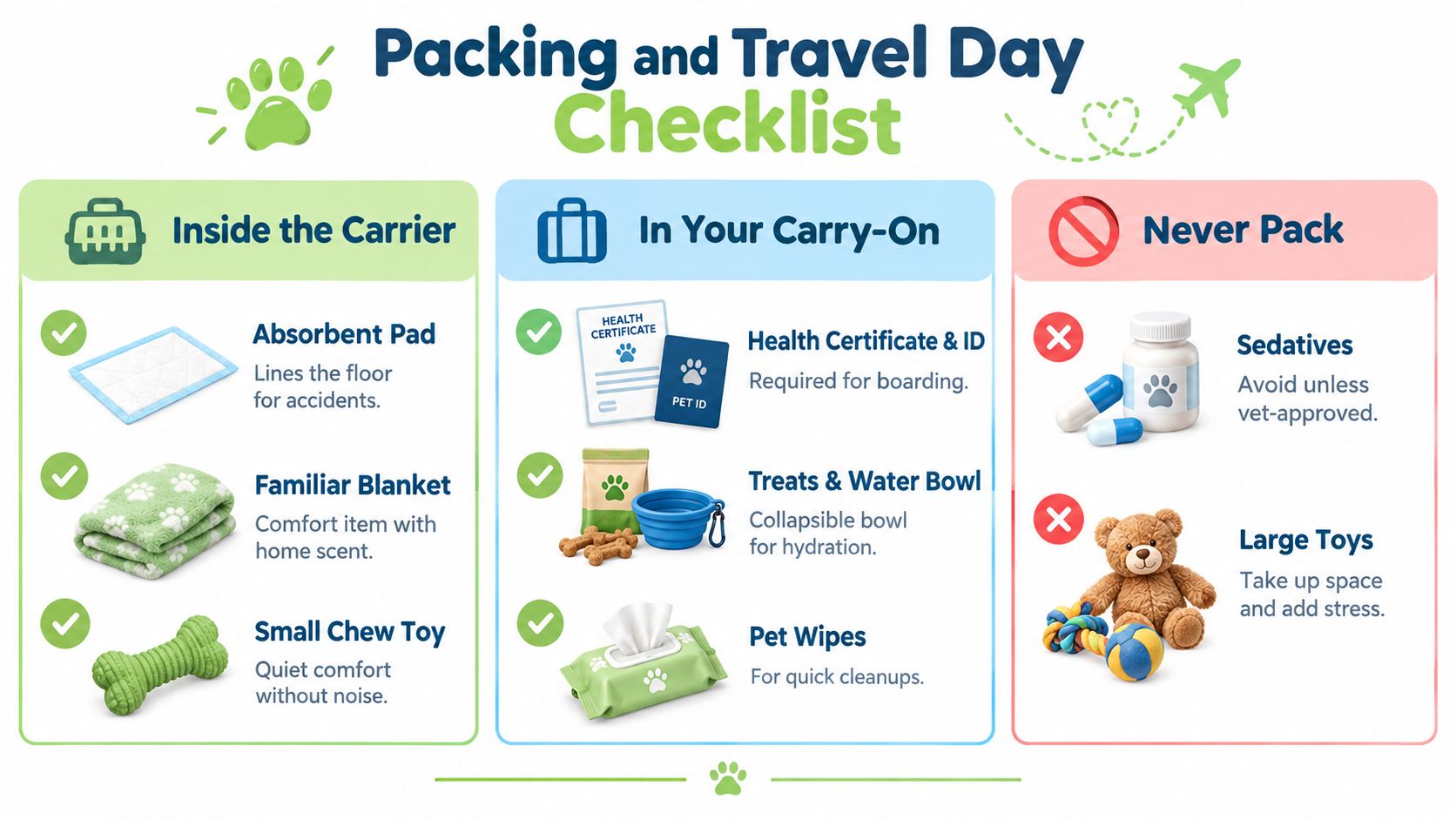
Use an absorbent pad on the floor, topped with a thin familiar blanket or washable liner. Add one quiet comfort item that won't block ventilation or take up the space your pet needs to turn and lie down.
- Absorbent pad: Helps contain an accident and keeps the base drier.
- Familiar blanket: Brings a recognizable scent without crowding the interior.
- Small toy: Offers comfort if it's quiet, compact, and safe for the individual pet.
In your carry-on
Keep the health certificate, vaccination records, identification details, and reservation confirmation together in an easy-to-reach document sleeve. Pack a sealed water bottle, a small collapsible bowl, treats, pet wipes, spare absorbent pads, and an extra liner.
A familiar-smelling item can stay in the carrier, but backup comfort items belong in the carry-on. If you're comparing broader private-aircraft options for a group itinerary, information about midsize jets for groups may help with that separate travel decision, though airline cabin-carrier rules still apply to commercial flights.
Before leaving home
Give your pet a calm practice session, a light meal appropriate for their normal routine, and a short walk or bathroom opportunity before check-in. Don't introduce a new food, toy, or calming product on the morning of travel.
Avoid sedatives unless your veterinarian has prescribed and specifically advised them for your pet. Medication can affect animals differently in flight, so never improvise with a human medication or someone else's prescription. The Pet Magasin guide to traveling with pets provides another preparation reference, but your airline and veterinarian remain the authorities for current travel and health requirements.
At the airport and onboard
Arrive with enough time for document review and a possible carrier inspection. At the gate, keep the carrier closed and ask whether the staff needs to check the pet before boarding.
Once onboard, place the carrier on the floor under the seat in front of you. The pet must remain inside during taxi, takeoff, landing, and turbulence, so don't open the bag because the animal seems restless. Speak calmly through the mesh and wait for a stable, permitted moment only if the airline's rules allow any interaction.
Picking a Carrier That Travels with You
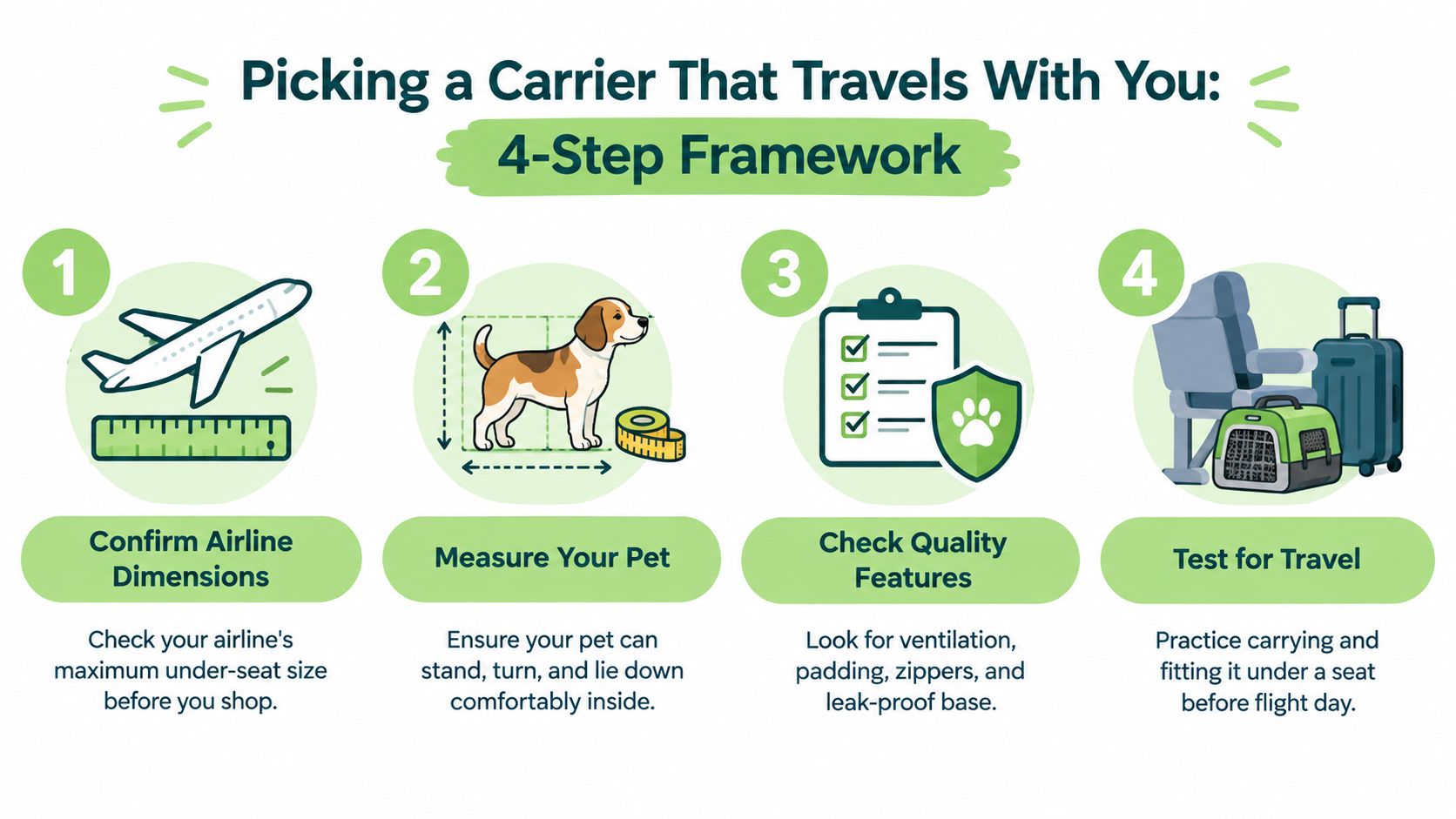
The carrier that works for one flight may fail on another, so choose it through a sequence rather than by appearance. You're balancing four requirements: the airline's exterior envelope, your pet's internal posture, the bag's safety construction, and its performance when loaded.
Start with the least flexible limit
Check the airline and the aircraft assigned to your itinerary. If you expect to use the same bag across several airlines, compare every published maximum and choose a carrier that sits meaningfully below the tightest dimension, rather than buying right at the largest number.
That approach gives the soft walls somewhere to flex without crushing the interior. It also leaves room for measurement differences caused by frame shape, seams, and the floor pad.
Match the bag to the animal
Use the nose-to-tail, shoulder-width, and standing-height measurements you recorded at home. Select the smallest carrier that still lets your pet stand, turn around, sit naturally, and lie down without the roof or mesh pressing against the body.
Don't let a large exterior create false confidence. A thickly padded carrier can offer less usable room than a slimmer model with the same outside dimensions.
Inspect the build
Prioritize a reinforced frame, self-locking or securable zippers, mesh on at least two sides, and a waterproof or leak-resistant base. Check the carrying handle and shoulder strap while the carrier is loaded, because an uneven lift can shift the pet into one corner.
A Pet Magasin soft-sided carrier is one example of this format, combining interior padding, a mesh ventilation window, a carrying handle, and an adjustable padded shoulder strap. Treat those features as a checklist rather than a guarantee of acceptance, and compare them with the airline's current policy.
Test the loaded carrier
Before airport day, load the carrier with the actual liner and comfort item. Slide it under a mock airline seat or a sturdy table with a comparable opening, then remove it without forcing the frame or folding the roof onto your pet.
Carry it through a short practice outing. Notice whether the base sags, the zipper pulls separate, or the shoulder strap makes the bag swing. For cats and small dogs traveling on multi-airline itineraries, a soft-sided carrier with a rigid insert is usually the most adaptable choice. Travelers who want maximum shell protection and rarely change carriers may prefer a hard-sided option, provided the specific airline and aircraft accept it.
Pet Magasin offers in-cabin travel carriers with practical features such as padding, mesh ventilation, secure carrying options, and a design intended for airline travel. Visit Pet Magasin to compare pet travel supplies and choose a carrier that fits your animal, your itinerary, and the airline's current rules.

Leave a comment