


Professional Grooming Supplies for Dogs: Best of 2026

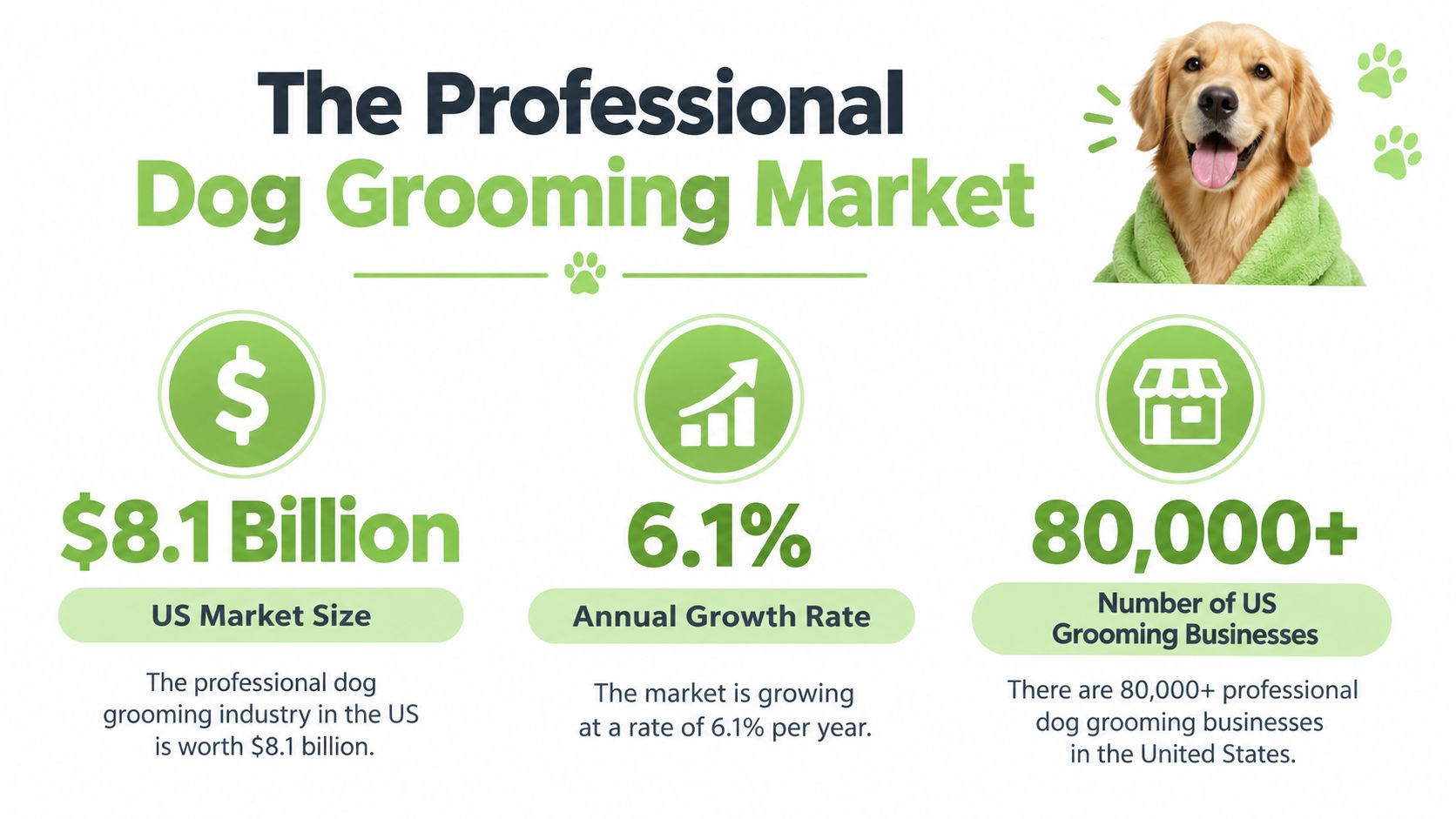
The U.S. pet grooming services market was estimated at USD 2.06 billion in 2024, with projected growth of 6.7% CAGR from 2025 to 2030, according to Grand View Research's market analysis. That scale changes how you should evaluate professional grooming supplies for dogs. A clipper, blade, dryer, or disinfectant isn't merely a purchase. It becomes part of a repeated workflow that affects appointment speed, animal comfort, tool life, sanitation, and the consistency clients expect.
A salon that handles a steady stream of dogs can't rely on a scattered collection of consumer tools. Each station needs a clear purpose, each used item needs a defined place, and every groomer needs the same maintenance habits. The most expensive equipment won't rescue a disorganized process, but the right equipment can remove avoidable delays and reduce unnecessary strain.
Understanding the Professional Grooming Market
Professional grooming is a recurring service, so equipment decisions should follow the work a salon performs every day. Global estimates place the market at USD 6.89 billion in 2024, with projected growth to USD 10.35 billion by 2030 at a 7.33% CAGR. These figures describe a broad market rather than a single equipment category, but they point to a practical requirement: tools must withstand repeated handling while protecting animal comfort, sanitation, and appointment timing.
Dogs account for the largest share of grooming demand in several market estimates. One forecast assigns dogs 58.4% of grooming-related demand, while another estimates dogs at 71.3% of dog-grooming-services revenue in 2025. For salon owners, that supports a dog-first equipment plan built around recurring bath, trim, deshedding, and sanitary services. Choose supplies according to coat types, service frequency, and the number of dogs each station handles, rather than buying a mixed catalogue of tools.
Recurring demand changes the buying decision
Survey-based industry reporting found that 84% of pet owners groom their dogs at least once a year, including 41% grooming at home, 30% using grooming salons, and 9% using mobile grooming services. Owners who use professional grooming visit about five times per year on average, and the average professional grooming cost is around USD 60, according to Dogster's pet grooming industry statistics.
That pattern creates two equipment priorities. Salon tools need to survive repeated use, heat, moisture, and frequent cleaning. They also need predictable handling, because a tool that overheats, pulls coat, or requires repeated adjustment slows the groom and increases stress for the dog. At-home buyers compare convenience and cost, while salons must also account for tool rotation, replacement blades, maintenance time, and consistent finishing.
A new operator can use this guide to starting a dog grooming business to connect equipment choices with staffing, service planning, and operating costs. Retailers serving groomers can use QR rewards for retailers to support repeat purchases of consumables and replacement blades, while keeping product selection aligned with salon sanitation and maintenance procedures.
Practical rule: Buy for the services your salon repeats, and organize every tool around safe, consistent workflow.
Sanitation Protocols for Salon Equipment
A clean-looking tool isn't automatically a sanitary tool. Hair, skin oil, shampoo residue, and other organic material can shield surfaces from disinfectants, so sanitation must follow a sequence rather than a single spray-and-wipe action. The Iowa State University Center for Food Security and Public Health guidance emphasizes removing visible debris, cleaning, drying, and disinfecting between every dog.
Use the same sequence every time
- Remove hair and debris. Brush clippers, blades, shears, combs, and other tools before applying liquid. Pay attention to hinges, blade teeth, shear pivots, and the area around clipper housings.
- Clean the surface. Use warm soapy water or another suitable degreasing cleaner where the tool's material and manufacturer guidance allow it. Cleaning removes soil and oils that can interfere with the disinfectant.
- Dry completely. Water left on metal surfaces can dilute a chemical product and can contribute to corrosion. Use a clean towel or an appropriate air-drying setup, then inspect seams and moving joints.
- Disinfect with an approved method. Apply a labeled chemical disinfectant or use an appropriate UV-C system. The product's label controls the required concentration and contact time. If the label requires a surface to remain wet for a specified period, wiping it dry immediately doesn't complete disinfection.
- Return only ready tools to the clean area. Keep used tools physically separate from disinfected tools. A clean tray, closed container, or clearly divided station prevents a groomer from grabbing the wrong item during a busy appointment block.
The key timing point is between every dog. A tool that touches one animal's coat, skin, paws, or secretions shouldn't move directly to another animal without completing the sanitation cycle.
Sanitize the station as well as the tool
Tables, tubs, restraints, mats, handles, and work surfaces also need attention. Remove visible hair and soil first, apply the selected cleaner, rinse or wipe as appropriate, and then use the disinfectant for its full labeled contact time. Store clean towels separately from used laundry, and clear hair from dryer intakes and other equipment openings.
A salon owner comparing broader hygiene systems may find this overview of the sterilization equipment market in 2026 useful for general equipment context. Grooming tools still require grooming-specific procedures, however. Don't substitute a large sanitation device for careful cleaning, drying, and disinfection at the station.
Maintaining Clippers and Shears
Clippers and shears tell you quickly whether a salon has a maintenance culture. A blade that pulls, a shear that feels stiff, or a clipper that heats unpredictably can slow an appointment and compromise the finish. The post-use routine should be automatic: brush out hair, clean, disinfect, dry, then lubricate.
Follow the post-use sequence
Start by brushing loose hair from the blade teeth and the clipper body. With shears, clear the pivot and the inside faces of the blades. Hair left in those areas holds oil and moisture against metal, so a quick surface wipe isn't enough.
Next, clean according to the tool's construction and the cleaner's instructions. Degreasing removes residue that can trap debris, but don't immerse an electric clipper body unless the manufacturer specifically permits it. Treat detachable blades and shears as separate metal tools, and keep electrical components away from unnecessary moisture.
Disinfect after cleaning. The correct product and contact time depend on the label, so staff should know which disinfectant the salon uses and where the instructions are posted. Disinfection isn't a replacement for cleaning, and it doesn't excuse skipping visible-debris removal.
Dry every part completely before storage or oiling. Moisture accelerates corrosion and can contribute to dulling, rough pivots, and unreliable cutting. Inspect teeth for damage, check shear alignment, and remove any tool that no longer operates safely.
Lubricate moving parts deliberately
Once the metal is dry, apply suitable clipper oil to the blade and lubricate shear pivots as directed. Excess oil attracts hair and dust, so more isn't better. Use enough to protect and support movement, then wipe away the surplus before the tool returns to service.
A dedicated tray for tools waiting for cleaning and another for ready tools makes the sequence visible to every staff member. Groomers who want a more detailed equipment comparison can review professional grooming clippers for dogs, then judge any model by motor consistency, blade compatibility, heat management, cleanability, and serviceability rather than by appearance alone.
Maintenance standard: A tool isn't ready because it looks clean. It's ready when it's clean, disinfected, dry, lubricated where required, and safe to use on the next dog.
Standard versus Wide Grooming Blades
Blade width is a workflow decision, not just a specification. Standard and wide grooming blades use the same A5 snap-on mounting system, but the cutting head on a wide blade is typically about 50% wider. Industry references place wide heads at about 65–70 mm, compared with 47–49 mm for standard blades, as described in this professional guide to wide grooming blades.
Where standard blades earn their place
Standard blades are easier to maneuver around small contours and restricted areas. They suit detailed work around feet, faces, sanitary zones, legs, and coat transitions where the groomer needs controlled positioning rather than maximum coverage.
They also simplify a mixed appointment book. A salon working on small dogs, varied breed trims, and detail-heavy styles can use standard blades as its dependable baseline. Their narrower head gives the groomer more room to adjust angle and pressure when working around folds, bony areas, or uneven coat.
Where wide blades save time
Wide blades cover more coat in each pass, making them useful for large body areas and substantial coats. They can reduce repeated passes across a broad back, side, or hindquarter, which is valuable when the salon routinely performs full-body clips on larger dogs.
The trade-off is control. A wider head can feel cumbersome around paws, faces, narrow legs, and small transition zones. It also demands careful handling because the larger cutting surface leaves less room for casual angle changes.
| Workflow need | Standard blade | Wide blade |
|---|---|---|
| Detailed shaping | Strong choice for controlled work | Less convenient |
| Large body areas | Slower coverage | Faster coverage |
| Small dogs and tight contours | Easier to position | Can feel oversized |
| Full-body clips on larger coats | Useful but less efficient | Often the more efficient option |
| Blade inventory | Flexible general-purpose base | Add when coat volume justifies it |
Don't replace every standard blade with a wide version. Keep standard blades for precision and add wide blades when the salon's regular coat volume makes broad clipping the clear bottleneck.
Selecting the Correct Blade Sizes
Blade length determines how much coat remains and how close the cutting surface works to the skin. Professional A5-style snap-on systems give groomers a practical range, but the number printed on the blade doesn't replace coat assessment. Before clipping, check the dog's coat condition, skin visibility, requested finish, matting, and the specific area being trimmed.
Use the blade for the task
A #10 blade leaves roughly 1/16 inch and is commonly used for sanitary trims, paw pads, and some face work. It provides a close, controlled finish, but it isn't a default body blade for every dog. On sensitive or compromised skin, the groomer must use appropriate technique and judgment.
A #7F blade leaves about 1/8 inch, making it suitable for short body clips where the groomer wants more coverage than a #10 provides. The “F” finish refers to a fine-tooth configuration, which can produce a more even surface when the coat is prepared and the blade is used appropriately.
A #5F blade leaves about 1/4 inch and suits medium body clips. It preserves more coat than a #7F and can be a useful starting point when the owner's request calls for a visibly fuller finish.
For extremely close or surgical-length work, groomers reserve #30 and #40 blades. A #40 is around 1/100 inch, or about 0.25 mm, and professional guidance describes it as a surgical-prep-only blade. Those lengths require a clear reason, controlled handling, and careful attention to skin condition.
| Blade Size | Cut Length | Primary Use Case |
|---|---|---|
| #10 | About 1/16 inch | Sanitary trims, paw pads, selected face work |
| #7F | About 1/8 inch | Short body clips |
| #5F | About 1/4 inch | Medium body clips |
| #30 | Very close | Close preparation and specialty work |
| #40 | About 1/100 inch | Surgical preparation only |
The size guidance is summarized in professional A-series blade references and this dog grooming blade size chart. Keep the decision tied to the requested finish and the exact body area. A blade that works efficiently on a paw pad may be entirely inappropriate for a broad body clip.
Build a decision habit
Train staff to state the intended length before selecting a blade. If the request is unclear, confirm whether the owner wants a close, short, or fuller result, then choose the blade that leaves the intended amount of coat while preserving safe control. When a coat is matted, don't assume a familiar blade will move safely through it. Stop, assess the skin and coat, and change the plan when necessary.
Safe Drying Practices for Dogs
Drying is where speed can become a safety problem. A dog may tolerate warm air poorly even when the groomer finds the temperature comfortable, and a confined drying setup can make it harder to detect distress quickly. The safer operating principle is to control airflow and monitor the animal, rather than treating heat as the shortcut.
Avoid heated cage dryers
Neutral safety guidance recommends avoiding heated cage dryers and using cage dryer styles without a heating element, so the air remains close to room temperature instead of being actively heated. The rationale is explained in this professional danger-free drying guidance.
That doesn't mean every dog should receive identical airflow. Start gently, observe the dog's posture and breathing, and increase airflow only as the animal remains comfortable. Keep the nozzle moving during hand drying, avoid directing force into the face or ear openings, and use lower intensity around sensitive areas.
Organize the drying station around observation
A force dryer can remove bulk water, but the groomer still needs to watch the dog's response. Keep the dog positioned securely, maintain a clear line of sight, and stop when the dog shows escalating stress, fatigue, or discomfort. Don't use a dryer to overpower poor handling or a rushed schedule.
A stand or hands-free dryer can support brushing while leaving both hands available for coat control, but supervision remains necessary. Passive drying should never become an excuse to leave a dog unobserved. Temperature control, airflow direction, clean filters, and a calm transition from bathing to drying matter more than a high-heat setting.
Drying should make the next grooming step easier, not force the dog to endure avoidable heat or noise.
Addressing Anxiety in Professional Settings
Many supply guides stop at a list of clippers, brushes, shears, and dryers. That misses the operational question anxious dogs, senior dogs, apartment groomers, and mobile groomers face every day: how does the equipment affect the dog's tolerance of the process? Recent market coverage identifies low-noise technology and 2-in-1 multifunctional devices as emerging product themes, according to IndexBox's United States dog grooming supplies analysis.
Evaluate sound as part of tool performance
A quiet tool isn't automatically a safe tool, but lower noise can make handling more manageable for dogs that react to vibration or sudden changes in sound. Compare the clipper's operating noise, the dryer's speed range, and whether the groomer can begin at a lower setting before increasing airflow.
For anxious dogs, stage the equipment instead of turning everything on at once. Let the dog settle on the table, introduce the brush, then bring in the clipper or dryer at a distance. Keep the first passes brief, reward calm behavior when appropriate, and stop before distress becomes a struggle.
Senior dogs require more than a quiet motor. They may need stable positioning, careful support during transfers, reduced session intensity, and frequent observation for fatigue. A compact tool can help in a mobile or apartment setup, but portability shouldn't lead to weaker sanitation, poor ventilation, or an unstable workstation.
Match the kit to the setting
Mobile groomers need equipment that packs securely, cleans easily, and operates reliably within the available space and power setup. Apartment groomers may prioritize compact storage, low-noise tools, and quick-dry bathing formats. A salon with multiple stations may value duplicate low-noise tools so a sensitive dog isn't placed beside the loudest active dryer.
This practical focus remains underserved because product lists rarely explain how noise, airflow, portability, and animal tolerance interact. Use the video below as an additional visual reference, then test tools with the actual dogs and workflow rather than trusting a specification sheet alone.
Building a Professional Grooming Toolkit
A professional toolkit should support the full appointment from restraint and bathing through drying, cutting, cleanup, and tool storage. Start with equipment that solves a repeated workflow need, then add specialized items when the salon's coat mix or handling requirements justify them.
Use a purchasing checklist
- Clippers and blades: Choose a dependable clipper platform with compatible A5-style blades, then stock lengths that match the services you perform.
- Shears: Keep straight, curved, and thinning options appropriate for the salon's common trims. Inspect pivots and edges regularly.
- Brushes and combs: Select slickers, combs, pin brushes, rubber tools, or undercoat tools according to the coats on the appointment book.
- Drying equipment: Prioritize controllable airflow and safe temperature management. Avoid heated cage dryers, and choose a configuration that preserves supervision.
- Sanitation supplies: Keep cleaners, labeled disinfectants, drying materials, clean trays, used-tool containers, and protective supplies at the station.
- Safety equipment: Use stable tables, non-slip surfaces, suitable restraints, and first-aid supplies. Staff should know where each item belongs before the salon gets busy.
Don't judge a purchase by its feature count. Judge it by whether the tool can be cleaned correctly, withstand repeated use, remain comfortable for the groomer, and perform safely across the dogs you serve. For finishing work, compare options such as this professional grooming shears set for dogs against the actual hand-feel, coat types, and maintenance demands of your team.
Write the sanitation sequence where every groomer can see it, label clean and used storage, and audit blades and dryers before the first appointment. That simple discipline does more for throughput and animal safety than buying another tool without a defined place in the workflow.
Pet Magasin offers grooming tools designed for practical home and professional care, including grooming scissors and grooming gloves for shedding and bathing. Visit Pet Magasin to compare grooming supplies that can support a cleaner, more organized dog-care routine.

Leave a comment