
Dog Travel Crate XXL: Airline Rules and Car Safety Guide

You've found a crate that looks enormous, your dog can stretch out inside it, and you're already picturing a smooth trip. Then the problems begin. The crate doesn't clear the SUV's rear opening, its exterior size doesn't match the airline's limits, or the carrier asks for details that the product page never mentioned.
That's the trap with a dog travel crate XXL. “XXL” describes a general size category, not a universal travel standard. A crate for loading into a car has different practical demands from one intended for air cargo, and a crate that works for one purpose may be unsafe or unusable for the other.
Why Choosing an XXL Dog Travel Crate Is More Complicated Than It Looks
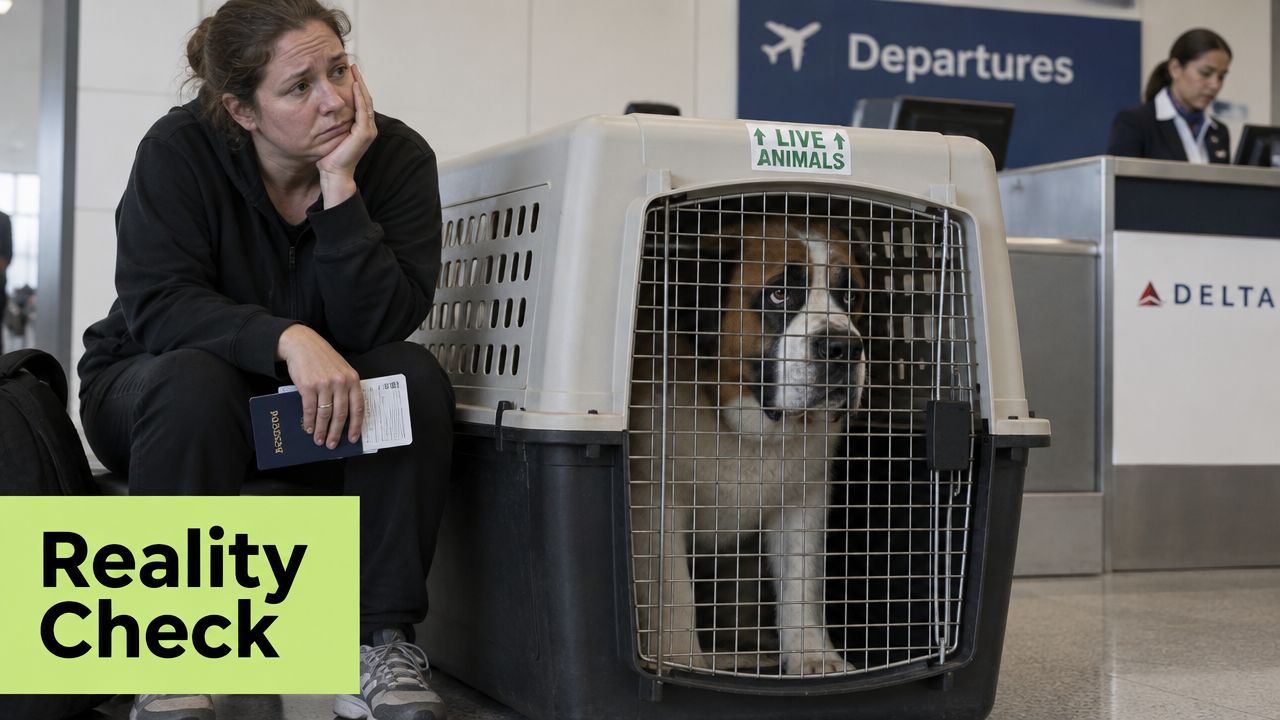
A Saint Bernard owner once told me they chose a crate by looking at the largest label available. The crate seemed generous in the shop, but at home they discovered that the packed unit couldn't pass through the vehicle's rear threshold without being tilted awkwardly. The dog could fit, yet the crate wasn't practical to load, anchor, or remove.
Air travel creates a different kind of surprise. Airlines assess internal space, construction, ventilation, hardware, total weight, and aircraft limits. A brand's XXL label doesn't override those requirements. Car travel, meanwhile, is governed less by a universal size formula and more by the vehicle's opening, cargo floor, seat configuration, tie-down points, and the way the crate behaves during braking.
The label hides three different measurements
Crate makers often promote external dimensions because those are easy to compare online. Airlines need usable internal dimensions, while vehicle owners need both the external footprint and the shape of the loading path. Bedding, door hardware, wall thickness, and sloped panels can reduce the space your dog has.
Common industry charts place XXL crates at about 107 to 122 cm in length for dogs such as Great Danes, Saint Bernards, and Mastiffs, but that range is only a starting point, not proof of fit. PetSmart's crate sizing guide explains why body measurements matter more than the label.
The category still matters commercially. Extra-large crates for giant breeds account for 12.2% of the dog crate market, while the broader dog-crate-and-kennel market was valued at US$1,984.4 million in 2024, according to industry market data. That demand reflects a real need, but it doesn't make every XXL product suitable for every journey.
Practical rule: Decide whether the crate's primary job is air cargo, vehicle travel, or both before comparing brands. The travel mode determines which compromises are acceptable.
For a car, test a full-size cardboard mock-up or measure the crate diagonally through the hatch opening. For a flight, begin with the airline and route, then verify the dog's measurements against the required internal dimensions. “Roomy” is useful only when the crate remains secure, ventilated, and accepted at the point of departure.
How to Measure Your Dog for an XXL Travel Crate
The most common sizing mistake is measuring the dog's back from shoulder to rump and treating that as crate length. Airline formulas use nose-to-tail-base length, not just the torso, and they add part of the dog's front-leg measurement. A dog can appear to fit a crate by body length yet lack enough room to turn or lie naturally.
IATA's framework requires the animal to stand, turn around, and lie down naturally. Its minimum internal dimensions are calculated as length equals nose-to-tail-base length plus half the front-leg length, width equals twice shoulder width, and height equals standing head height plus bedding. PetSmart's sizing reference summarizes the same approach.
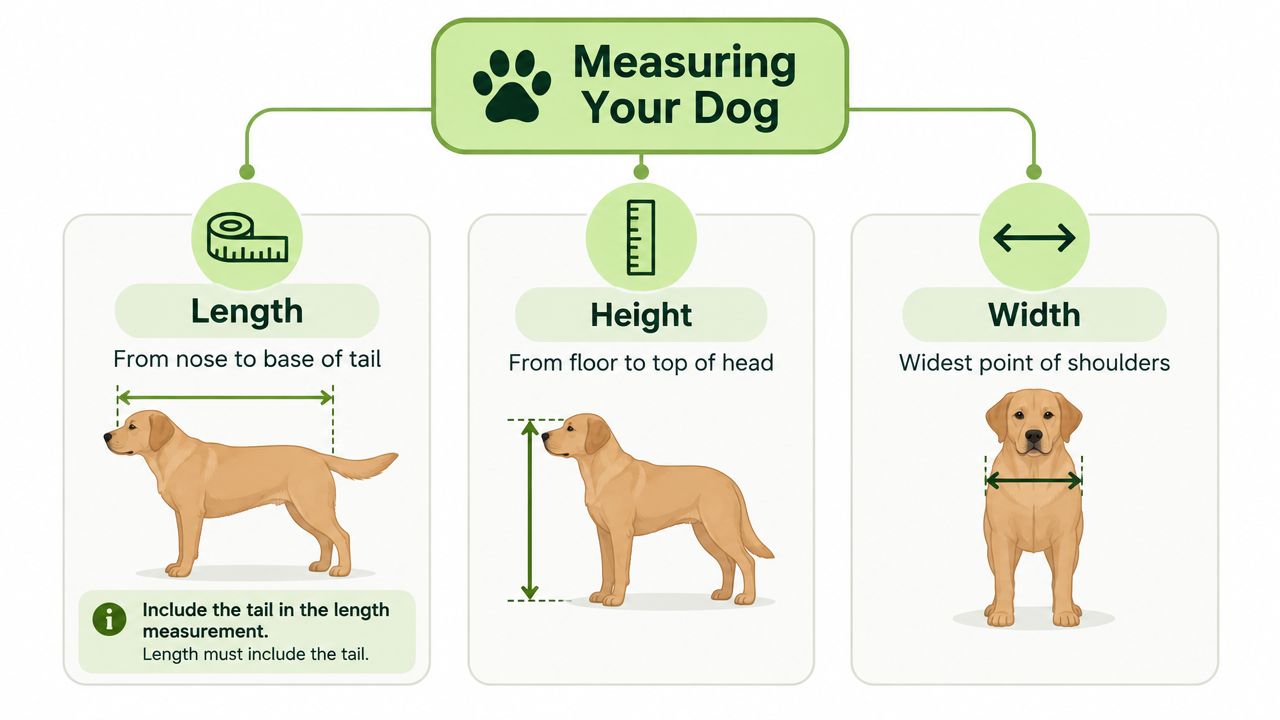
Take the four measurements carefully
Use a flexible tape measure, a helper, and a calm dog. Measure twice if your dog shifts position.
- Nose to tail base, A: Measure from the tip of the nose to the base of the tail. Don't include the tail itself. This is the length component used in the formula.
- Elbow height, B: Measure from the floor to the elbow joint or the point where the front leg meets the body. The formula uses half of this measurement.
- Shoulder width, C: Measure the widest part across the shoulders or chest. The crate width must be twice this figure for one dog.
- Standing head height, D: Measure from the floor to the highest point of the head or ears while the dog stands naturally. Add the bedding thickness to the height requirement.
A Saint Bernard may need a crate in the 107 to 122 cm XXL length range, but the exact choice depends on its own proportions. Two dogs of similar weight can have different shoulder widths, leg heights, and body lengths, so weight alone can send you toward the wrong crate.
For snub-nosed breeds, the crate must be 10% larger than the calculated minimum because breathing comfort needs additional consideration. That requirement is especially important for dogs with shortened muzzles, including some bulldog and mastiff types.
Use the larger size when the result is between options
If your measurements sit between two available crate sizes, choose the larger one. Pet Travel's airline-crate guidance supports that approach, and it makes practical sense for a dog that needs to change posture during a journey.
Keep this checklist beside your tape measure:
- Nose to tail base
- Floor to elbow
- Widest shoulder measurement
- Floor to top of head or ears
- Bedding thickness
- Internal crate dimensions, not external dimensions
- Extra allowance for a snub-nosed breed
You can also compare your results with extra-large dog crate dimensions, but use published size charts as a screening tool. Your dog's measurements decide the final fit.
Airline Rules vs Car Travel Requirements for XXL Crates
An airline crate and a car crate solve different safety problems. Air cargo requires a rigid container that can withstand handling, maintain ventilation, prevent escape, and meet acceptance rules. Vehicle travel requires a crate that fits the cabin or cargo area, stays anchored, and doesn't become a dangerous loose object during sudden braking.
For air freight, IATA-based guidance calls for rigid construction, metal door bolts, and ventilation on at least three sides. One industry source says compliant ventilation should be provided on all four sides, with openings covering at least 16% of total side surface area. See the detailed ventilation guidance for dog crates before treating a product description as proof of compliance.
Compare the travel jobs
| Requirement | Air Cargo, IATA-Compliant | Car Travel |
|---|---|---|
| Main sizing basis | Dog's internal fit by body measurements | Dog's fit plus vehicle opening and cargo geometry |
| Construction | Rigid structure required | Rigid structure is generally preferable for secure transport |
| Door hardware | Metal bolts and escape-resistant closure | Secure latch, with anchoring and access also important |
| Ventilation | Openings on at least three sides, with some guidance calling for all four sides | Balanced airflow on both sides helps reduce heat buildup |
| Loading limits | Airline and aircraft restrictions apply | Vehicle threshold, hatch angle, floor, and tie-down points apply |
| Weight planning | Include the crate and dog in airline limits | Include the crate and dog when judging safe handling and vehicle setup |
A 48-inch crate may offer the interior length a giant breed needs, yet fail at the SUV. Measure the hatch opening at its narrowest point, account for the rear threshold, and check whether the folded seats create a level platform. A sloping hatch can make a crate impossible to load even when the cargo floor looks long enough.
Materials create different compromises
A metal or steel crate can provide strong rigidity and broad airflow, but its weight makes loading difficult. A hard-sided plastic crate usually offers a lighter structure and integrated ventilation panels, while a fabric crate may be convenient for a car but lacks the rigid construction expected for air cargo.
If you're combining both uses, start with the stricter air-cargo requirements, then confirm that the unit fits and can be anchored in the vehicle. Resources such as preparing your pet's crate for international flights can help you organize the wider preparation process.
Flight availability matters just as much as crate design. Independent guidance notes that large dogs usually can't travel in the cabin, and checked or cargo options vary by airline. As of September 2026, Delta and United had suspended general-public pet cargo or checked shipping, according to large-dog flight guidance. Confirm the route, aircraft, and acceptance policy before buying a crate.
For a closer look at air-focused features, see this guide to an airline-approved dog crate for large dogs. A crate that meets both sets of requirements is useful, but it may cost more, weigh more, and demand more careful vehicle planning.
Comparing Materials and Durability in XXL Travel Crates
The right material depends on where the crate will work hardest. I've seen owners choose steel because it feels indestructible, then struggle to lift it into a vehicle. Others choose a soft-sided model because it folds neatly, only to discover that it doesn't provide the rigid structure needed for air cargo.
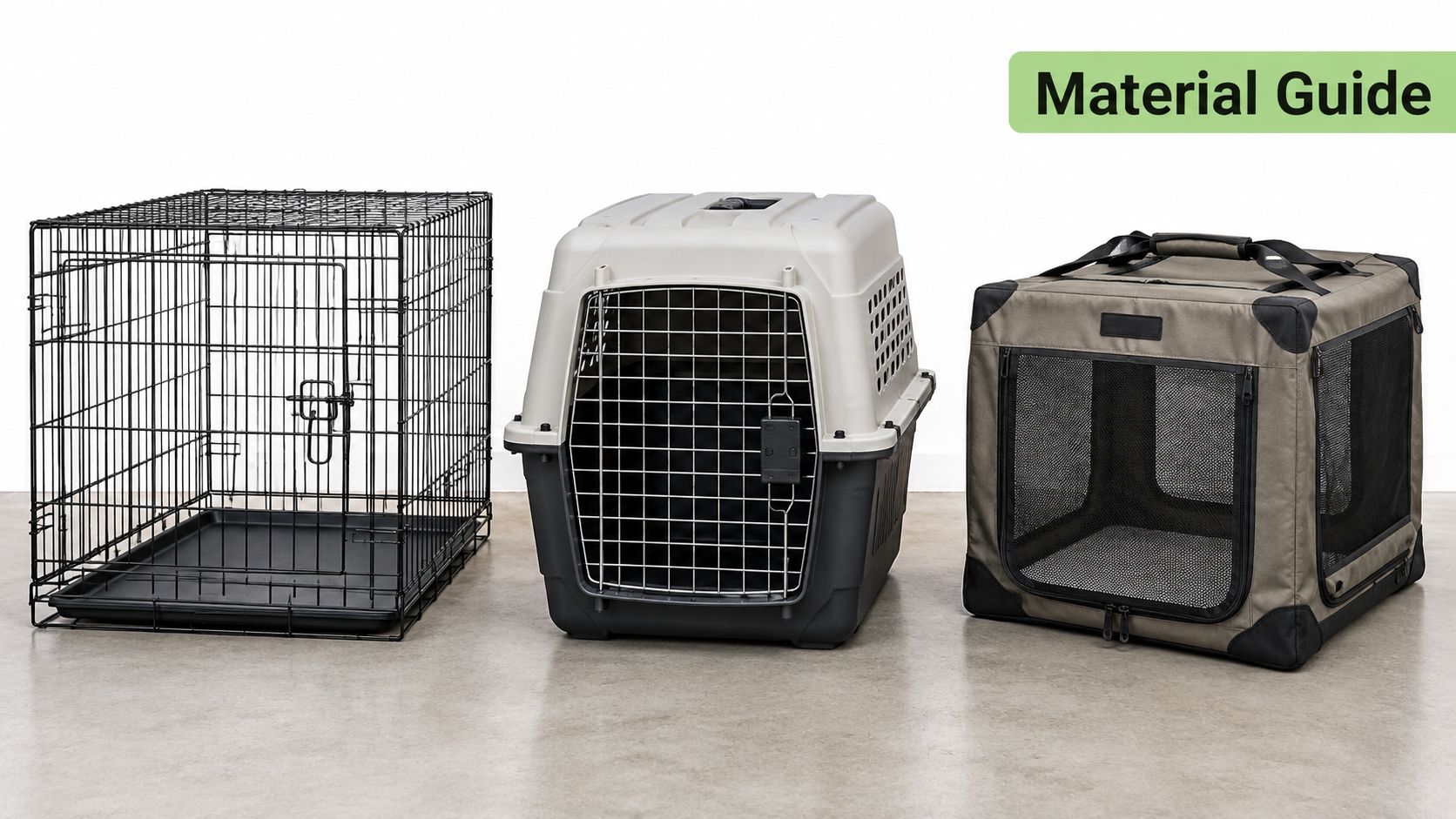
Steel and wire options
Steel crates offer rigidity, visibility, and airflow. They can suit vehicle use when you have a flat cargo area and reliable anchoring points. Their drawbacks are weight, awkward handling, and exposure to weather if used outside the vehicle.
Inspect the door before admiring the frame. A strong-looking crate can still fail if the latch flexes, the hinge side wobbles, or the corner joints separate under pressure. For a giant dog, the door is a working component, not a decorative detail.
Hard-sided plastic
Hard-sided plastic crates are often easier to move and clean than heavy steel designs. Ventilation panels can make the compliance check more straightforward, but the plastic around the door, corners, and bolt channels deserves close inspection.
Press gently around the door frame. It shouldn't bow noticeably, and the locking hardware should engage fully without scraping or leaving a gap. Check that the floor pan is solid and leak-resistant rather than a grate that allows bedding or paws to shift.
Soft-sided fabric
Soft-sided crates work best for calm, supervised car travel and temporary use. They fold down, weigh less, and can be convenient in a vehicle, but fabric walls and mesh panels don't provide the structural rigidity expected for air cargo.
Whatever material you choose, examine these stress points:
- Door hinges: Look for reinforced attachment points and smooth movement.
- Latch mechanism: Test it repeatedly, then apply light pressure from inside and outside.
- Corner joints: Check for flexing, exposed edges, or weak fasteners.
- Floor pan: Confirm that it stays level and can be cleaned after accidents.
- Anchoring points: Make sure the crate can be restrained without crushing its walls.
Choose steel when rigidity and airflow outweigh handling difficulty, plastic when you need a lighter enclosed structure, and fabric when the crate is strictly for controlled car use. Don't pay for airline features you'll never use, but don't send a fabric crate toward an airline cargo desk.
Acclimating Your Dog to an XXL Travel Crate
A correctly sized crate can still fail if your dog sees it as a trap. Large dogs often need time to understand that the crate is a resting place rather than a signal that something stressful is about to happen. Rushing the process before a flight or long drive usually creates more work.
Start by placing the open crate in a familiar room. Put a blanket or bedding inside, leave the door secured open, and reward any calm investigation. Don't push your dog through the entrance or close the door the first time they step inside.
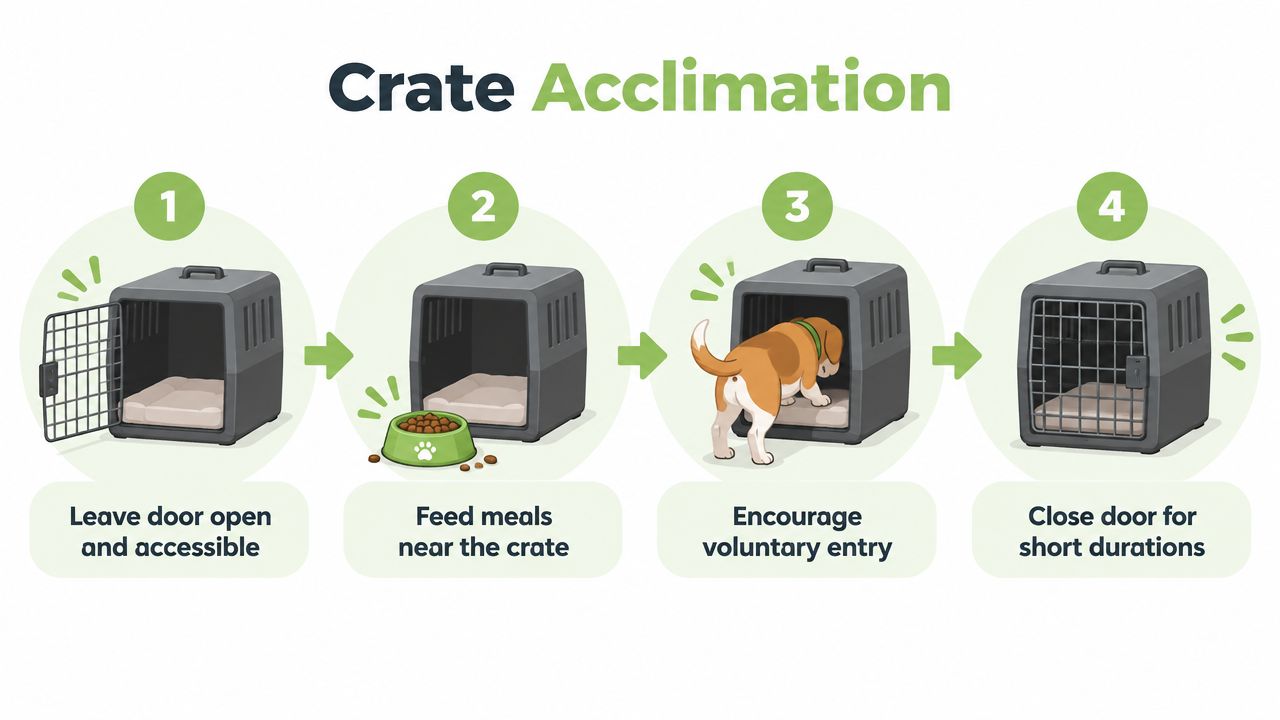
Build duration in small increments
Feed treats near the entrance, then just inside, and later farther toward the back. Meals can follow the same progression. Once your dog enters willingly, introduce brief door closures while you remain nearby, then open the door before your dog becomes distressed.
Most large dogs need one to two weeks of consistent daily practice, while anxious or rescue dogs may need longer. Max, a reluctant Saint Bernard, took three weeks to settle comfortably in his new crate. The progress came from short, uneventful sessions, not from forcing him to stay inside.
Watch the behavior rather than the clock:
- Pacing: The session may be too long, or the crate may be in a busy location.
- Whining: Your dog may need a shorter closed-door interval or more distance from the crate.
- Refusal to enter: Return to rewards near the entrance and remove pressure.
- Relaxed lying down: Continue calmly and increase duration only gradually.
Once daytime sessions are easy, practice longer quiet periods. Add nighttime use only after your dog can rest calmly during the day. For a multi-day trip, the crate should become an ordinary sleeping space before it becomes part of the travel routine.
This short video can provide a visual reference for calm crate practice:
Keep car acclimation separate from crate acclimation. First make the crate comfortable at home, then place it in the vehicle without driving, and only afterward try short journeys. That sequence helps you identify whether the problem is the enclosure, the vehicle, or motion itself.
Your Pre-Travel Crate Verification Checklist
Before every trip, inspect the crate as if someone else will have to approve it. Don't rely on memory, a product badge, or the fact that your dog used it successfully last month. XXL equipment is heavy and difficult to improvise with at a departure point.
Fit and comfort
- Standing: Your dog can stand naturally without pressing the head against the roof.
- Turning: Your dog can turn around without wedging its shoulders.
- Lying down: Your dog can lie naturally with bedding installed.
- Length calculation: You used nose-to-tail-base length plus half the front-leg measurement for an air-cargo assessment.
- Width calculation: You compared the internal width with twice the shoulder measurement.
- Height calculation: You included the dog's standing head height and bedding.
- Borderline size: If the measurements fall between two crate sizes, you selected the larger one, consistent with airline crate sizing guidance.
Structure and ventilation
Run your hands over the door, hinges, bolts, corners, and floor. The door should close completely, the metal bolts should engage securely for air cargo, and the floor should remain solid and stable.
Check airflow from both sides rather than looking only at the front. For air freight, verify the ventilation arrangement against the airline's current requirements, including the guidance described earlier. For car use, make sure luggage, seatbacks, or protective covers don't block the openings.
Vehicle and airline checks
Place the empty crate in the vehicle, then test the dog's real loading route. Check the rear threshold, hatch clearance, folded-seat position, cargo-floor angle, and anchoring points. Add bedding and any travel accessories before judging the final fit.
For air travel, confirm that the airline accepts pet cargo on your route and aircraft type. A compliant crate can still be rejected if the aircraft hold can't accommodate its dimensions or if the airline has suspended the relevant service. Requirements can change, so verify them close to departure rather than relying on an old booking page.
For car-specific preparation, use this guide to dog car travel safety as a practical companion to your physical inspection.
Your XXL crate is ready only when the dog fits, the structure holds, airflow remains clear, the vehicle accepts the footprint, and the airline confirms the route when flying. Treat the crate as a complete travel system, then test that system before the journey.
Pet Magasin offers foldable soft dog crates, pet travel kennels, and airline-focused carriers for owners who need practical travel equipment for different situations. Visit Pet Magasin to compare travel solutions and prepare your dog's setup before the next trip.

Leave a comment