
Dog Car Travel Safety: A Practical Guide for Every Trip

You're buckling the dog in, tossing a leash and water bottle into the back seat, and then realizing you've still got two miles of city traffic, a hot afternoon, and a pup who hates the car. That's the moment dog car travel safety stops being theory and turns into a real-world setup decision. The right restraint, the right seating position, and a plan for heat, stress, and delays make the difference between a calm ride and a risky one.
Preparing for Safe Dog Car Travel
The first mistake many make is treating the car like a short extension of the house. It isn't. A moving vehicle adds braking force, blind spots, sudden noise, heat buildup, and enough distraction to pull your attention away from the road, so the prep has to happen before the key turns.
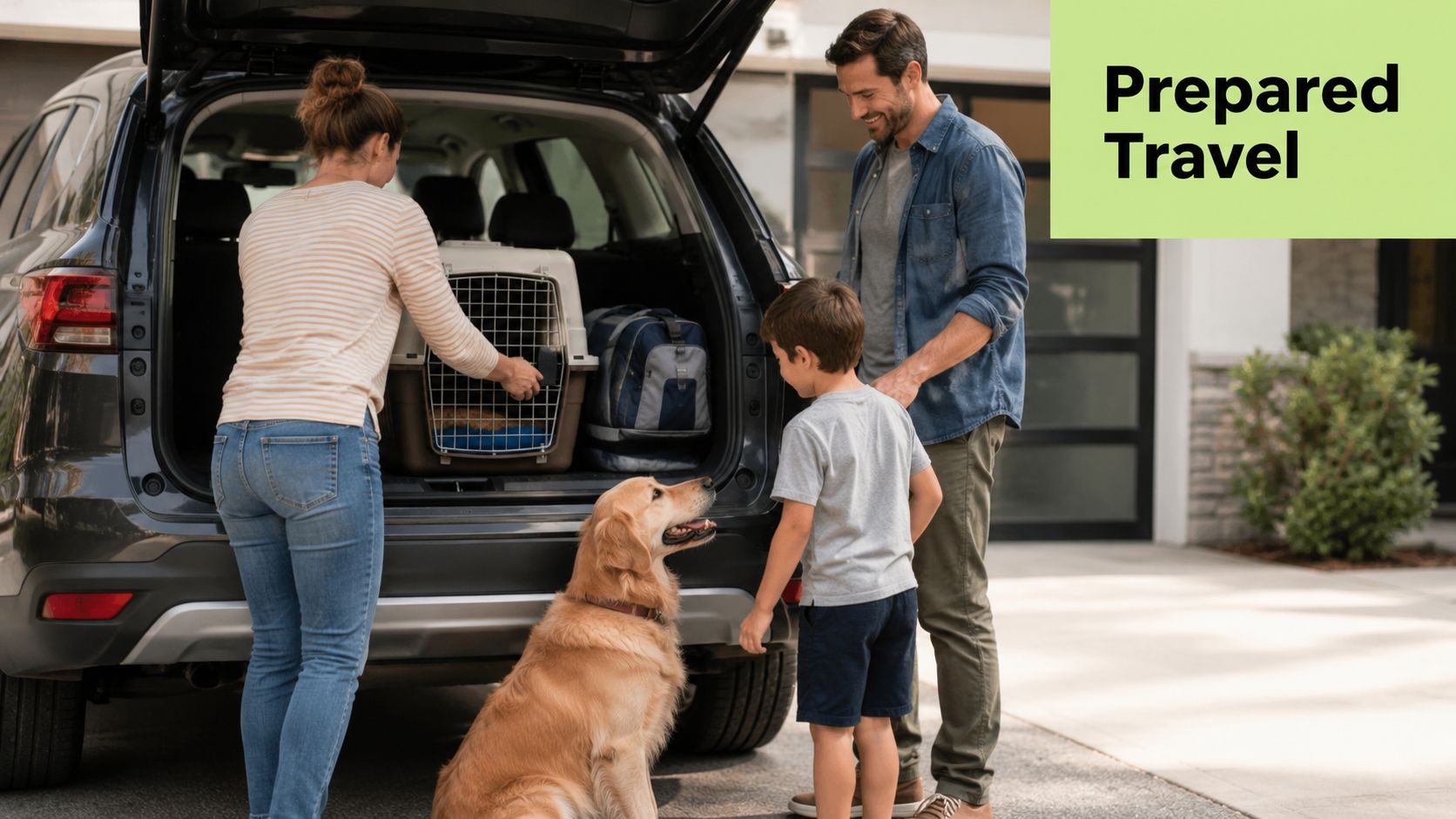
Read the car, not just the dog
I always look at three things first, the back seat, the cargo area, and where the airflow reaches. A crate or harness can only work if the vehicle layout lets it stay stable, and the safest spot is the one you can secure properly without slack or wobble. The AVMA says loose pets are unsafe in vehicles, and both the CDC and Humane World recommend back-seat transport or a secured crate positioned so it won't shift during the drive, with enough ventilation for the dog to stand, sit, lie down, and turn around comfortably (AVMA vehicle transport guidance, CDC travel guidance for pets, Humane World travel safety guidance).
For hatchbacks and SUVs, I check whether the cargo area really has a rigid barrier or just empty space. A soft barrier might help with distraction, but it doesn't replace containment, and open cargo space without a secure enclosure is a bad trade if the dog can launch forward under braking. If you're traveling with a brachycephalic dog or a senior, give extra thought to airflow and rest stops, because heat and fatigue hit those dogs faster.
Practical rule: if you can't show how the dog stays put in a hard stop, the setup isn't ready.
Pack for the trip you're actually taking
A short errand and a five-hour drive need different kits. I pack water, a collapsible bowl, a leash, waste bags, a towel, and something familiar, like a blanket or toy, because calm dogs travel better than fussy ones. The CDC also says never leave a pet alone in a parked vehicle, so I plan every stop as if the dog is coming with me, not waiting in the car (CDC parked vehicle warning).
For dogs with heat sensitivity, I plan the timing before I plan the route. Cooler morning or evening travel beats midafternoon in most climates, and that matters even more for pugs, French Bulldogs, and older dogs with less tolerance for heat. If there's any chance of traffic delay, I'd rather leave earlier with fewer miles to cover than gamble on a warmer cabin and a stressed dog.
The one thing I never ignore is ventilation. The back of the car can heat up quickly even when the front feels fine, and cracked windows aren't a substitute for proper airflow. If you need a simple benchmark, think in terms of whether the dog can breathe comfortably, stay upright, and stay cool without the cabin becoming a trap.
Choosing the Right Restraint or Crate
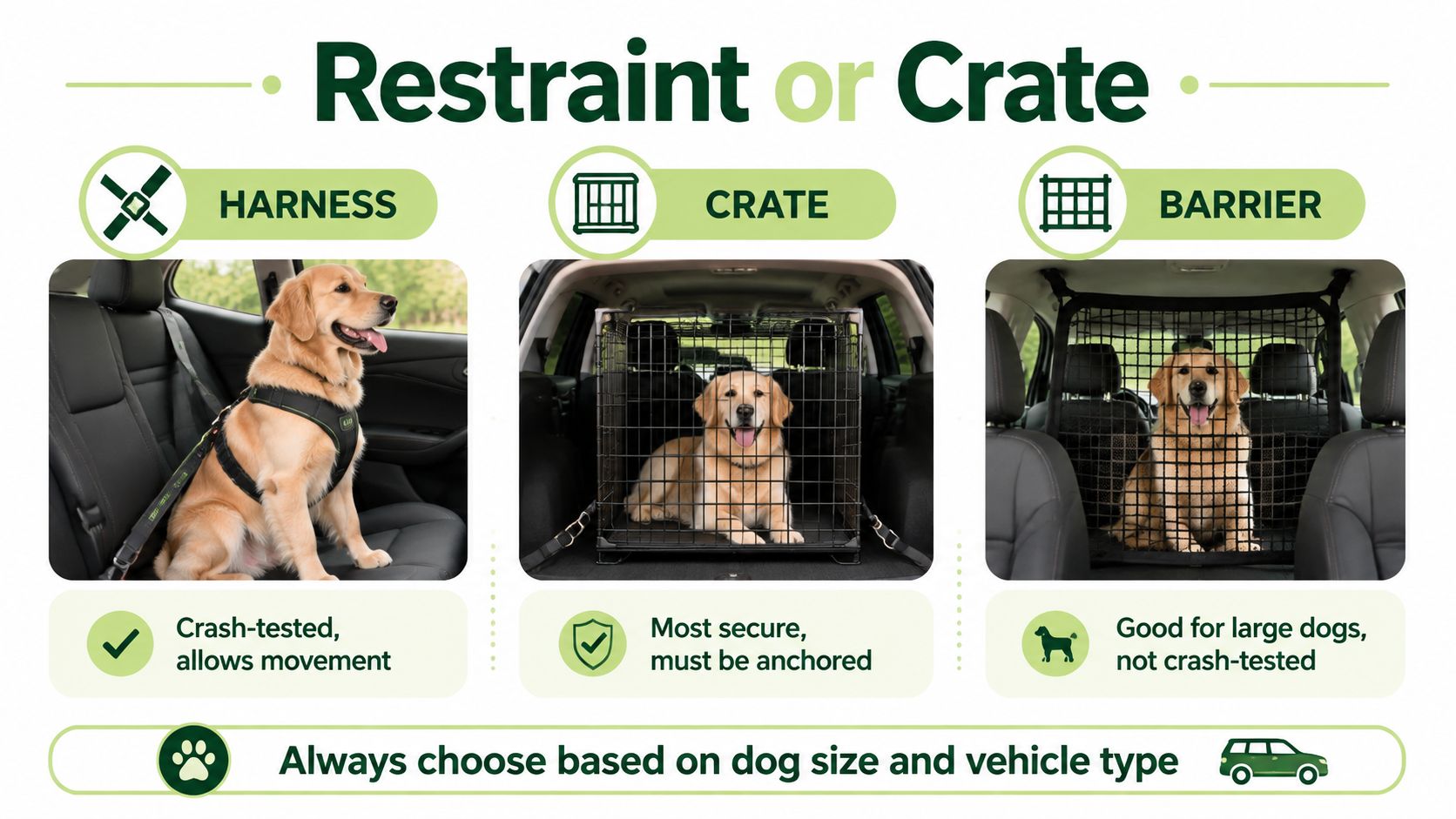
The setup that works best in a parking lot or on a sidewalk is not always the one that holds up in a hard stop. A walking harness may feel familiar, but crash loads are a different job entirely. Look for crash-test validation, solid anchoring, and seat-belt compatibility first, then judge comfort and convenience.
Start with the crash-tested option, not the pretty one
The Center for Pet Safety has shown that restraint design and dynamic loading matter more than simple restraint presence, and some products failed catastrophically in simulated crashes while others held structural integrity and limited forward excursion (Center for Pet Safety crashworthiness analysis). That's why the safest advice stays boring. Choose a crash-tested harness or a secured crate, then install it exactly as designed.
A harness should connect to the vehicle's seat-belt system, and the dog should stay upright without being able to lunge forward. If you want a closer look at fit, attachment style, and vehicle-friendly designs, this guide to a dog car safety harness is a useful starting point. A crate or carrier should be large enough for the dog to stand, sit, lie down, and turn around, but still anchored so it cannot slide. Humane World says the crate should be placed as near the center of the vehicle as possible, and the CDC says it must be well ventilated and secured so it will not shift when the car stops (Humane World travel guidance, CDC travel guidance for pets).
Match the setup to the dog and the vehicle
Small dogs often do better in a secured carrier than in a loose harness. It cuts down on wandering, and many anxious riders settle faster in a den-like space. Large dogs usually need either a crash-tested harness in the back seat or a properly secured crate in cargo space, depending on the vehicle and how much room is available. Cornell's canine travel guidance makes the same point, restraint choice depends on dog size, vehicle type, and how securely the system can be installed, not on what looks easiest to clip in (Cornell canine travel safety).
| Dog Size | Best Option | Pros | Cons |
|---|---|---|---|
| Small | Secured crate or carrier | Easier to contain, simpler to keep stable | Needs careful anchoring |
| Medium | Crash-tested harness or crate | Flexible for different vehicles | Harness must be vehicle-rated |
| Large | Anchored crate or crash-tested harness | Better control in sudden stops | Cargo setup takes more space |
If you are comparing crate models, internal dimensions and tie-down points matter more than padding. A useful resource for narrowing the crate side of the decision is best dog crate for car travel. For seat-based systems, the harness should route cleanly through the seat-belt path and stay aligned under load, especially with stronger pullers or broader-chested breeds.
Hard truth: a barrier keeps a dog out of the front seat, but it does not make the dog crash-protected by itself.
If you are trying to keep multiple dogs sorted in one vehicle, separate them by size and temperament before you worry about comfort accessories. A calm small dog can ride well in a secured carrier, while a bigger dog with a lot of body mass needs a setup that will not twist under braking. Brachycephalic dogs and heat-sensitive seniors deserve extra caution, too, because they can overheat faster in a packed cabin and do worse when airflow is weak. Cleanup matters after long trips as well, and expert dog hair removal tips can help once the ride is over, especially if you travel with heavy shedders.
Understanding the Risks of Unrestrained Pets
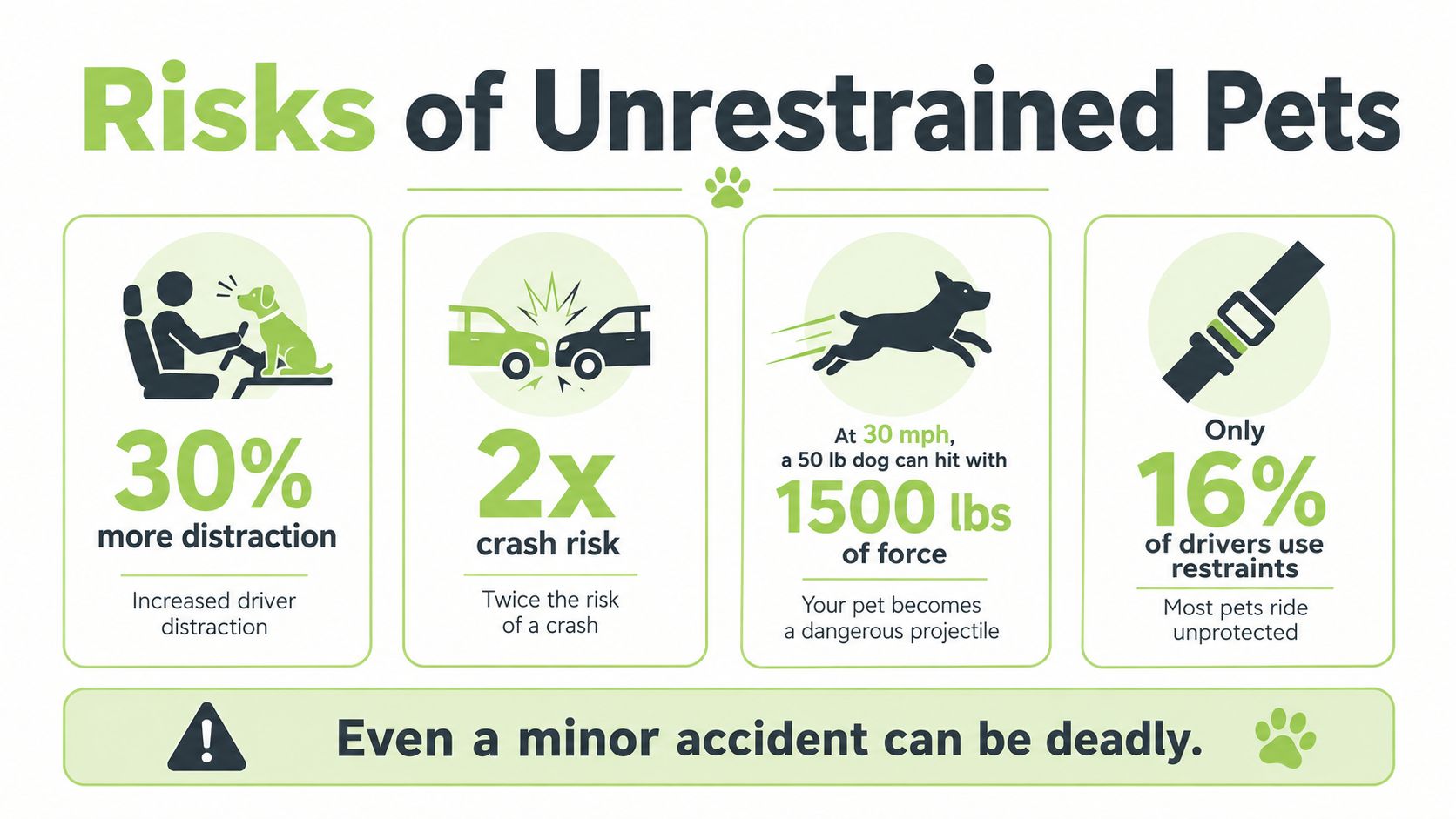
A loose dog in the car creates risk before the vehicle even reaches highway speed. In the AAA/Kurgo survey, 84% of dog owners who travel with their dogs said they do not use any restraint, while only 16% reported using some form of restraint, and 83% agreed that an unrestrained dog in a moving car can be dangerous (Kurgo dog travel statistics). That gap between what owners know and what they do is where most of the danger starts.
Loose dogs create two problems at once
The first problem is distraction. A peer-reviewed U.S. study on driving with pets found that drivers with pets in the vehicle had a collision rate of 4.9 per million person-miles versus 5.1 for drivers without pets, but the broader analysis still found that those who drove with pets were 16% less likely to have an at-fault collision on their record when comparing pet owners who did and did not drive with pets, which points to transport method as the issue, not pet ownership itself (peer-reviewed study on driving with pets). In practical terms, a loose dog is still a moving distraction inside the cabin, and that is enough to pull attention away from braking, mirrors, and lane position.
The second problem is impact physics. Volvo Car USA and Harris Poll reported that when pets were allowed to move freely, dangerous driving events more than doubled, with 649 occurrences versus 274 when pets were secured, and driver distraction time rose to 3 hours 39 minutes compared with 1 hour 39 minutes when restraints were used (Volvo Car USA and Harris Poll study). That is the kind of difference that turns a normal trip to the park into a preventable mess.
The worst positions are easy to spot
A dog on the lap, in the front seat, or roaming between seats can interfere with steering, braking, and airbag safety. The CDC says dogs riding on a seat should be in the back seat in a harness attached to the seat buckle, and it says crate setups should allow the dog to move normally inside the crate while the crate stays well ventilated and secured. For a closer look at crate sizing and vehicle fit, best dog crate for car travel is a useful starting point. The practical rule is simple, if the dog can get into your driving space, the setup is wrong.
An unrestrained dog does not have to cause a crash to make the drive unsafe. It only has to distract you at the wrong time.
The standard worth using every trip is whether the setup keeps the dog from becoming a projectile, a lap sitter, or a driver distraction. That question matters more than whether the dog seems comfortable for the first few minutes. Small breeds often do best when they are contained low and steady, while larger dogs need more structure so they do not shift hard under braking. Brachycephalic dogs and heat-sensitive seniors need extra attention as well, because they can struggle faster in a warm cabin with weak airflow, and multi-dog households need separation that matches size and temperament rather than whatever fits next to the cooler. After long trips, cleanup can be part of safety too, and expert dog hair removal tips can help once the ride is over, especially if you travel with heavy shedders.
Comparing Restraint Options for Different Dog Sizes
Different vehicles force different trade-offs. A compact sedan, a three-row SUV, and a pickup all change what safe looks like, so restraint choice should follow the vehicle, the dog's body type, and how much movement the dog needs to stay comfortable on the road. The safest setup is often the least flexible one, because it keeps the dog controlled during hard braking and sudden turns.
A tiny dog and a sprawling senior Labrador do not need the same arrangement. A toy breed that likes to curl up may do well in a secured carrier or a booster-style seat that is anchored properly, while a medium dog often needs a crash-tested harness or a secured crate that gives enough room to lie down without sliding around. Larger dogs usually need more structure than a simple tether can provide, especially on longer drives where shifting weight becomes tiring for the dog and distracting for the driver.
Side by side trade-offs
| Dog Size | Best Option | Pros | Cons |
|---|---|---|---|
| Toy and small breeds | Secured carrier or booster-style seat with tether | Easier to contain, less wandering, calmer for nervous dogs | Must be anchored correctly, not just placed on the seat |
| Medium breeds | Crash-tested harness or secured crate | Good balance of control and comfort | Harnesses must be vehicle-rated, crates need space |
| Large breeds | Anchored crate or crash-tested harness in back seat or cargo area | Better stability, fewer front-seat intrusions | Cargo area needs rigid containment, not a loose barrier |
The back seat is usually the cleanest place for restraint systems that use seat belts or tether points. Cargo-area transport can work for larger dogs, but only when the crate is anchored and the setup keeps it from sliding or tipping. Cornell's guidance on choosing a secure crate for vehicle travel lines up with what works in real cars, the crate has to fit the dog, stay ventilated, and stay put. That matters even more with loose-hatched SUVs and pickup setups, where a crate can look stable until the first hard stop.
Brachycephalic dogs need extra caution because airflow and heat build up against them faster than many owners expect. A French Bulldog riding in a warm cabin with weak ventilation has a very different risk profile from a short-coated terrier in the same seat, and the restraint choice should reflect that. Heat-sensitive seniors and puppies also do better when they can settle without being pressed against hot upholstery or shoved by another dog.
Multi-dog households need separate decisions
Two dogs are not one gear choice. If they ride loose together, they can tangle, crowd each other, and turn a manageable stop into a full-body scramble. Separate crates or separate secured positions usually work better, because each dog needs its own space to settle and its own way to be restrained if traffic changes fast.
A barrier can help reduce front-seat access in larger vehicles, but it should be treated as a boundary rather than a crash system. That distinction matters in older cars and in pickup trucks, where cargo setups can tempt owners to rely on convenience instead of real containment. A good setup is the one that still makes sense if you brake hard on wet pavement, or if one dog decides the other dog's crate is the best place to lean.
Rule of thumb: if the dog can shift into another dog's space during braking, the arrangement still needs work.
For households that travel with a heavy-shedding dog, the cabin protection side matters too. Seat covers and cargo liners will not make a setup safer, but they do make it easier to keep the restraint system usable instead of burying it under fur and dirt. If you want a practical example of cleanup-focused gear that pairs with travel routines, Pet Magasin's Dog Car Seat Cover - Hammock Style is one option designed to protect the back seat from fur, muddy footprints, water, and clawing damage. For a closer look at cleanup after the drive, expert dog hair removal tips can help once the trip is over.
Training Your Dog for Stress-Free Car Rides
A dog that dislikes the car can still learn to settle in it. Short, calm exposures usually work better than one big test drive, because nervous dogs respond to repetition without pressure. The aim is to make the vehicle feel routine before you expect it to work for a long haul, a vet visit, or a family trip with extra stops.
Build comfort in small steps
Start with the parked car, then move to a few minutes with the engine running, then take a short drive around the block. That gradual approach matches ASPCA travel safety tips, and it tends to work well with puppies and anxious adults alike. If the dog starts panting hard, whining, pacing, or drooling, end the session early and keep the next one shorter and calmer.
Food timing matters more than many owners expect. Feed before the drive only if there is enough time for the dog to settle, and avoid feeding a dog that is already moving, because motion sickness can worsen quickly once the stomach is unsettled. For dogs with a known nausea pattern, a lighter meal schedule and a clean, upright position in the back seat usually work better than a full bowl right before departure.
If the trip is long, break the training into the same pattern you plan to use on the road. A puppy riding to a park across town does not need the same pacing as an older dog preparing for several hours of interstate travel. Match the practice run to the trip type, then build from there.
Adapt for heat, age, and body type
Brachycephalic dogs need extra caution because heat and airflow problems stack up fast. The ASPCA notes that short-snouted dogs like Pugs and French Bulldogs can succumb to heat exhaustion faster than other breeds, so I avoid midday travel and do not trust “it is only a short stop” logic with them. Senior dogs usually need the same kind of respect, since stiffness, anxiety, and temperature sensitivity can show up in the car.
Small dogs often do well in raised, secured seats when the unit stays stable, while larger dogs usually settle better when they can lie down without sliding around. Multi-dog households need even more planning, because one dog leaning into another can trigger crowding, tension, and a mess of tangled leashes or shifting bodies. The key is safe containment, not whether the dog gets a view.
For dogs that calm down only when they can look outside, a window-facing setup can still work if the restraint is solid and the position does not encourage jumping or twisting. I have found that some dogs relax once they can see movement, while others get more keyed up and stare at every passing car. Watch the individual dog, then adjust the setup instead of assuming one arrangement fits every breed or every road trip.
Calm is a skill you can teach. It usually starts with repetition, not a long haul to the beach.
For more behavior-specific troubleshooting, the guide to car sick puppy is worth reading before you plan a long trip with a young dog or one that has had a rough ride before.
Emergency Preparedness and Legal Considerations
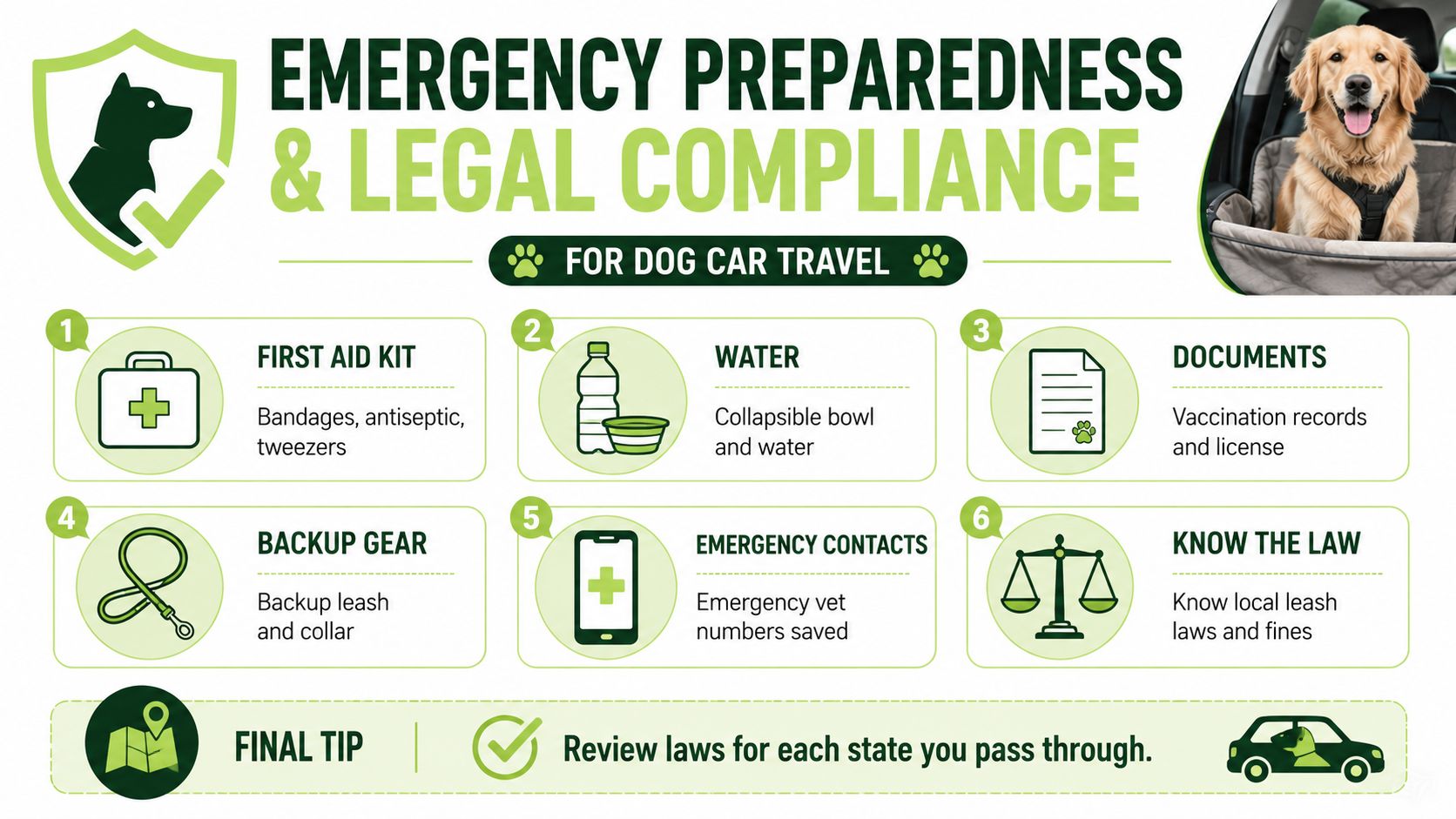
A road trip can go sideways fast when a dog starts panting hard, a leash slips, or traffic stretches a quick stop into a long wait. I plan for those moments before I leave, because a cooler, water, basic first-aid supplies, and a backup restraint are much easier to use from the start than after the problem has already escalated. Local restraint rules matter too, since requirements can change from place to place and it is far simpler to sort them out at home than after a roadside stop.
Keep the kit simple and ready
I keep a first-aid kit, water, a collapsible bowl, a backup leash, and current ID in the car because those items handle the most common problems without a scramble. For dogs that travel poorly, I also like to have a towel, paper towels, and a spare layer of bedding, since small messes can become a real comfort issue on long highway runs. The ASPCA also recommends travel records, grooming supplies, medication, and a first-aid kit, along with food and water for the trip itself (ASPCA travel safety tips).
Size and body shape matter here. A toy dog may need a smaller carrier or booster-style setup so it does not slide around, while a large breed often does better with enough floor or crate space to lie down fully without being tossed by every turn. Brachycephalic dogs need extra caution, because heat and stress can build quickly, and a multi-dog load needs separate handling so one anxious dog does not crowd or tangle another. If you're crossing state lines, check the rules in advance, because restraint, transport, and pet-entry requirements can differ.
For the human-seat side of trip planning, a practical overview of car seat laws for travel helps keep the whole vehicle organized, especially when pets and passengers share the same trip. It is not only about avoiding tickets, it is about keeping people and dogs in their own safe space when the ride gets rough.
Never treat parked-car waiting as safe
The CDC warns never to leave a pet alone in a parked vehicle because temperatures can rise quickly enough to cause death on hot days, while cold weather can also be fatal (CDC parked vehicle warning). I do not make exceptions for “just a minute,” and neither should anyone planning real dog car travel safety.
If the trip includes a long stop, take the dog with you or have another adult stay with the vehicle and the pet. Heat stress deserves special attention in short-snouted breeds, senior dogs, and dogs that already arrive at the car anxious or panting. If the dog gets carsick or overheats, pull over, offer water, and reset before continuing. Prepared owners pack gear and build a plan that still works when traffic, weather, or the dog itself changes the schedule.
Pet Magasin offers travel-focused pet supplies that fit the way real road trips happen, including a Dog Car Seat Cover - Hammock Style for back-seat protection and a foldable pet carrier for smaller pets. If you're tightening up your setup for safer drives, visit Pet Magasin and look for gear that helps keep your dog contained, comfortable, and easier to manage on the road.

Leave a comment