
Dog Travel Bag on Wheels: The Complete 2026 Guide

You've just reached a crowded airport terminal with a small dog on one shoulder, a rolling suitcase in one hand, boarding passes between your teeth, and a leash somehow tangled around everything. The walk to the gate feels longer with every step. Security adds another awkward handoff, and you keep checking whether your dog is sitting comfortably or being pushed against one side of the carrier.
A dog travel bag on wheels can solve one part of that problem by giving the carrier its own rolling base. It can reduce shoulder strain, steady the pet compartment, and make long walks across smooth floors easier. It can also add weight, bulk, and airline-compliance problems if you choose one without checking the details. The right decision depends on the full trip, not just whether the bag rolls.
The Airport Moment That Started the Search
The traveler in the terminal doesn't necessarily need a larger carrier. They need better weight distribution. A soft carrier hanging from one shoulder pulls sideways as the dog shifts, while the suitcase occupies the other hand and the leash creates another point of tension. Every turn through the crowd becomes a small balancing exercise.
A wheeled bag changes that arrangement. The carrier rests on a frame, and a telescoping handle lets the traveler pull it along smooth ground. The dog still needs to remain secured inside, but the enclosure no longer swings against the owner's body with every step. That difference matters during a long terminal transfer, especially for someone managing other luggage or dealing with back and shoulder discomfort.
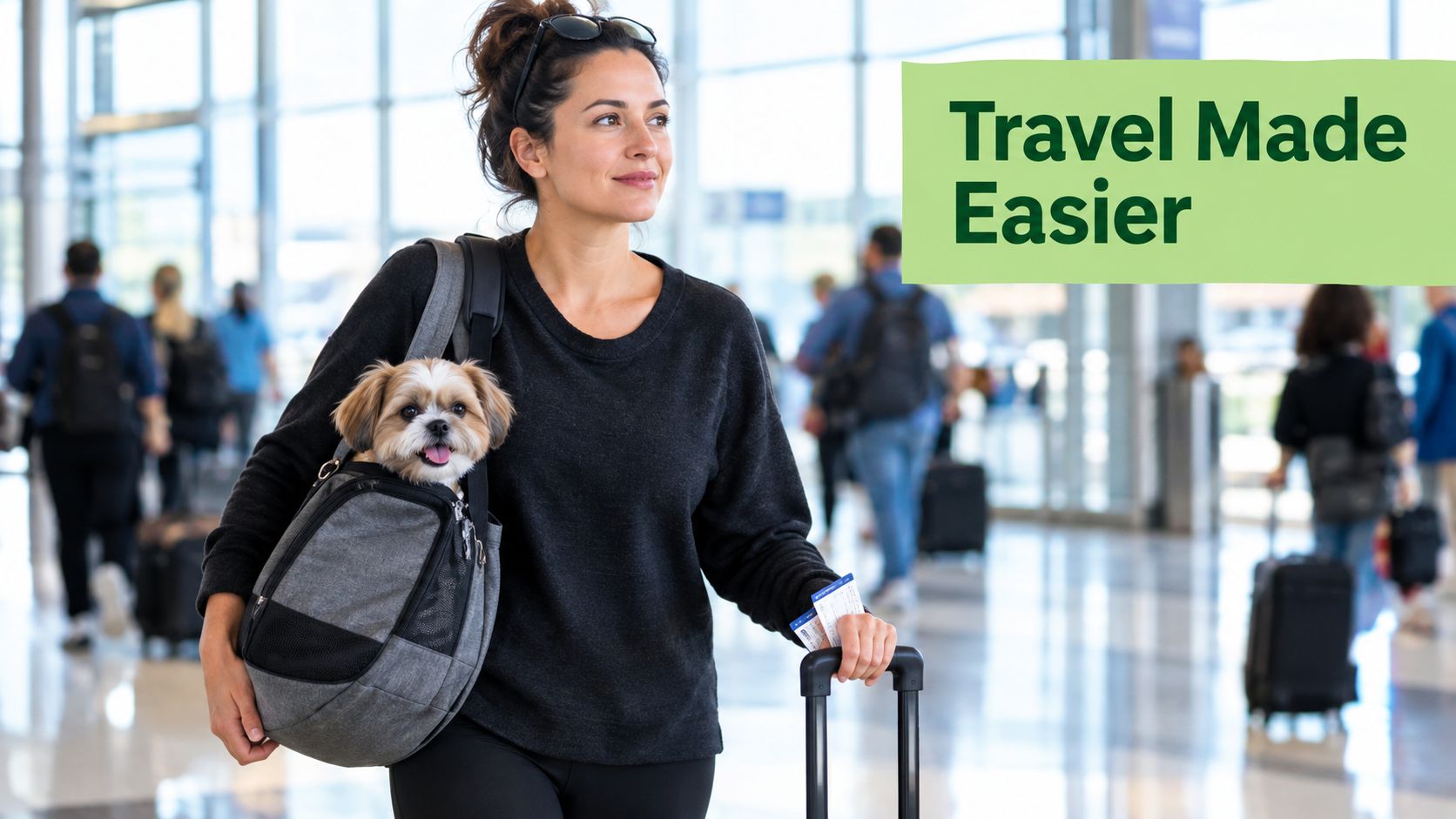
The benefit is most obvious on flat, continuous surfaces. Airport concourses, station platforms, hotel corridors, and paved sidewalks let the wheels do their intended job. Stairs, escalators, rough paving, and tightly packed aisles tell a different story. There, the frame becomes something you must lift or maneuver rather than just tow.
Airline rules make the choice more complicated. On U.S. flights, the U.S. Department of Transportation's pet travel guidance explains that a cabin pet container is treated like carry-on baggage and must fit beneath the seat in front of you. The FAA requires it to stay properly stowed during taxi, takeoff, and landing. A wheeled model therefore has to work as a compact cabin carrier before it works as rolling luggage.
That tension defines the category. You're not just buying a suitcase for a dog. You're choosing a mobile enclosure that must balance pet comfort, airline clearance, rolling stability, and the terrain of the trip.
What a Dog Travel Bag on Wheels Is
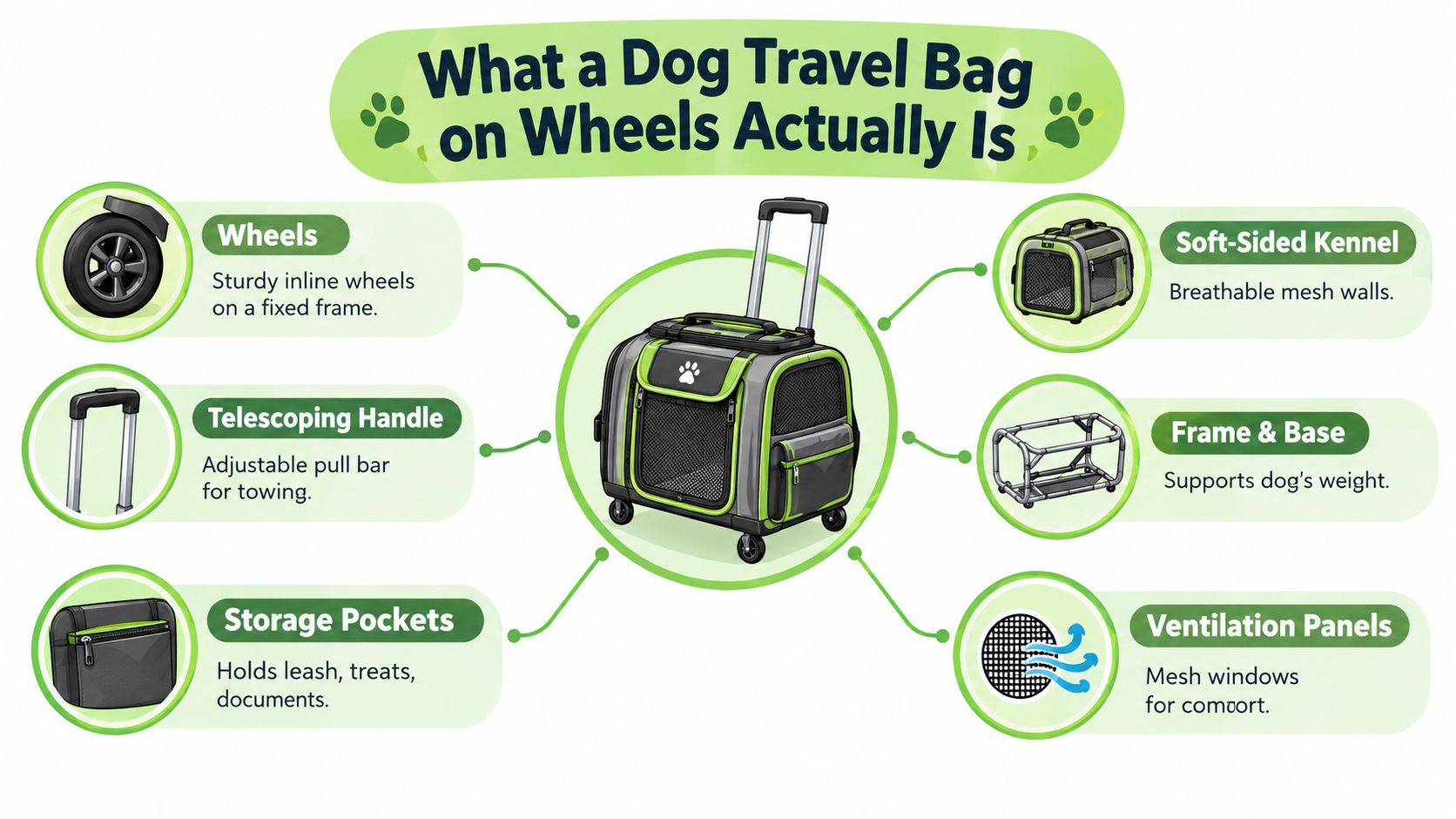
A dog travel bag on wheels is a soft-sided pet carrier mounted on a rolling frame. It combines a fabric enclosure for the dog with luggage-style hardware for moving across the ground. That combination creates two separate jobs: the bag must provide a secure, comfortable space, while the frame must carry its load without making the enclosure sway or collapse.
Start with the base. Most designs use a stiff board or framed platform with two inline-style wheels, though layouts differ. The platform supports the dog's weight and keeps the floor from folding inward. The wheels control how the carrier tracks over a surface. A low-profile or removable wheel system can help when the bag must fit beneath an aircraft seat, but the reduced hardware may affect stability or rolling comfort.
The telescoping handle transfers your pulling force to the frame. It should lock at a usable height and stay steady under load. If it flexes, leans, or rattles, each change in direction can jolt the dog's compartment. The mechanical guidance for wheeled pet carriers describes axle-mounted wheels with sealed bearings, a comfortable handle range of 90 to 100 cm, and carrier use for pets around 8 to 15 kg. Treat those figures as product guidance, not a universal rule. The dog's weight, the bag's weight, and the frame's stated rating all need to fit together.
The enclosure is the dog's space during transit. Mesh panels provide airflow and visibility, while a zippered front or top opening gives you access for loading and checks. An interior tether should connect to a harness, not restrict the neck. Reinforced seams and a flat base help the carrier keep its shape while you pull it through a terminal or lift it over an obstacle.
Three carrier types that look similar
An under-seat cabin carrier gives priority to compact dimensions and flexible construction. A cargo-style rolling crate provides more rigid protection and may suit larger animals, but it generally is not built to slide beneath a passenger seat. The hybrid wheeled travel bag occupies the middle ground, pairing a soft cabin-style enclosure with a frame for ground travel.
Most bags in this category suit small dogs that can lie down, turn around, and settle without being compressed. Measure the dog and the interior rather than relying on breed labels or weight alone. A long-backed dog may need more floor length than a shorter, heavier dog.
Practical rule: Treat the wheels and handle as transportation hardware, not as proof that the bag qualifies for cabin use.
Key Features That Separate a Good Wheeled Carrier from a Frustrating One
A product page can make almost any carrier look convenient. The useful question is how each component behaves when the dog is inside, the terminal is crowded, and the bag must be stored beneath a seat.
The five pillars to inspect
| Feature Pillar | What to Look For | Real Tradeoff |
|---|---|---|
| Size and capacity | Enough room for the dog to stand, turn, and lie down, with a firm internal floor | More interior room can make under-seat fit harder |
| Wheels and handle | Stable wheels, protected axles, sealed bearings, and a handle that locks at useful heights | Better hardware usually adds weight |
| Airline compatibility | Soft construction, a leak-resistant or leakproof base, collapsible sections, and published dimensions | A reinforced frame may reduce flexibility |
| Ventilation | Mesh on multiple sides, clear airflow paths, and zippers that don't block the panels | More mesh can reduce insulation and structural stiffness |
| Durability and safety | Reinforced seams, locking zippers, a stable base board, and a secure interior tether | Stronger materials can make the bag heavier |
Size comes first. A dog shouldn't have to crouch continuously or curl tightly because the wheels consumed usable interior space. Measure the inside dimensions, not only the outside dimensions, and check whether the frame, handle housing, or wheel guards reduce the floor area.
Wheel and handle quality determines control. A carrier that tracks straight on smooth flooring is easier to manage than one that fishtails when you turn. Test the handle at more than one height. It should lock without excessive play and stay aligned when you pull.
Airline compatibility requires more than a marketing label. The U.S. Department of Transportation notes that airlines can impose their own restrictions, while travel guidance identifies requirements such as water-resistant material, mesh ventilation, and a leakproof base. The bag must retain enough shape to protect the dog, yet compress enough to meet the available clearance.
Ventilation needs placement, not just a mesh window. Panels on the upper sides can help air move through the enclosure while allowing the dog to see out. A solid front combined with small side openings may feel enclosed, especially in warm terminals. At the same time, a carrier made almost entirely of mesh may offer less protection from drafts and accidental contact.
Safety hardware is easy to overlook. Check the zipper pulls, stitching at the handle connection, base-board edges, and tether attachment. The tether should prevent an escape when the door opens, but it shouldn't be used to drag or suspend the dog. A washable liner is also more practical than a permanently fixed interior after a travel accident.
The best design is therefore a compromise. Light construction is easier to lift, but heavy-duty wheels roll better. More frame support improves stability, but may make the bag fail an under-seat measurement. More ventilation improves airflow, but may leave less fabric for structure and insulation.
How Airline Rules Shape Your Choice
At the airport check-in desk, a wheeled carrier can fail for a simple reason: its outside measurements do not fit the aircraft's under-seat space. Cabin layouts vary, so a bag accepted on one route may be refused on another, even if its product page says “airline approved.” Treat that label as a design description, not a boarding guarantee.
Use these airline pet carrier size requirements as a starting point, then verify the operating airline's current policy. Delta recommends a soft-sided kennel around 18 x 11 x 11 inches, as stated in its official pet policy. American Airlines lists soft-sided carrier dimensions of 18 x 11 x 11 inches and limits the combined pet-and-carrier weight to 20 pounds, according to its official pet policy. JetBlue gives a smaller example, 17 x 12.5 x 8.5 inches, for an FAA-approved under-seat carrier in its pet travel policy.
| Airline | Max Length (in) | Max Width (in) | Max Height (in) | Max Carrier + Pet Weight (lbs) |
|---|---|---|---|---|
| Delta | 18 | 11 | 11 | Check with airline |
| American Airlines | 18 | 11 | 11 | 20 |
| JetBlue | 17 | 12.5 | 8.5 | Check with airline |
These limits reveal the main wheeled-carrier tradeoff. Wheels, axles, frame pieces, and the handle housing occupy the same limited clearance as the dog's compartment. A removable or low-profile wheel assembly may simplify measuring, but taking the wheels off does not promise acceptance. The airline assesses the complete carrier and the pet inside it.
Rules also cover booking and eligibility. Southwest permits one pet carrier per ticketed customer, with up to two small cats or dogs in that carrier, under its official pet policy. JetBlue allows up to two pets per traveler, subject to its carrier requirements. Allegiant charges a non-refundable $50 per segment per carrier and requires pets to be at least 8 weeks old, according to its official pet policy.
Before you buy: send the operating airline the carrier's outside dimensions, wheel configuration, and combined weight. Ask about your exact aircraft and route. A general policy page may not answer whether your particular bag fits that flight.
International and cargo travel follow different handling categories. Air Canada requires cargo handling for carriers exceeding 45 kg (100 lb) or 292 cm (115 in) in linear dimensions, and Delta has specific conditions for carrying two same-breed, same-size pets in one kennel. Those rules sit outside a typical small-dog cabin trip, yet they show why route-specific confirmation matters.
A service-animal policy does not provide a shortcut for an ordinary pet in a bag. Service animals follow separate airline and accessibility rules. A pet carrier remains subject to cabin-pet requirements, so confirm the booking conditions before arriving at the airport.
Wheels, Backpacks, and Shoulder Bags Compared
The smooth terminal is where a wheeled carrier makes its strongest argument. You can pull it beside you instead of keeping the dog's full weight against your back or shoulder. The advantage weakens as soon as the route includes stairs, broken pavement, tight turns, or a crowded aisle where the frame can't follow cleanly.
A backpack offers a different kind of mobility. It keeps both hands available and handles stairs well, but it transfers the load to your shoulders and back. A shoulder bag is simpler and lighter, yet it concentrates the dog's weight on one side and usually suits only very small dogs. No format wins every trip.
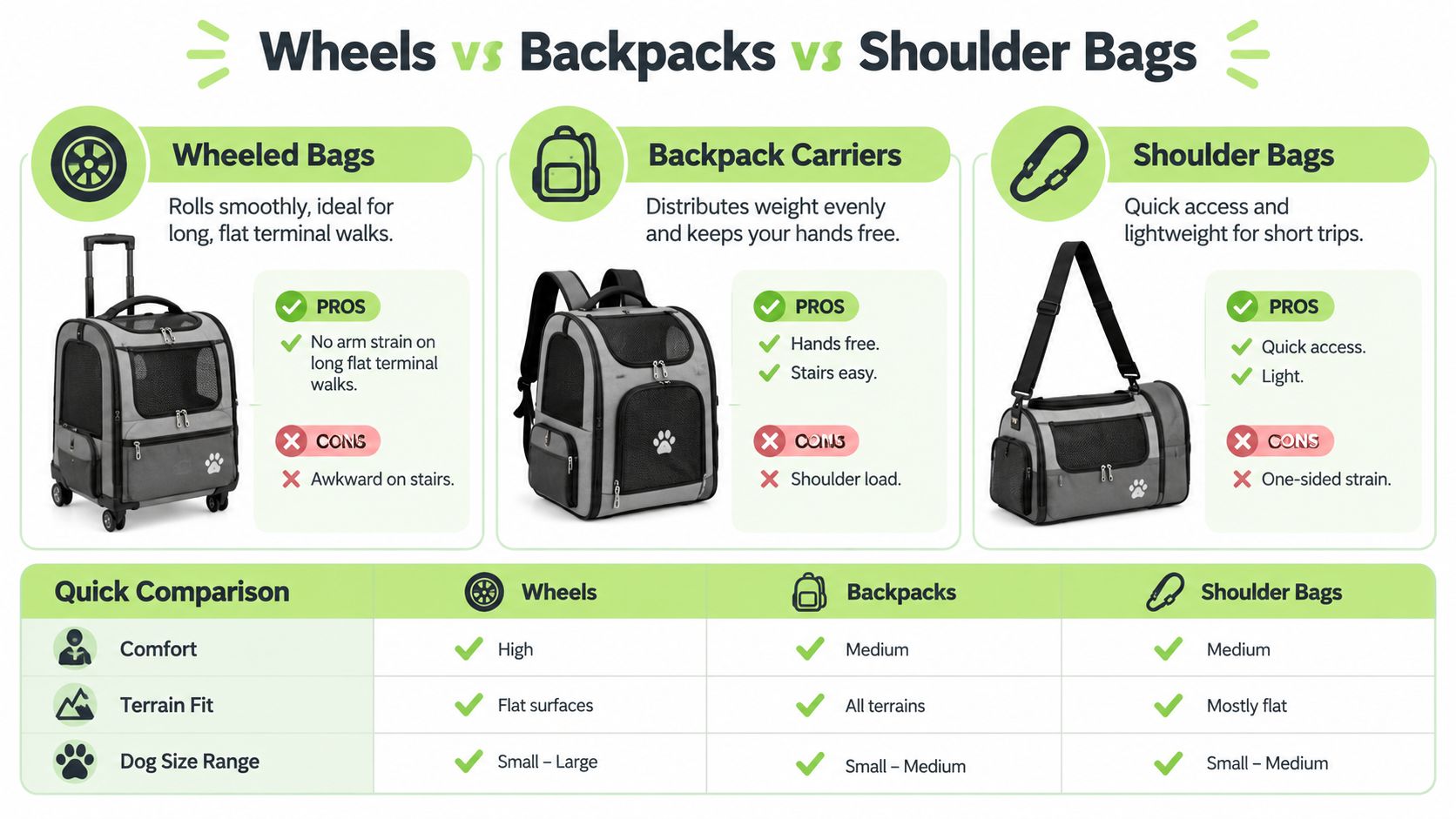
| Carrier style | Best setting | Main advantage | Main limitation |
|---|---|---|---|
| Wheeled bag | Airports, train stations, hotel corridors | Removes much of the carrying load on flat ground | Awkward on stairs and rough surfaces |
| Backpack | Hikes, stairs, crowded streets | Keeps both hands free | Places the load on the wearer and can reduce airflow against the back |
| Shoulder bag | Short café visits and quick errands | Light and easy to access | Creates one-sided strain and suits smaller dogs |
The choice also depends on the owner. An older traveler or someone with shoulder pain may gain more from a roller than a younger traveler who can comfortably carry a backpack. A dog that stays calm when the carrier moves beside the owner may adapt well to wheels. A dog that becomes unsettled when the carrier slides behind it may need a closer, body-worn design.
For a broader look at carrying formats, compare the practical differences in this guide to a pet travel carrier backpack. If you're also comparing rolling luggage for work travel, the design principles behind wheeled bags for business trips can help you evaluate handle stability, storage access, and wheel placement, though a pet carrier has additional ventilation and safety requirements.
Use the video below as a visual reference for handling and carrier movement, then test the product on the terrain you expect to encounter.
A roller is usually the practical choice when most of the trip takes place on smooth floors. A backpack is more versatile when stairs and uneven streets dominate. A shoulder bag remains useful for short outings where low weight and quick access matter more than all-day comfort.
Measuring Your Dog and Packing the Bag
A carrier can meet an airline's outer dimensions and still be wrong for your dog. Measure while your dog is standing naturally on a flat surface, not while curled up in a favorite sleeping position.
- Measure length. Run the tape from the front of the chest to the base of the tail.
- Measure width. Find the widest point across the shoulders or body.
- Measure height. Measure from the floor to the top of the shoulders.
- Add working room. Add 2 inches to each measurement as a practical minimum for the interior.
- Check weight. Weigh the dog, then account for the blanket or bed that will travel inside.
- Compare the total. Match the combined load to the carrier's stated capacity and frame rating.
The dog measurement guide for airline carriers can help you repeat the process before ordering. Don't rely on a small, medium, or large label. Those labels vary widely between manufacturers.
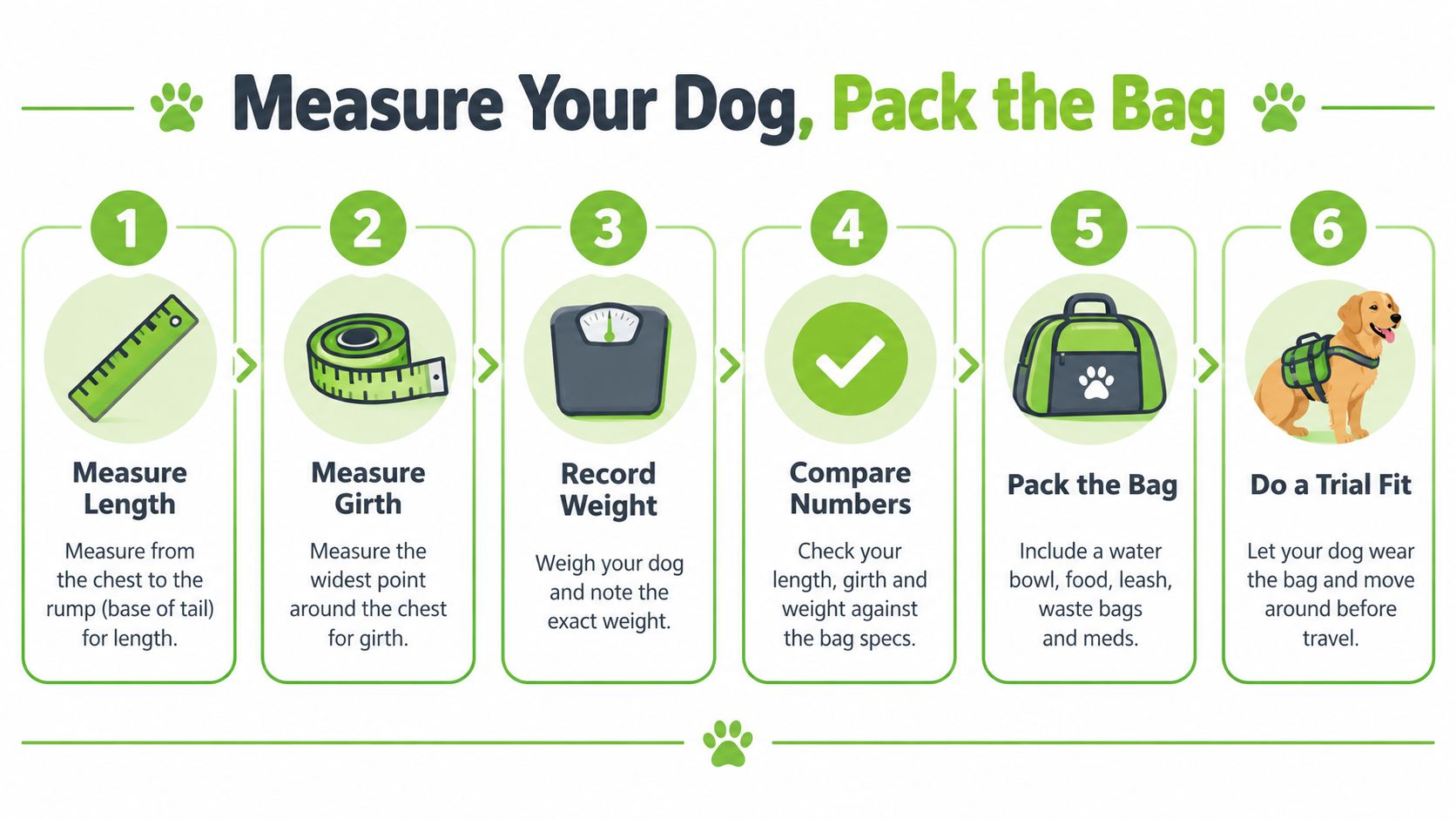
Pack for access, cleanliness, and calm. A two-hour flight with a 12-pound terrier might call for a folded pee pad beneath a small bed, a collapsible water bowl clipped to the mesh door, vaccination records in a side pocket, and treats in the top pouch. Keep the dog's area clear enough to turn and settle, and put frequently needed items outside the enclosure.
Do a trial fit at home. Zip the dog inside for a short period, roll the bag across the floor, stop, turn, and lift it over a threshold. Watch whether the dog can change position and whether the carrier stays balanced when the handle is extended.
A carrier should be tested as a moving space, not judged as an empty bag on a shelf.
A Simple Pre-Purchase Checklist Before You Click Buy
Product pages often show a dog sitting happily beside a polished suitcase. That image doesn't tell you whether the bag fits beneath your aircraft seat, rolls straight, or survives a wet accident. Use the specification sheet as your primary evidence.
Run these checks in order
- Confirm the airline limits: Check the operating carrier's current dimensions, weight rules, pet restrictions, and aircraft requirements before adding the bag to your cart.
- Measure the dog: Record length from collar area to tail base and height from the floor to the shoulders, then compare those figures with the usable interior.
- Check the complete footprint: Include wheels, frame, handle housing, and any rigid base when comparing the carrier with under-seat space.
- Inspect the rolling hardware: Look for protected axle housing, stable wheel attachment, smooth tracking, and a handle that locks without leaning.
- Review airflow: Confirm that mesh panels provide meaningful ventilation on at least two sides and aren't blocked by internal padding.
- Examine the base: A removable, washable liner makes cleanup far easier than a fixed fabric floor.
- Check containment: Look for secure zippers, reinforced seams, and an interior tether that attaches safely to a harness.
- Test the weight: Add the dog, carrier, bedding, and travel items before comparing the result with the airline and product limits.
Lifestyle photos show how a carrier looks. A spec sheet shows whether it can do the job.
If the listing hides exterior dimensions, interior dimensions, wheel construction, or weight capacity, ask the seller for those details. When possible, test-roll the bag in a store and check how it behaves during a turn, over a small threshold, and with the handle at your natural height.
When a Rolling Carrier Is Worth It and When to Skip One
Return to the airport scene. If your trip includes a long terminal walk, a train transfer, and a hotel corridor, a roller can remove repeated lifting from the day. It makes the most sense for owners of small-to-medium dogs who travel regularly, spend substantial time on flat ground, or manage shoulder and back discomfort.
The category also has clear limits. Skip a wheeled carrier when a very small toy dog already travels comfortably in a light backpack, or when the route centers on hiking, stairs, cobblestones, and uneven sidewalks. Wheels catch on seams, and the frame adds bulk you may have to carry.
A nervous dog deserves special consideration. Some dogs settle better when held close to the owner, while others prefer a stable enclosure that moves beside them. Test the response before the trip rather than discovering at the gate that the rolling motion makes your dog anxious.
The right bag isn't the one with the most features. It's the one whose dimensions, structure, rolling behavior, and carrying options match the dog and the actual route.
Pet Magasin offers soft-sided pet travel carriers with carrying handles, padded shoulder straps, and mesh ventilation windows, giving you another format to compare when wheels aren't ideal for the journey. Visit Pet Magasin to review travel carriers and practical pet-care supplies before choosing the setup your dog will use.

Leave a comment