


How to Measure Dog for Airline Carrier Fit Guide

You're probably here because the carrier you bought says “airline approved,” your dog fits in it at home well enough, and yet you still don't feel sure. That instinct is good. At the airport, I've seen plenty of carriers that looked fine in the living room but turned into a problem at check-in because the dog couldn't stand comfortably inside, or because the bag's handles, frame, or bulging sides made the outside just a little too large for the airline.
The fix is simple, but it has to be done in the right order. First measure the dog's body correctly. Then translate those body numbers into the usable interior space your dog needs. Last, measure the full outside envelope of the carrier the same way an airline agent will.
Why Measuring Your Dog Correctly Matters Before You Fly
At the airport gate, the stressful moment usually starts after the scale. The carrier label says “airline approved.” Your dog is under the posted weight limit. Then an agent asks for a fit check, and the problem shows up fast. The dog has to duck to stand, the roof presses down once the zipper closes, or the bag measures larger than expected once the handles and side bulge are counted.
That happens because airline approval has two parts, and they are easy to mix up.
One part is the dog's body. The other is the carrier's full outside envelope. A soft-sided bag can look roomy on a product page and still lose usable space inside because of padding, curved walls, a raised zipper track, or an inward-bending frame. It can also look small enough from the front, then measure too tall or too long once the feet, seams, pockets, and handles are included. Airlines check the outside. Your dog lives in the inside. Both have to work at the same time.
The body method used in IATA pet transport guidance helps because it starts with the dog, not the marketing label. Weight alone cannot tell you whether a carrier will fit a long-backed dog, a broad-chested dog, or a dog with tall ears. Two dogs can weigh the same and need very different interior space, much like two suitcases with the same weight can have very different shapes.
Why weight and breed charts fail
Breed suggestions on carrier listings are only rough guesses. “Fits Yorkie,” “good for toy breeds,” or “for pets up to 15 pounds” tells you very little about shoulder width, standing height, or how much headroom disappears once the top panel bends inward.
A better rule is simple.
Choose the carrier from your dog's measurements and the carrier's usable interior space, then confirm the carrier's full exterior size.
That is also why it helps to review the broader airline pet travel requirements for in-cabin pets and carriers before you book. Approval is a three-way match between your dog's body dimensions, the space your dog can use inside the bag, and the airline's under-seat limit measured on the outside.
Where owners get caught
The usual failure points are predictable once you know what to look for:
- The interior works, but the exterior does not. The dog can stand, yet the carrier becomes too tall or too long once handles, end panels, and bulging sides are measured.
- The exterior works, but the interior does not. The bag matches the airline's posted dimensions, but thick walls or a sloped roof steal enough space that the dog has to crouch.
- The listed dimensions are not the usable dimensions. Product measurements often describe fabric edge to fabric edge, not the actual floor area and headroom your dog gets after structure, seams, and curvature are accounted for.
That is why correct measuring matters before you buy, not after. It turns “my dog fits” into a checkable answer: enough interior room for normal posture, and a true outside size that still stays within the airline's limit.
What You Need and How to Position Your Dog for Accurate Measurements
At the airport, I often see the same problem. A dog looks like it fits the carrier at home, but the measurements were taken with the dog twisted, leaning, or half-sitting, so the numbers are too small to trust.
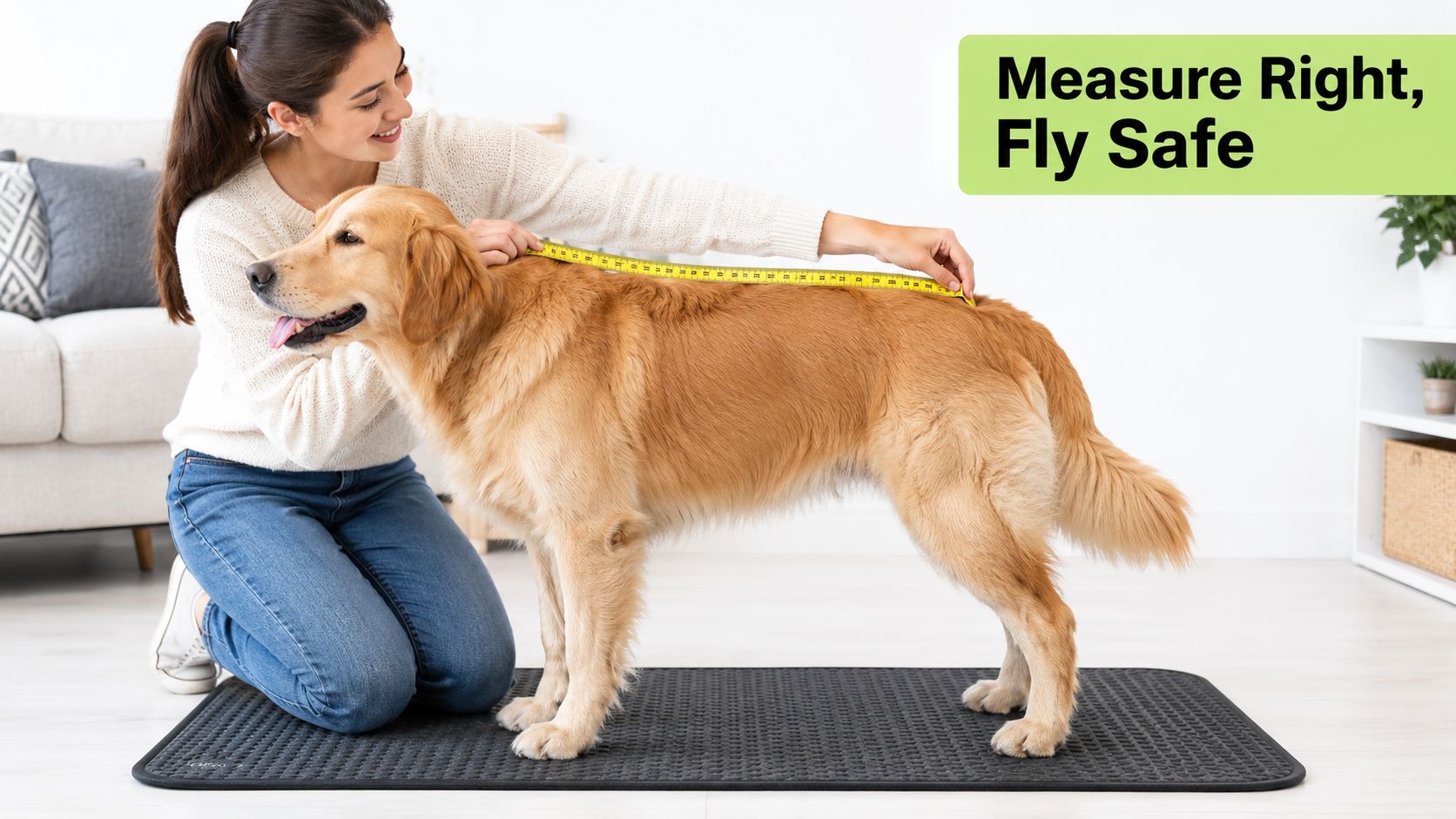
Good measurements start with a calm setup. Gather a flexible tape measure, your phone or a notepad, a wall, and a floor with grip. A bath mat or yoga mat helps if your dog slips. If another person is available, have one person steady the dog and the other read the tape. That usually gives cleaner numbers than trying to do both jobs alone.
Your dog should stand the way a passport photo works. Straight, natural, and square on all four feet. The head should be in a normal position, not lifted high for a treat and not dropped to sniff the floor. A stretched pose can add length that is not real. A crouched pose can steal the height your dog needs inside the carrier.
The four body measurements to record
Use the standard A, B, C, and D body points from IATA pet measurements guidance.
-
A is body length
Measure from the tip of the nose to the base of the tail. Stop where the tail begins. Do not measure out along the tail. -
B is leg height to the elbow
Measure from the floor to the elbow joint on the front leg. This is the bend above the paw, not the top of the shoulder. -
C is body width
Measure across the widest part of the body, which is often the shoulders or chest area. -
D is standing height
Measure from the floor to the highest natural point, usually the top of the head or the ear tip if an ear stands higher.
How to place the tape so the numbers mean something
This part trips people up.
For A, run the tape in a straight horizontal line, not over the curve of the back. If you follow the spine like a road over a hill, the number gets longer than the space your dog really occupies on the carrier floor.
For B, keep the tape vertical from the floor to the elbow. It helps to place one finger lightly on the elbow first so you do not drift up toward the shoulder.
For C, wrap the tape across the widest point without squeezing. You are measuring body width, not making the dog thinner for the chart.
For D, place the tape from the floor straight up beside the dog. Do not angle it from the chest to the top of the head. With floppy ears, use the top of the head unless an ear naturally sits higher. With upright ears, include the highest ear tip because that height still has to fit under the roof of the carrier.
A few small technique choices make a big difference:
- Keep the tape level for length and width. Tilt adds extra inches.
- Smooth thick fur with your hand. Measure the body under the coat, not the outer fluff.
- Use the tail root. Many owners stop too far forward at mid-back.
- Read the tape at eye level. Looking down from above can misread the mark.
Here is the home routine I recommend:
| What to do | Why it helps |
|---|---|
| Measure after a walk | Your dog is calmer and more likely to stand naturally |
| Use a helper with one quiet treat | Keeps the head forward without stretching the neck |
| Take each measurement twice | Confirms the tape did not shift |
| Save the numbers in inches and centimeters | Makes carrier listings easier to compare |
After the first round, let your dog reset for a minute and measure again. If one number changes, use the larger realistic reading. That gives you a safer starting point when you later compare those body dimensions to the carrier's usable interior space, not just the fabric shell.
A short visual can help if you want to see the landmarks before you start:
Stand your dog squarely on all four feet before taking any reading. A sitting measurement usually leads to a carrier that is too small.
Special cases owners ask about most
Tiny dogs can be measured on a low table if the surface is steady and non-slip. Large or nervous dogs are usually easier to measure on the floor against a wall. Long-coated dogs need the coat smoothed down first. Puppies are a separate judgment call, because a carrier that fits today may be too small by the travel date.
One more note from the gate-check side of this process. Keep your body measurements separate from the carrier measurements you will verify later. Your dog's A, B, C, and D tell you how much usable room the dog needs inside. The carrier still has to be checked on the outside too, including puffed side panels, piping, feet, pockets, and handles if they add to the airline's size envelope.
Turning Body Measurements Into the Right Carrier Size
At the airport, this is the step that often decides whether a carrier works or fails. A dog can measure small on paper and still not fit the usable space inside a soft-sided bag.
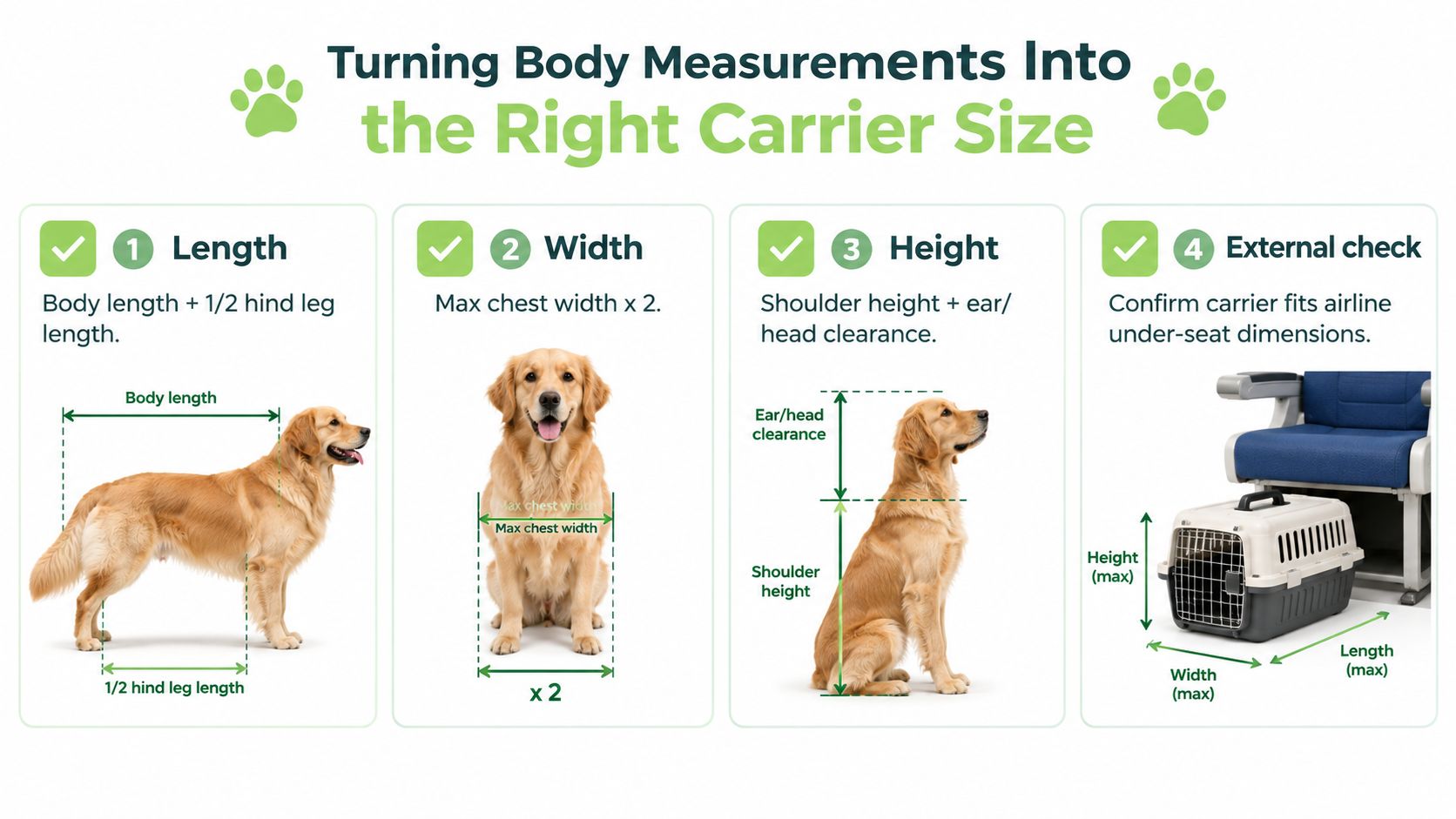
Start by converting your dog's body numbers into the minimum interior room the carrier must provide. IATA's body-fit method gives you a practical baseline:
- Length = A + 1/2 B
- Width = 2 × C
- Height = D + bedding
Those formulas are the starting point for live-animal container sizing (airline pet carrier dimension guidance).
Translate the formula into real interior space
The key word is interior.
Owners often read a product page, see a promising size, and assume the dog will have that full amount of room. Soft-sided carriers rarely work that way. The base pad takes up height. The zipper track and seam binding eat into width. The roof curves inward, so the center peak may be taller than the spot where your dog's head sits.
A good way to picture it is a winter coat pocket. The outside looks roomy, but the lining and shape shrink the space your hand can really use. Carrier measurements work the same way.
So compare your dog's calculated minimums to the usable inside space, not the outer fabric shell. If a brand provides interior dimensions, use those first. If it does not, look closely at photos of the base, sidewall shape, and roofline before trusting the listed size.
A practical sizing check is simple. Your dog should have a little clearance when lying naturally or sitting in travel posture, and snub-nosed dogs usually need more room because their breathing is less forgiving in tight spaces. That is a sizing principle, not a reason to size up blindly. The bag still has to fit the airline's outside limit.
Two quick examples
A small terrier with upright ears may need more height than owners expect, even if the body is short. A long-backed dog may fit the weight limit and still come up short on floor length, which is the measurement that matters most when the dog lies down.
That is why charts help only after the dog is measured. If you want a visual reference for comparing your numbers to common bag categories, this pet carrier size chart is a useful starting point.
The goal is correct usable space inside the carrier, with an outside shape that still stays within the airline's allowed envelope.
A simple way to judge a soft-sided carrier
Use this checklist while reading product specs or measuring a carrier at home:
- Interior floor length: Match your length calculation to the flat base your dog will lie on. Do not count extra room that exists only in the rounded end panels.
- Interior shoulder room: Check width at your dog's widest body point. Soft walls can bow inward once zipped.
- Interior standing or sitting height: Measure the lowest part of the roof above your dog's head position, not the tallest center point of an arched top.
- Bedding thickness: Include any liner, fleece pad, or absorbent layer. Even thin padding reduces usable headroom.
- Door opening shape: Some carriers are technically large enough inside, but the opening is too tight for an easy, calm entry.
This translation step matters because airline travel uses two different sizing realities at once. Your dog needs enough inside room to ride safely and comfortably. The carrier also has to pass as a compact outside object once seams, piping, bulges, and handles are all counted.
Matching Your Dog and Carrier to Airline Rules
Now you're doing the second half of the job. You already know how much interior space your dog needs. Next, you need to verify the exterior envelope the airline will measure.
Many airlines cluster near small soft-sided in-cabin limits of about 18 × 11 × 11 inches or a similar range such as 17.5 × 11 × 10.5 inches for cabin carriers, reflecting under-seat constraints across major airlines (airline dog carrier rules and size ranges). But “about” doesn't mean interchangeable, and aircraft type can change what's allowed.
Measure the carrier like an airline agent would
When you measure the carrier, set it up exactly as it will travel. Zip it closed. Insert the base pad. Extend or position the handles the way they naturally sit. Then measure the widest, tallest, and longest outside points.
That means you include:
- Handles
- Wheels if present
- Rigid frame edges
- Zipper ridges
- Side bulges
- Pockets if they don't compress flat
Chewy's airline policy guide notes that airline-relevant dimensions must include wheels, handles, rigid frames, zippers, and bulges, not just the fabric shell. It also lists specific American Airlines in-cabin limits of 18 × 11 × 11 inches for soft-sided carriers, 19 × 13 × 9 inches for hard-sided on mainline flights, and 16 × 12 × 8 inches on American Eagle flights (Chewy airline pet policy guide).
Common in-cabin carrier limits by type
| Carrier Type | Typical Size Limit | Key Fit Note |
|---|---|---|
| Soft-sided in-cabin | About 18 × 11 × 11 inches | Flexibility helps, but protrusions still count |
| Hard-sided mainline example | 19 × 13 × 9 inches | Rigid walls don't compress under seat |
| Hard-sided regional example | 16 × 12 × 8 inches | Regional aircraft can be much less forgiving |
If you're comparing hard-sided options for American Airlines specifically, the same figures are summarized in this TSA and airline carrier rules article and also appear in an American Airlines carrier size guide.
Soft-sided versus hard-sided
Soft-sided carriers are often easier for in-cabin travel because they can adapt slightly to the under-seat area. Hard-sided carriers hold shape better, but that same rigidity can make a near-fit become a no-fit.
If you're choosing between them, ask two questions:
- Can my dog stand and settle comfortably inside the usable interior?
- Can the fully assembled outside dimensions pass the airline's published limit for my exact aircraft type?
One product example in this category is the Pet Magasin TSA airline-approved pet travel carrier, which is designed for airline travel use. As with any carrier, the right choice depends on matching its usable interior and full exterior dimensions to your dog and your airline's rules.
Common Measuring Mistakes That Cause Airport Rejection
Most travel-day rejections aren't dramatic. They're small errors that stack up.
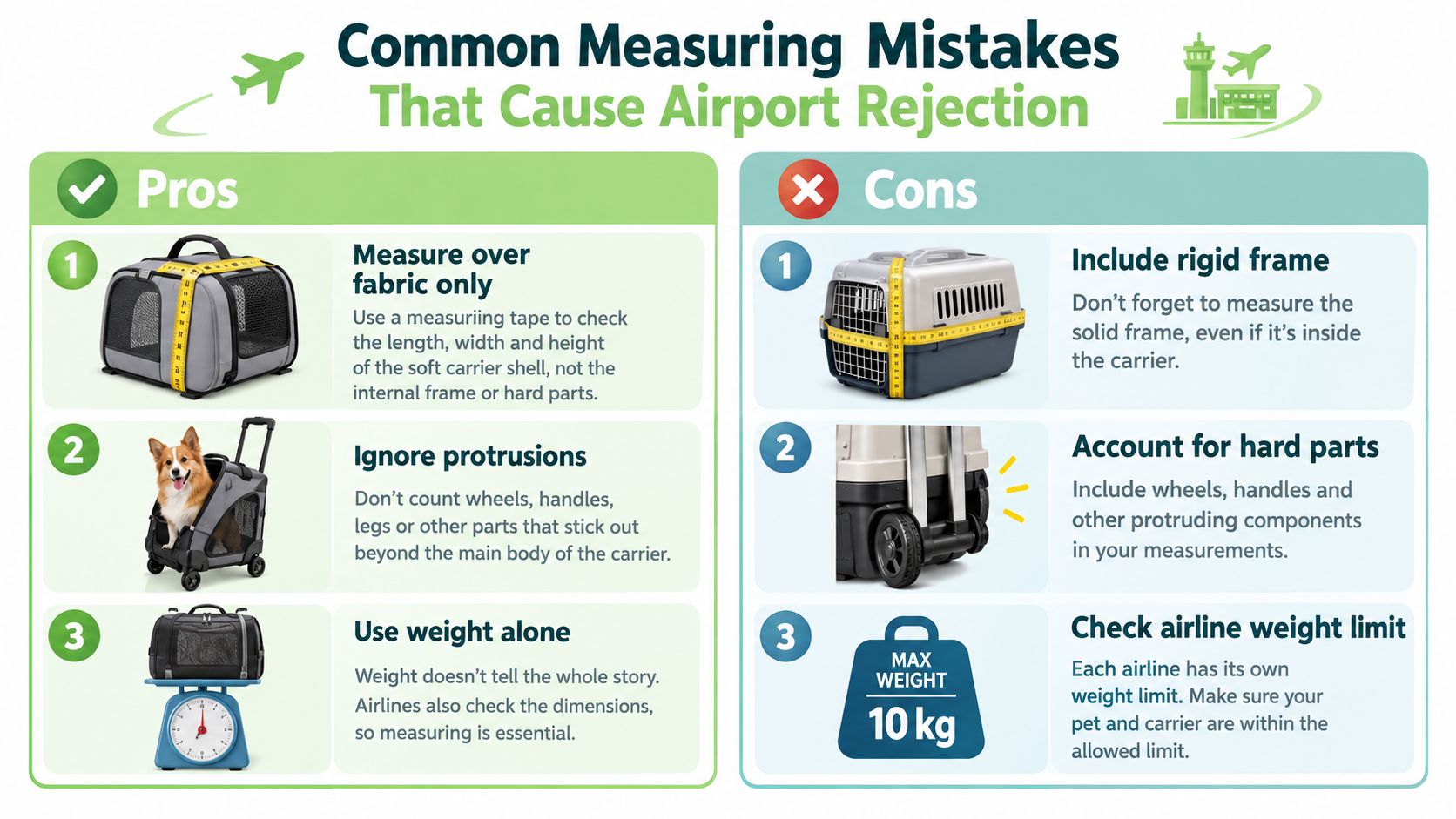
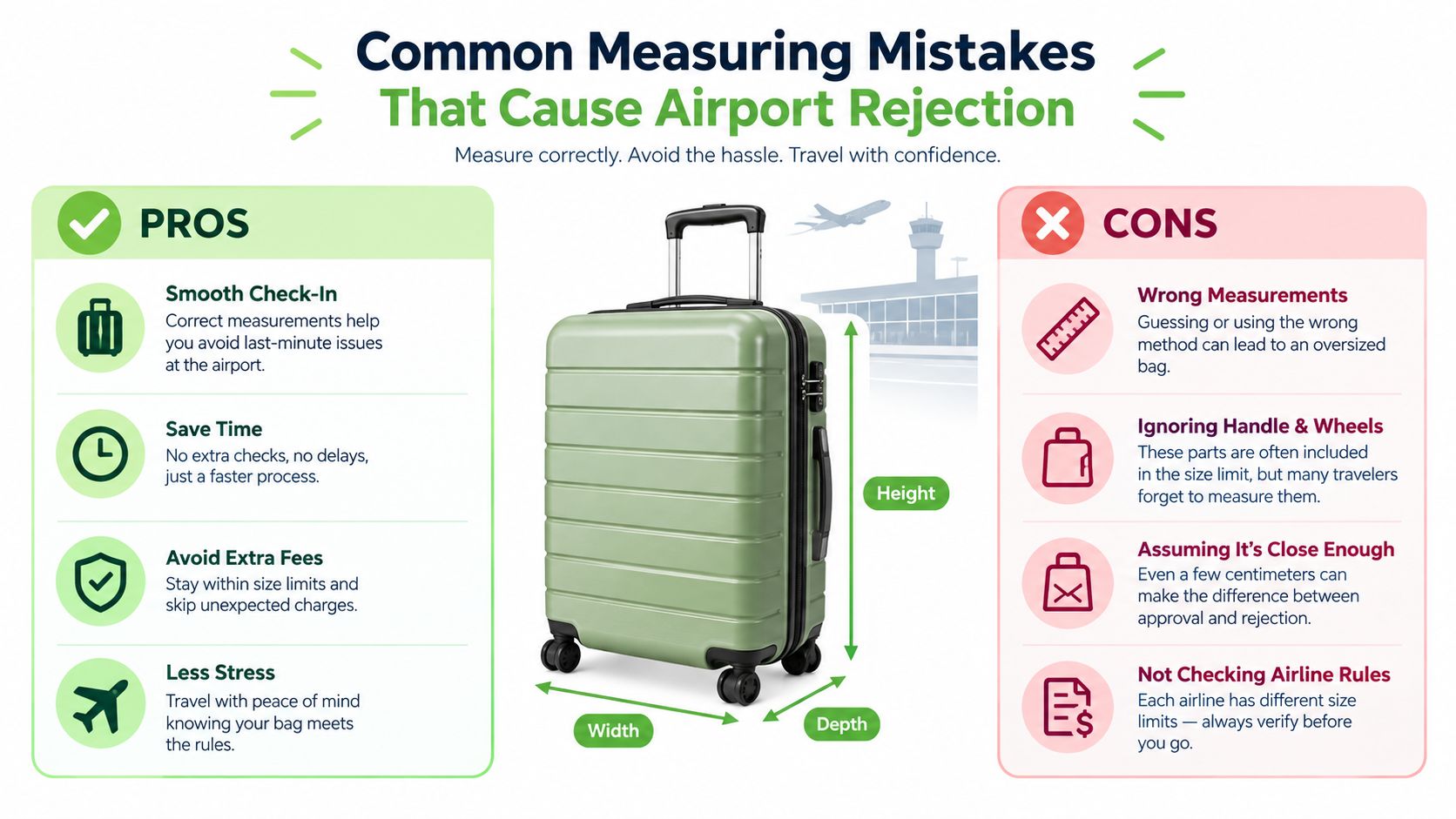
A dog was measured while sitting. The owner used the bag's marketing label instead of a tape measure. The carrier fit empty, but not once the bedding was inside. None of those mistakes feel big at home. At the airport, they matter.
The mistakes I see most often
-
Measuring only the fabric shell
Soft carriers lose usable space to seams, structure, and inward curve. Measure the inside, then verify the full outside. -
Ignoring handles and bulges
A carrier can look compliant until the top handle or end pocket adds enough height or length to fail. -
Using weight or breed alone
Industry guidance consistently points back to body dimensions because shape matters more than weight for fit. -
Measuring a lying or sitting dog
You need a natural standing posture. Anything else usually shrinks the numbers.
Two errors that catch careful owners off guard
PetTravel points out a common gap in many guides. Owners often compare their dog to a carrier's exterior dimensions, even though what the dog experiences is the interior usable space, which can be reduced by seams, mesh, and structure (interior versus exterior carrier fit).
Another issue is forgetting bedding height. If your dog barely fits standing up in an empty bag, the travel pad may remove just enough headroom to create a problem.
Check fit with the exact liner or bedding you'll use on flight day, not with an empty carrier.
A quick home self-audit
Before travel day, ask yourself:
| Question | If the answer is no |
|---|---|
| Can my dog stand without hunching? | Recheck interior height |
| Can my dog turn and settle naturally? | Recheck width and length |
| Did I measure the full outside bag, including protrusions? | Recheck exterior envelope |
| Am I using the airline's exact dimensions for my trip? | Verify aircraft-specific rules |
How to measure dog for airline carrier fit becomes practical, not theoretical. You're not chasing perfect math. You're preventing a frustrating surprise at the airport.
Final Fit Check and Travel Ready Template
When you've measured everything, keep it in one note on your phone or print it out. You want one clean record, not scraps of numbers spread across product pages and screenshots.
Simple measurement template
Use this format:
- A length: nose tip to tail base
- B elbow height: floor to elbow
- C width: widest shoulder point
- D standing height: floor to top of head or ear tip
- Minimum interior length: A + 1/2 B
- Minimum interior width: 2 × C
- Minimum interior height: D + bedding
- Clearance check: about 1 inch on all sides where appropriate
- Breed note: add extra container margin if your dog is snub-nosed
Final verification routine
Do this in order:
- Put the bedding inside the carrier.
- Have your dog enter and stand naturally.
- Check that your dog can sit and reposition without pressing into the roof or sides.
- Measure the full exterior again with all handles, frames, and bulges included.
- Confirm the airline's published dimensions for your itinerary.
- Do a short practice session at home so your dog settles in the bag before travel day.
What a good final fit looks like
A good fit is not oversized and sloppy. It's also not snug like a handbag. Your dog should look supported, able to settle, and able to maintain a normal posture inside the carrier.
If you do one careful measuring session and one honest fit test at home, you'll remove most of the uncertainty. That's really what owners want. Not just a bag that's labeled for air travel, but a setup that works for the dog and passes the airline check calmly.
Pet Magasin offers practical travel gear and plain-English guidance for pet owners who want fewer surprises on flight day. If you're comparing carriers, sizing options, or travel prep details, visit Pet Magasin for airline-focused pet travel products and helpful resources that pair well with the measuring process you just completed.

Leave a comment