
Dog Separation Anxiety Help: An Actionable Guide

Coming home to shredded pillows and a frantic dog is distressing. Your first thought might be, "He's mad at me for leaving." But this behavior isn't about revenge. For many dogs, it’s a symptom of a genuine panic attack.
Understanding this is your first step. True separation anxiety is a phobia of being alone. Your job is to help your dog feel safe, not punish them for being scared. This guide provides the actionable dog separation anxiety help you need to start making a real difference.
Is It Really Separation anxiety?
First, confirm you're dealing with separation anxiety and not something else. A dog suffering from this condition isn't acting out of spite; they're in a state of overwhelming, uncontrollable panic.
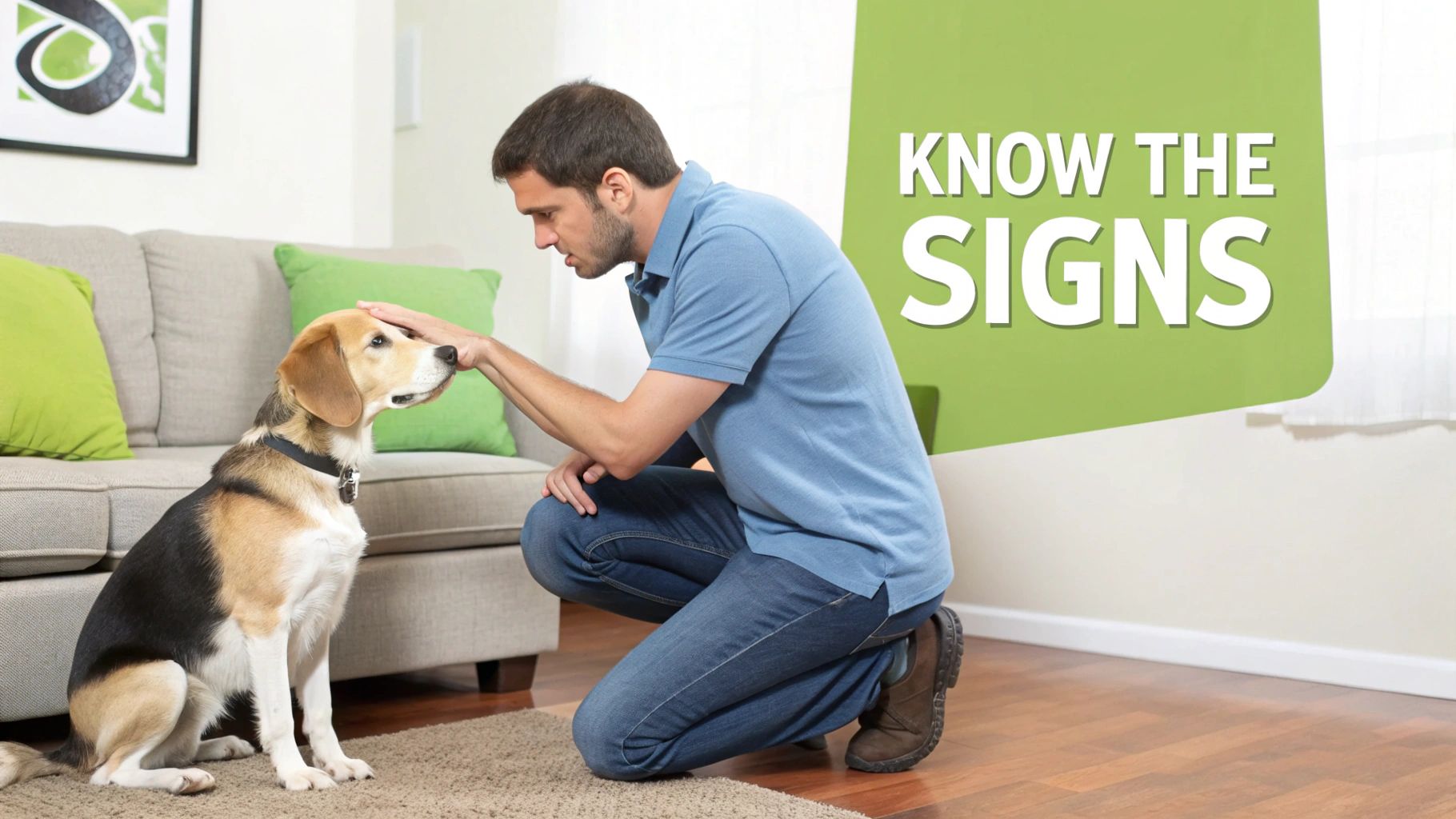
Imagine a person with severe claustrophobia trapped in an elevator. A chewed-up doorframe isn’t defiance; it’s a desperate escape attempt fueled by terror. Shifting your perspective from frustration to empathy is the foundation for helping them.
Step 1: Look for Pre-Departure Cues
The panic often starts before you leave. Dogs learn to recognize "departure cues"—jingling keys, putting on shoes, grabbing a bag. Your first action step is to observe your dog as you get ready.
Watch for these physical signs of building stress:
- Excessive Drooling or Licking: Are there pools of saliva on the floor? Is your dog frantically licking their paws?
- Trembling or Shaking: A subtle quiver can escalate as you get closer to the door.
- Pacing and Panting: Restless wandering and panting (without exercise) are clear signs of rising anxiety.
If you see these behaviors, you've confirmed that your dog's panic begins with the anticipation of being alone.
Step 2: Distinguish Panic from Boredom
Next, determine if the destructive behavior is a phobia or just a bored puppy. The biggest clue is when it happens.
A dog with separation anxiety almost exclusively acts out when you're gone, and usually within the first 30 minutes of your departure. They rarely, if ever, engage in these behaviors when you're home.
A bored dog, however, might shred a shoe anytime, even if you're in the next room. It's an opportunistic act. A panicking dog is trying to cope with a crisis.
A dog with separation anxiety isn't being bad; they are in a state of crisis. Their destructive behaviors are an external manifestation of an internal panic attack. Shifting your perspective from frustration to empathy is the most important step forward.
Use this checklist to clarify what you're seeing.
Separation Anxiety vs. Common Dog Behaviors
| Behavior | Separation Anxiety Indicator | Could Also Be... |
|---|---|---|
| Destructive Chewing | Focused on exits (doors, windows); happens only when you're away. | Boredom, teething (in puppies), lack of exercise, or play. |
| House Soiling | Urination/defecation occurs only when alone, even if recently taken out. | Incomplete house training, medical issues, marking territory. |
| Vocalizing (Barking/Howling) | Persistent and distressed; starts shortly after you leave and continues. | Alert barking (at sounds), boredom, territorial response, play. |
| Following You ("Velcro Dog") | Becomes intensely anxious when you move from room to room. | Breed trait (common in companion breeds), seeking attention. |
If your dog's behavior aligns with the "Separation Anxiety Indicator" column, it's time to implement a targeted plan.
A Widespread but Specific Challenge
If you're dealing with this, you're not alone. Canine anxiety is incredibly common. A massive 2020 study found that a staggering 72.5% of dogs show at least one anxiety-related behavior.
While things like noise sensitivity were more frequent, separation-related issues were a major problem, often tied to other traits like hyperactivity. You can dig into the prevalence of these canine behaviors in the full study. This research shows us that while many dogs get anxious, the specific panic of being alone is a unique challenge that needs its own dedicated plan.
Creating a Safe and Predictable Environment
Managing your dog's environment is the foundation for all successful separation anxiety training. Your goal is to create a world where being alone is no longer a cause for panic. This involves building a safe space, establishing routines, and providing the right kind of stimulation.
It all starts with creating a dedicated 'safe haven'—a place your dog associates with calm and reward, not isolation.
Action 1: Build a "Safe Haven"
Designate a specific room, a corner sectioned off with a baby gate, or a comfortable crate as your dog's sanctuary. This space should never be used for punishment.
To build a positive association, take these steps:
- Feed all meals there.
- Provide special toys. Offer high-value puzzle toys or long-lasting chews that they only get in this space.
- Use calming sounds. A white noise machine or classical music can muffle startling outside noises.
The objective is to transform a simple space into a predictable retreat. When your dog sees their safe haven as a place of comfort and reward, they are less likely to view your absence as a threat.
If you use a crate, choosing the right one is critical. For guidance, check out this article on selecting the right kennel for your dog to ensure it's a welcoming space.
Action 2: Establish Predictable Routines
Dogs thrive on predictability. An inconsistent schedule can heighten general anxiety, making them more vulnerable to panic when left alone.
Implement a consistent daily schedule:
- Consistent Mealtimes: Feed your dog at the same times each day.
- Scheduled Walks: Walk them in the morning and evening around the same time.
- Predictable Downtime: Designate quiet times during the day where your dog learns to settle, even while you are home.
This structure lowers their baseline anxiety, making your specific training for separation more effective.
Action 3: Use Enrichment to Build Confidence
Enrichment is a powerful tool for building independent problem-solving skills. Activities that use a dog’s natural instincts to sniff, chew, and forage are mentally tiring in a positive way.
- Use puzzle feeders. Instead of a bowl, make your dog work for their food with puzzle toys or snuffle mats.
- Introduce calming objects. A weighted plushie like the Charlie the Weighted Puppy Dog plushie can offer a comforting presence.
Introduce these new items while you are home so your dog doesn't associate them only with your departure. These tools build confidence, not just mask anxiety.
Action 4: Provide Meaningful Exercise
The type of exercise you provide matters. A frantic game of fetch can spike adrenaline, which is counterproductive for an anxious dog. Focus on activities that mentally engage and calm them.
- Take "Decompression Walks." Go to a quiet park or trail on a long leash and let them sniff freely. Sniffing is a natural behavior that lowers their heart rate and reduces stress.
- Play Scent Work Games. Hide smelly treats around the house and encourage your dog to find them. This activity is mentally exhausting and highly rewarding.
A 20-minute "sniffari" can be more tiring for a dog than a 60-minute run. The goal is to burn off nervous energy in a way that promotes a calm state of mind.
Rewiring Your Dog’s Panic Response
To achieve lasting change, you must change how your dog feels about being alone. This requires a two-part process: desensitization (gradually exposing your dog to being alone at a level that doesn't cause anxiety) and counterconditioning (building a new, positive association with your absence).
The goal is to teach their brain that being by themselves is safe and normal.
Action 1: Neutralize Departure Triggers
First, identify what tells your dog you're about to leave. These are their departure cues. Your dog's anxiety likely starts the second you grab your keys or put on your work shoes.
To desensitize them:
- Identify the triggers. Make a list of actions you take before you leave (e.g., picking up a purse, turning off the TV).
- Perform them randomly. Jingle your keys, then sit on the couch. Put on your coat, then go to the kitchen for a snack.
- Repeat often. Do this throughout the day until these actions become meaningless background noise.
By stripping these cues of their power, you prevent the anxiety from building before you even open the door.
Action 2: Practice Micro-Absences
This is the core of the training. You will practice leaving for such short periods that your dog has no time to panic. We’re talking seconds, not minutes.
Follow these steps precisely:
- Start small. Walk to the door, touch the doorknob, and immediately walk away. Repeat until your dog doesn't react.
- Open and close. Next, open the door, close it immediately, and go back to what you were doing.
- Step out briefly. Step through the doorway for one second, then come right back in. The key is to return before your dog shows any stress.
You are methodically teaching your dog that departures are no big deal because you always come back, and the duration is always manageable. If your dog whines, you’ve gone too fast. Go back to the previous step where they were calm.
This foundational training is more critical than ever. Post-pandemic routine changes caused a massive spike in separation anxiety. A 2022 survey found that 47.38% of dog owners reported anxious behaviors, a jump from just 5.5% in 2020, as our pets got used to us being home 24/7. Read more about how pandemic-related routine changes impacted pets in the study's report.
Basic obedience work can also help build a calmer, more confident dog. For tips, see our guide on 5 easy commands that you can teach your dog today.
Here is a sample training plan for your first week. Adjust the pace based on your dog’s comfort level.
Sample Desensitization Training Plan: Week 1
| Day | Morning Session (5 mins) | Afternoon Session (5 mins) | Goal |
|---|---|---|---|
| 1 | Touch doorknob, return to couch. Repeat 5x. | Put on coat, take it off. Repeat 5x. | Neutralize initial departure cues. |
| 2 | Open door, close it, sit down. Repeat 5x. | Jingle keys, then start making tea. Repeat 3x. | Combine cues without triggering anxiety. |
| 3 | Step outside for 1 second, come back in. Repeat 3x. | Step outside for 2 seconds, come back in. Repeat 3x. | Introduce the briefest possible absence. |
| 4 | Step out for 3 sec, 1 sec, 4 sec. Mix it up. | Touch doorknob, step out for 2 sec, return. | Keep it unpredictable; combine cues and absences. |
| 5 | Step out for 5 seconds. Repeat 3x. | Step out for 7 sec, 3 sec, 5 sec. Mix it up. | Build slightly longer, but still very short, durations. |
| 6 | Rest day. Practice some fun obedience instead. | Rest day. Play a game of fetch. | Give your dog’s brain a break to process. |
| 7 | Step out for 10 seconds. Success! | Step out for 8 seconds. End on a high note. | Solidify gains and prepare for the next step. |
Always end on a successful repetition where your dog remains calm. If they show stress, make the next attempt much easier.
Why Distractions Don't Work
A common tip is to give your dog a food-stuffed toy as you leave. For a truly panicked dog, this can backfire. The toy becomes a "poisoned cue" that predicts your departure, increasing their anxiety. Many anxious dogs are also too stressed to eat.
True progress in separation anxiety training comes from helping your dog feel genuinely safe while alone, not from distracting them from their fear. The goal is a calm dog, not a busy one.
While training, continue to lean on your management strategies.
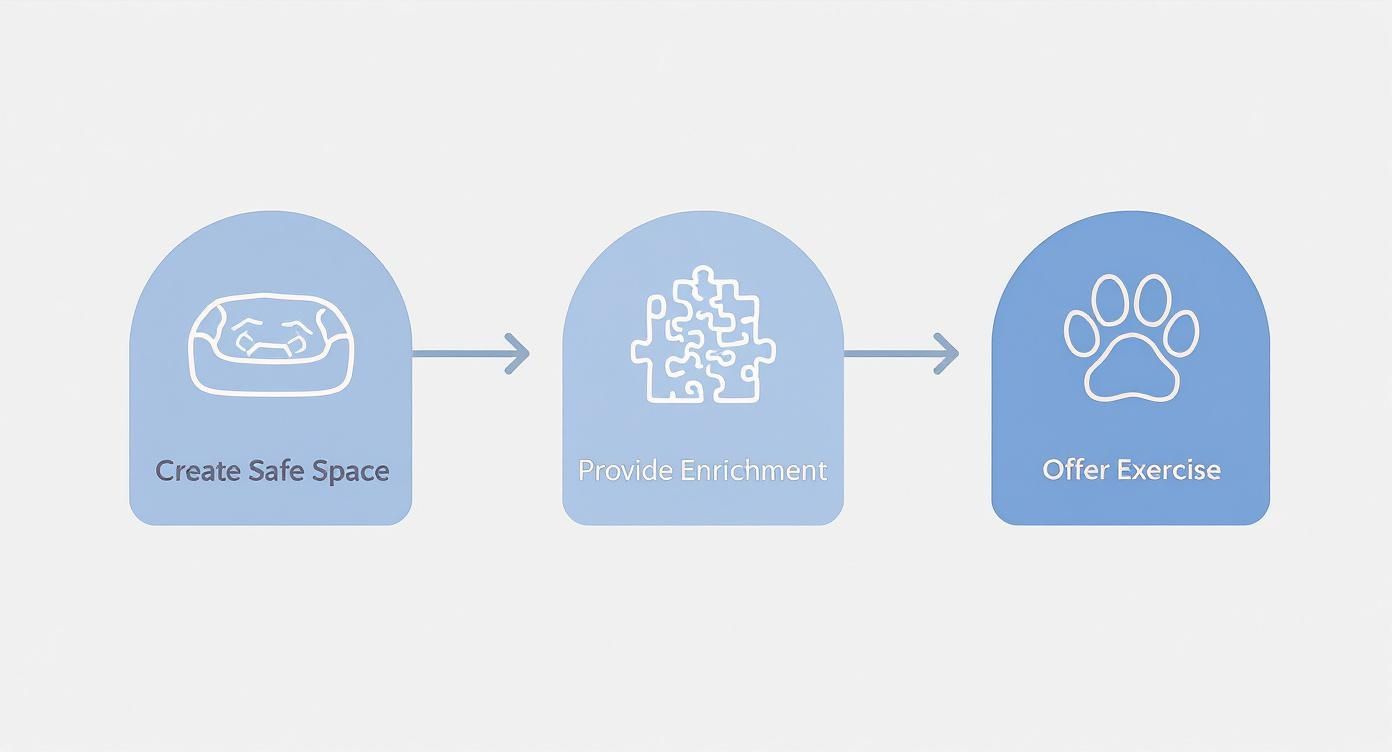
These three pillars—a safe space, enrichment, and the right exercise—create a stable foundation for your desensitization training to succeed.
How to Progress Your Training
Slowly increasing the duration of your absences requires patience and observation. The only rule is to go at your dog's pace. You must use a camera or baby monitor to watch them when you're out of sight.
Follow this progression:
- Master seconds first. Vary your absences: 5 seconds, 10 seconds, then 8 seconds. Keep it unpredictable.
- Move to minutes. Once your dog is calm with varied absences under a minute, start pushing toward two minutes, then five.
- Vary everything. Don't just increase the time. Leave through different doors. Get in your car and come right back. The more boring and unpredictable your departures are, the better.
Setbacks will happen. If your dog panics at five minutes, your next session must be much shorter—perhaps 30 seconds—to rebuild their confidence. By stacking these small wins, you are slowly rewriting their panic response.
How to Handle Setbacks and Common Pitfalls
Progress with separation anxiety is rarely a straight line. You'll have great days followed by frustrating ones. This is normal. A setback is not a failure; it's data telling you about your dog's current stress level.
Staying resilient and consistent is how you provide real, lasting dog separation anxiety help.
Understanding the Culprit: Trigger Stacking
A bad day is often caused by trigger stacking—a series of small stressors piling up. A loud truck, a squirrel at the window, or a tense encounter on a walk can all add to your dog's "stress bucket." Your departure training might be the final drop that causes it to overflow.
This is why a duration that was easy yesterday might be overwhelming today. Their stress bucket was already half-full before you even started.
Common Training Mistakes to Avoid
Knowing what pitfalls to avoid will keep your training on track.
- Pushing Too Fast, Too Soon: This is the most common mistake. Resist the urge to jump from a 10-minute success to a 30-minute one. Increase time in small, manageable steps.
- Emotional Goodbyes and Hellos: A dramatic farewell tells your dog your departure is a big, scary event. Keep arrivals and departures as low-key and boring as possible.
- Accidentally Rewarding Anxious Behavior: If you return inside to soothe a whining dog, you teach them that whining brings you back. It's crucial to only return when they are calm, even for a split second.
The goal isn't just to get your dog to tolerate being alone; it's to help them feel genuinely safe and relaxed. Pushing past their comfort zone, even a little bit, can unravel weeks of work by confirming their fear that being alone is, in fact, terrifying.
Your Action Plan After a Setback
When a setback happens, don't panic. Use this three-step recovery plan to get back on track.
- Take a Break: Pause formal departure training for a day or two. Focus on fun, stress-reducing activities like sniffy walks or puzzle toys to let their stress hormones reset.
- Go Way Back: When you resume training, make the session incredibly easy. If the setback occurred at five minutes, your next attempt should be something you know they can handle, like 30 seconds.
- Rebuild Confidence: The immediate goal is not to increase duration but to give your dog a series of easy wins. String together several successful, short absences to remind them that being alone is safe and that you always return.
A setback is a detour, not a dead end. With a solid recovery plan, you can navigate these bumps and keep moving forward.
When It's Time to Call in a Professional
Some cases of separation anxiety are too severe to tackle on your own. Getting professional help is a smart, proactive step for your dog's well-being.
It's time for professional dog separation anxiety help if you see these red flags:
- Self-harm: Your dog chews paws raw, breaks teeth on their crate, or claws doors until their nails bleed.
- Dangerous Destruction: They are chewing through drywall or gnawing on electrical cords.
- No Progress: Despite consistent effort, the behaviors are not improving or are getting worse.
Knowing Who to Call
When seeking an expert, you have several options.
- Your Veterinarian: This is your first stop. Rule out underlying medical issues and discuss if anti-anxiety medication is appropriate.
- Certified Separation Anxiety Trainer (CSAT): These specialists focus exclusively on separation anxiety, using science-backed, remote training plans.
- Veterinary Behaviorist (DACVB): A DACVB is a veterinarian with advanced, residency-level training in animal behavior. They can diagnose complex disorders, design behavior plans, and prescribe medication.
Finding the right expert can feel like a lot. While the advice is for humans, a guide on how to find a therapist can provide a good framework for vetting credentials.
What's the Deal with Medication?
Medication doesn't fix separation anxiety, but it can make training possible. For a dog in a full-blown panic, stress hormones make learning impossible. Anti-anxiety medication can lower their panic level enough for them to absorb the behavior modification work you're doing.
It's like trying to teach someone calculus while they’re having a panic attack. It’s just not going to happen. Medication helps turn down the "volume" on that panic, bringing them to a place where they can finally calm down enough to absorb the training you're doing.
Only your veterinarian or a veterinary behaviorist can determine if medication is right for your dog. Combining professional behavioral training with veterinary support is often the most effective path for severe cases.
The industry is responding to this serious condition. The global market for canine separation anxiety treatment was valued at $21.4 million in 2020 and is projected to grow significantly, largely driven by advances in behavioral medication. You can read more about this growing market and treatment trends.
Your Top Dog Separation Anxiety Questions Answered
It's normal to have questions as you work through this process. Here are answers to some of the most common ones.
A frequent question is, "Should I get another dog to keep mine company?" While it seems logical, this rarely helps with true separation anxiety. The phobia is about being separated from you, not just being alone. You often end up with two anxious dogs instead of one.
What About Crate Training?
For many dogs, a crate is a safe den. But for a dog with severe separation anxiety or confinement phobia, a crate can feel like a trap and intensify their panic.
Never force a terrified dog into a crate. If you see signs of extreme distress like bent crate bars or bloody paws, stop using it for confinement immediately. A dog-proofed room is a much safer alternative.
The whole point of any tool, including a crate, is to help your dog feel secure. If it's making them feel more scared, it's the wrong tool for the job.
What Is a Realistic Timeline for Improvement?
There is no magic number of days or weeks. Progress depends on your dog's personality, the severity of the anxiety, and your consistency with the training plan. Some dogs improve in a few weeks; others may take several months.
- Consistency is Key: Sticking to the gradual desensitization plan is the fastest way to achieve lasting progress.
- Expect Setbacks: A bad day doesn't mean you've failed. Just dial the training back a step.
- Celebrate Small Wins: Every calm departure, no matter how short, is a success.
This journey requires patience, but every step you take strengthens your bond and improves your dog's quality of life. For more ideas on boosting your dog's well-being, check out our guide on how to keep your dog happier with simple tricks.
At Pet Magasin, we understand the deep bond you share with your pet. We're committed to providing high-quality, practical supplies to support you through every challenge and celebrate every success on your journey together. Explore our products at https://www.petmagasin.com.

Leave a comment