


Dog Seat Belt for Small Dogs: A Buyer's Guide

Your small dog is probably riding in the car one of two ways right now. Either they're loose on the seat and inching toward you at every stoplight, or they're clipped into something that looks secure but hasn't been built with crash forces in mind.
That's the gap in this category. Small-dog travel gear is often sold as comfort gear first and safety gear second.
If you're shopping for a dog seat belt for small dogs, the right question isn't “Which one looks sturdy?” It's “Which design controls motion, spreads load across the body, and has evidence behind it?” Small dogs, especially toy breeds under about 25 lb (Center for Pet Safety harness study summary), need a more careful fit and a shorter leash on marketing claims. A harness that works for a walk can fail in a crash. A booster that keeps a dog happy at the window can still allow too much forward movement.
I judge these products by geometry first, then fit, then installation. That approach cuts through most of the packaging language and gets you to what protects.
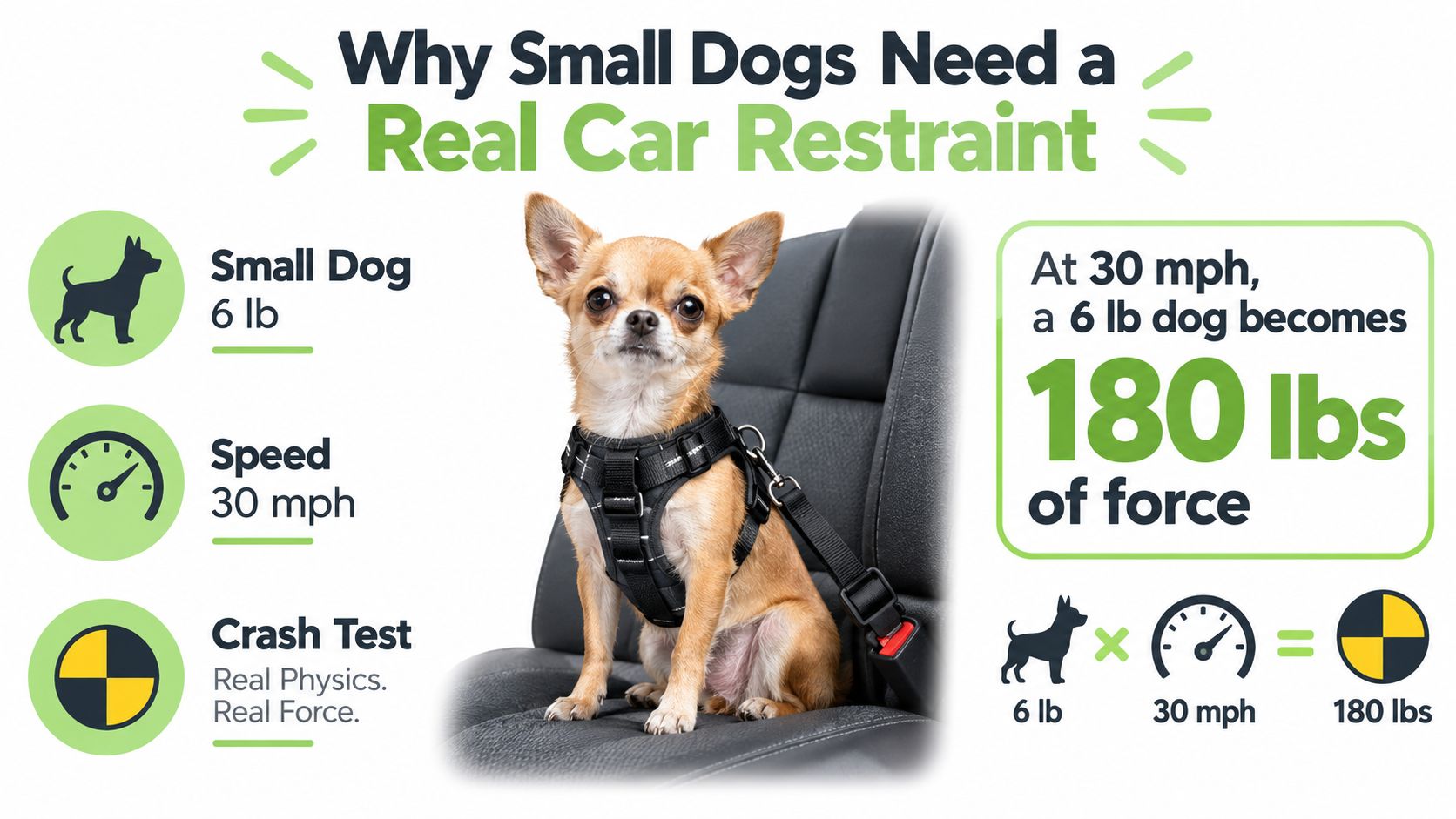
Why Small Dogs Need a Real Car Restraint
The common daily-drive scene is familiar. A Chihuahua or Yorkie starts the trip on the passenger seat, then stands up when the car moves, then paws at your arm when traffic slows. The driver looks away for a second to settle the dog. That moment is the problem, even before you get to crash protection.
A major U.S. survey found that only 16% of dog owners who travel with pets use any restraint, even though 83% agree that an unrestrained dog in a moving car can be dangerous. Among restraint users, 56% used a pet harness or safety belt, 30% used a hard-sided travel crate, and 10% used a pet vehicle seat. Another survey in the same market showed only 17% said they use a seat belt harness, while 27% said they use a pet carrier (Kurgo dog travel statistics). That tells you two things. Owners know the risk, and many still drive with no real restraint.
Why toy breeds are harder to protect
Small dogs don't get the margin for error that larger dogs sometimes do. Their chests are narrower. Their backs are shorter. Many slip out of broad, generic harnesses or end up with shoulder straps riding too high toward the neck.
What works is a restraint that keeps the dog low on the seat, limits forward travel, and puts force through the chest and ribcage, not the throat.
Practical rule: If a restraint lets your dog climb into the front seat, it's already too long for safety use.
What roaming actually costs you
A loose dog creates two risks at once. First, distraction. Second, impact movement. For a small dog, even a moderate stop can turn a casual setup into a neck-loading setup if the attachment point is wrong or the tether is too long.
That's why a real restraint isn't an accessory. It's part of the vehicle safety system for that passenger.
Main Restraint Designs for Small Dogs
The market keeps repackaging the same few designs. Once you understand the geometry, you can sort products quickly and ignore most of the branding.
Four Restraint Geometries at a Glance
| Design | Vehicle Attachment | Dog Attachment | Movement |
|---|---|---|---|
| Belt-and-bolt harness | Seat belt receptacle or anchor point by short tether | Back clip on harness | Low to moderate |
| Vest-style harness | Vehicle belt path or dedicated tether | Load-spreading vest around chest | Low |
| Carrier-secured system | Seat belt or anchor straps securing carrier | Dog enclosed inside carrier | Very low |
| Zipline tether | Line between headrest posts with sliding clip | Chest harness | High |
Belt-and-bolt harness
This is the simplest form of a dog seat belt for small dogs. A tether clicks into the car and clips to the harness. It's easy to use, easy to move between vehicles, and often the first thing owners buy.
Its weakness is load concentration. If the harness itself is narrow or shaped more for walking than impact control, the system can pull upward and inward under force.
Vest-style harness
This is usually the better harness geometry for small dogs because it spreads force across more surface area. The stronger versions route force across the sternum and ribs instead of relying on a thin chest strap.
The downside is twist. On toy breeds with slim chests, some vest harnesses rotate when the dog turns or braces.
Carrier-secured system
For very small dogs, this design often makes the most sense. The dog is contained, the carrier controls movement, and the vehicle attachment happens at the carrier rather than directly through the dog's body.
A good setup depends on the carrier being secured properly. An unsecured carrier is luggage, not a restraint.
Zipline tether
This design gives the dog the most freedom. It also gives the dog the most travel distance inside the cabin. That trade-off matters more for small dogs because free movement can become uncontrolled movement fast.
More mobility feels kinder in the moment. In a sudden stop, it often works against the dog.
What Independent Crash Testing Actually Measures
Marketing and safety part ways.
The Center for Pet Safety has run crashworthiness studies since 2011, and its 2013 harness study reported that only one brand qualified for crash testing while the rest failed to provide adequate protection in a simulated collision (Center for Pet Safety 2013 harness crash test study results). That single fact should reset how you read product pages.
“Crash tested” isn't the same as “passed”
Brands use “crash tested” loosely. It can mean anything from a basic in-house demonstration to a formal sled-test protocol. Those are not equivalent.
What meaningful testing looks at is simple in concept:
- Excursion control: How far the dog moves forward
- Structural integrity: Whether hardware, webbing, and stitching stay intact
- Load path: Where the force goes through the harness and the dog's body
- Fit under force: Whether the restraint stays on the thorax or migrates toward the neck
For small dogs, those details matter even more than the label on the package.
The engineering details worth caring about
The practical takeaway from CPS-based testing is that short tethers, chest load distribution, and hardware that doesn't separate under impact matter more than leash-style convenience. Third-party technical summaries of crash-tested designs describe seatbelt-grade polyester webbing in the roughly 1.5 to 2 inch range, steel hardware, and very short tether lengths as features that better control excursion and reduce forward projection (CPS harness study technical summary).
That doesn't mean every wide harness is safe. It means the safer designs tend to share those structural choices.
What to ignore on the package
Skip words like “durable,” “heavy duty,” and “travel ready” unless the product also shows real testing context. For a small dog, the useful questions are narrower:
- Was the design independently evaluated?
- Was the restraint built to keep the tether short?
- Does the chest panel spread force?
- Is the hardware metal and load-bearing?
- Does the fit stay stable on a short-backed dog?
If you can't answer those from the listing, move on.
Comparing the Four Leading Restraint Styles
Most owners don't need a single “best” restraint. They need the right tool for their dog's size, behavior, and vehicle. That's why I compare restraint styles by function, not by hype.
Restraint Style Comparison for Small Dogs
| Restraint Style | Crash Performance | Comfort | Ease of Use | Best For |
|---|---|---|---|---|
| Standard belt harness | Mixed. Depends heavily on harness structure and tether length | Usually acceptable for calm riders | Very easy | Short routine drives with a well-fitted chest harness |
| Vest harness | Better load distribution than narrow harness styles | Good when fit is correct | Moderate | Small dogs that tolerate body contact and need controlled movement |
| Carrier-secured system | Strong option for very small dogs when the carrier is properly secured | Excellent for dogs that settle in enclosed spaces | Moderate | Toy breeds, vet trips, dogs that travel better enclosed |
| Zipline tether | Weakest control of forward movement | Highest freedom of movement | Easy | Limited use for dogs that panic in fixed tethers, with clear safety compromise |
Where each style wins and fails
The standard belt harness wins on simplicity. It loses fast if the tether is long or the harness is little more than a walking harness with a clip point added.
Vest harnesses are usually the strongest compromise for owners who want a wearable restraint instead of a carrier. They spread force better, but poor fit can still let the whole unit twist.
Carrier-secured systems are the option I lean toward most often for tiny dogs that don't fit harness geometry cleanly. If your dog travels best enclosed, this category deserves a hard look. If you want to compare that route with a raised-seat setup, this guide to a car seat for small dogs helps frame the comfort-versus-restraint trade-off.
My blunt take on ziplines
Zipline systems solve behavior problems better than crash problems. They can reduce pacing and whining because the dog can reposition. But that same movement creates more travel distance in a stop.
If the design priority is “let the dog move around,” crash control usually comes second.
That doesn't make every zipline useless. It makes them a niche solution with a clear downside.
Getting the Right Fit for Toy Breeds and Slim Chests
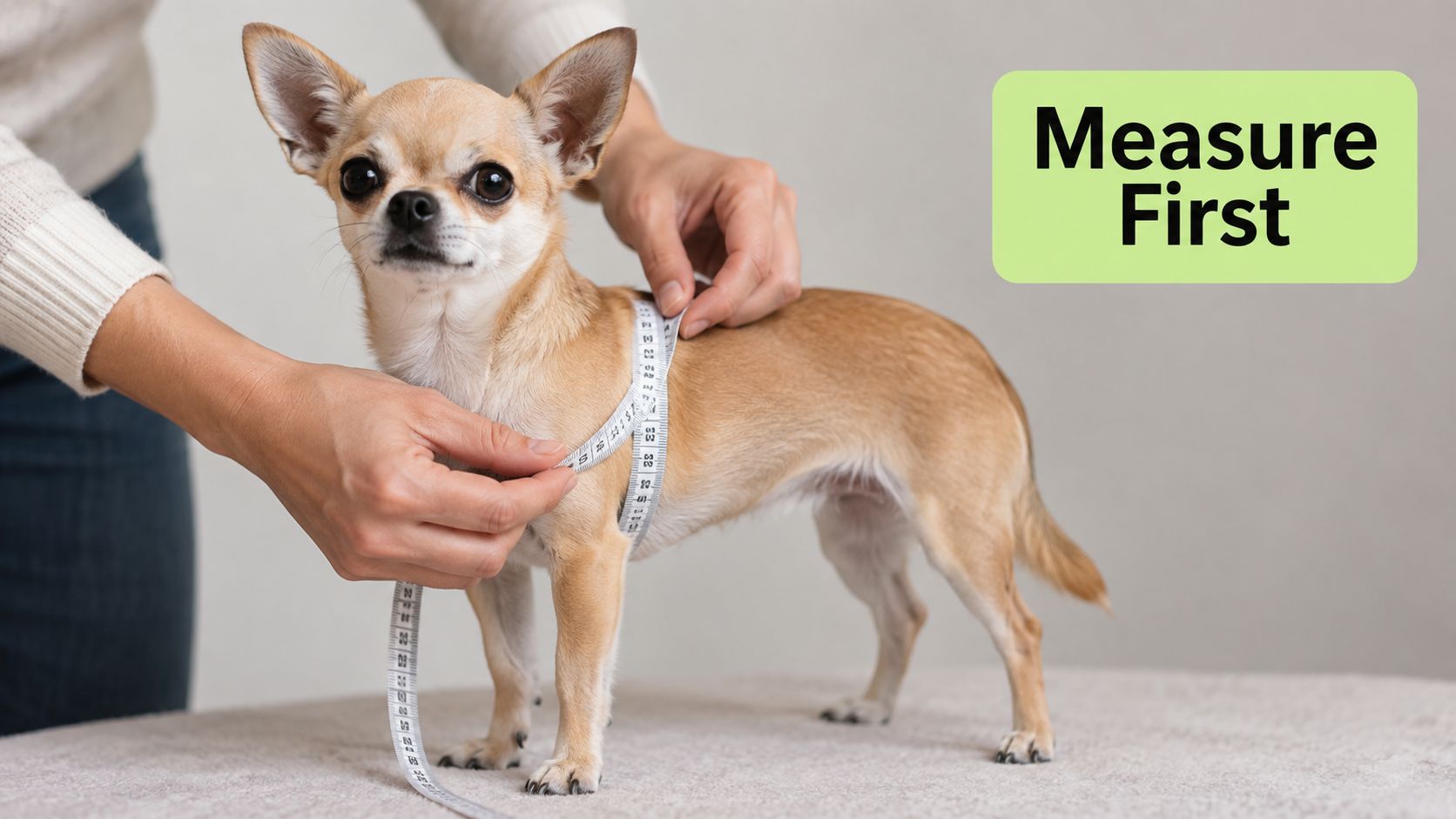
A six-pound dog can look “secure” in the driveway and still slip into a dangerous position the first time the car lurches forward. I see that problem most often on narrow chests, fine shoulders, and dogs whose harness size falls between puppy gear and true crash restraint sizing.
For toy breeds, fit is part of the safety system. Independent crash testing for small dogs has long used a dummy around the 25-pound class as a reference point. Owners of lighter dogs should treat that as a warning, not a comfort. Once you go smaller, weak harness geometry shows up faster. Straps ride into the throat, chest panels rotate, and the dog can partly back out during normal repositioning.
Start with measurements, but do not stop there.
Take these before you shortlist any restraint:
- Neck circumference: Measure low on the neck, where the harness will sit under load.
- Ribcage girth: Measure just behind the front legs at the deepest part of the chest.
- Back length: Measure from the base of the neck to the point where the restraint is meant to end.
Those numbers matter because toy-breed fit problems are rarely about chest girth alone. A harness can match the size chart and still fail on chest width, sternum length, or shoulder spacing. On slim dogs, a Y-shaped front usually tracks the chest better than a straight horizontal strap across the front, because it gives the neck and shoulders a clearer place to sit without forcing everything upward.
Then do the test that catches the problems size charts miss. Put the harness on your dog and place the dog in the exact seated position used in the car. Adjust it snugly enough that two fingers fit underneath, then watch what happens when the dog sits, turns, and leans. If the chest plate shifts off center or the neck opening climbs toward the throat, the fit is wrong for that body shape.
Some tiny dogs never sit cleanly in harness-based restraints, even when the product itself is decent. For those dogs, a secured enclosed option can be the better answer. Comparing your setup with a small dog travel carrier is worthwhile if your dog has a very narrow frame, a fragile neck, or travels calmer in a contained space.
A quick visual walkthrough helps here:
Signs the fit is wrong
Watch for these specific failure points during real use:
- Neck ride-up: The front of the restraint climbs toward the throat as tension comes on.
- Panel twist: The chest section rotates to one side instead of staying centered on the sternum.
- Escape gap: A shoulder starts to slip free when the dog turns or braces.
- Rear shift: The whole harness slides backward instead of holding at the chest and ribs.
Do not keep testing a setup that shows any of those signs. Poor fit does not break in. It gets exposed.
Installing a Dog Seat Belt Safely in Any Vehicle
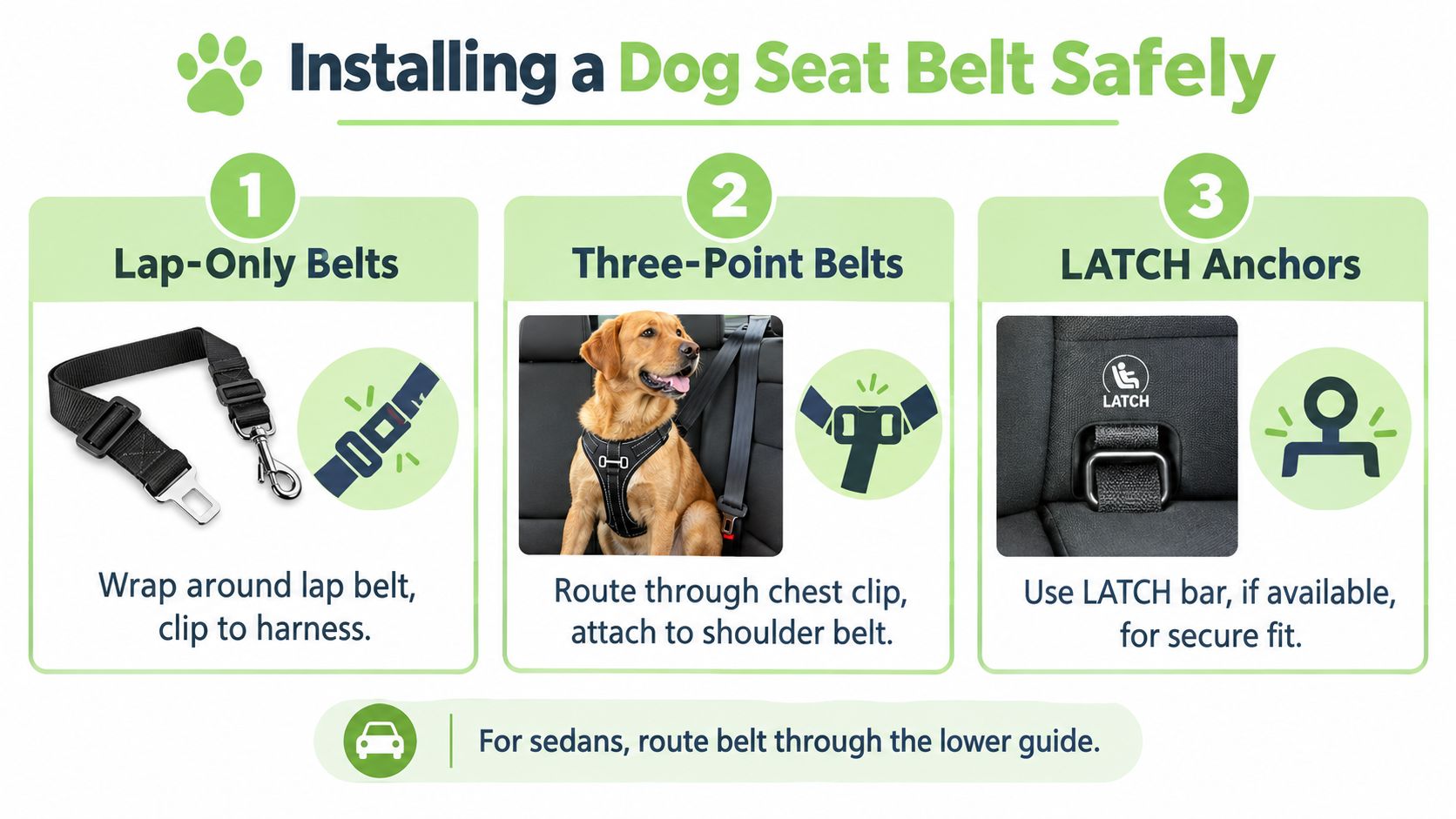
A solid restraint can still fail in practice if it's installed to the wrong part of the car or routed with too much slack. Owners mix up seat belt paths, tether anchors, and cargo attachment points all the time.
Sedan, SUV, and hatchback differences
In a sedan, keep the restraint in the rear seat and route it low through the seat crease when the design calls for belt routing. Don't run the tether up and over the headrest unless the product was built specifically for that geometry.
In SUVs, owners often move small dogs to the cargo area. That can work with a properly secured carrier or crate, but a loose tether point in cargo space creates too much uncertainty. In hatchbacks, don't attach anything to the hatch strut or trim hardware. Those parts aren't designed as crash anchors.
The setup points that matter
Three attachment methods show up most often:
- Seat belt routing: Good when the harness or carrier has a true belt path that holds the restraint in place
- Seat belt receptacle clip: Convenient, but only as strong as the restraint geometry attached to it
- Lower anchor attachment: Useful for some products, but owners need to confirm the product was designed for that point
If you're sorting out connector styles, this explanation of the dog seat belt clip helps distinguish simple buckle tethers from more secure routing systems.
Mistakes I see most often
Leave only the slack needed for sitting or lying down. Extra length becomes travel distance in a stop.
The recurring errors are predictable:
- Shared buckle use: Clipping the dog into the same seating position a passenger needs
- Too much slack: The dog can stand on the seat back or reach the front row
- Wrong attachment point: Using a convenient hook instead of a tested load path
- No trial drive: Finding out the dog twists, chokes, or tangles after you're already on the road
Installation is also part of routine management. If you're planning longer travel, this guide on protecting your pet's routines on trips is useful because feeding, bathroom timing, and rest breaks affect how calmly a small dog rides once restrained.
Matching the Restraint to Your Real-World Routine
A restraint should match the trip, not just the dog. Owners get into trouble when they buy one setup and expect it to solve every driving scenario equally well.
Restraint Matched to Driving Scenario
| Scenario | Best Restraint | Key Trade-Off |
|---|---|---|
| Short city commute | Vest-style harness with short fixed tether | Less freedom of movement, better position control |
| Routine vet visits | Secured carrier system | Bulkier to move, easier for dogs that are carried in and out |
| Long road trips | Well-fitted harness for active stops, secured carrier for sustained travel | More gear, better flexibility |
| Anxious riders | Carefully managed movement setup, sometimes enclosed carrier over tethered harness | Calmer behavior may come with stricter confinement |
The city-commute setup
For school runs, errands, and short stop-and-go driving, I'd pick a padded vest harness with a short tether over almost anything else. It limits roaming and keeps the dog in one zone without asking the dog to tolerate full enclosure.
That matters when the dog is alert but not panicked.
The vet-trip setup
For dogs that are already carried from house to car to exam room, a secured carrier is cleaner and calmer. You don't unclip and reclip a stressed toy breed in a parking lot. You lift the whole unit.
This is one place a soft-sided crate with proper seat belt loops can make sense. Pet Magasin offers a foldable soft dog crate with seat belt loops at the back, which is useful for containment-oriented travel when the vehicle setup and dog's behavior suit that format.
The road-trip and anxious-dog setups
Road trips ask for more than one answer. Some small dogs do best riding restrained for shorter stretches but settling in a secured carrier for longer highway time. Others dislike chest pressure and do better in a den-like enclosure from the start.
For anxious riders, convenience systems that maximize movement can backfire. If movement seems to calm the dog, test that assumption carefully. Sometimes what looks like “wanting freedom” is a dog asking for better support and less visual chaos.
A Quick Decision Checklist Before You Buy
Most buying mistakes happen because owners judge the product in the living room instead of judging the whole system. The right checklist keeps you honest.
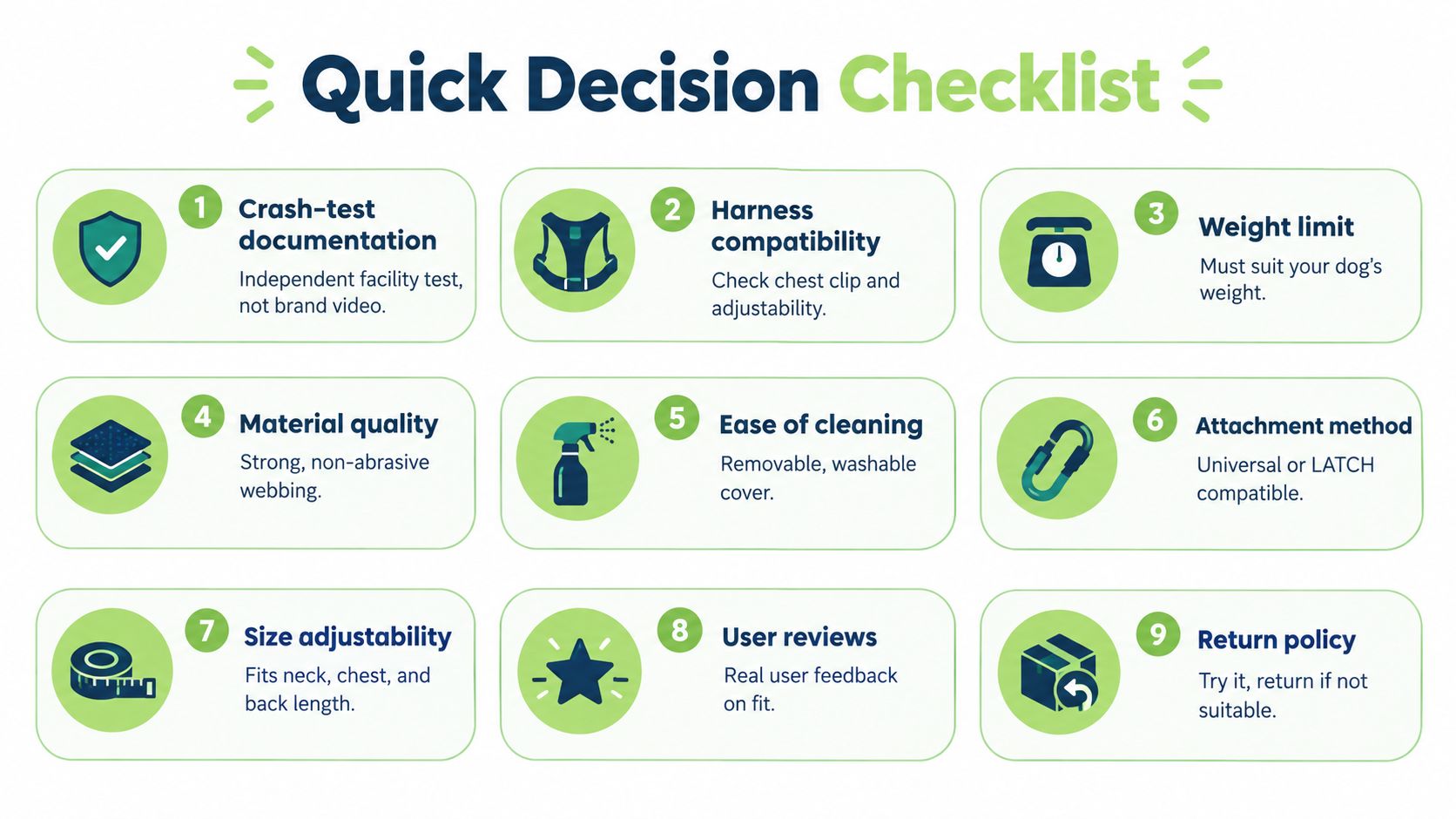
The nine checks that matter
-
Independent crash documentation
Don't settle for a brand video or a vague claim. The category changed when independent testing started exposing performance gaps, and the Center for Pet Safety's small-dog pet seat pilot study found a 100% failure rate for the restraints evaluated in that initial phase (CPS pet seat pilot study). That's why proof matters. -
Weight class relevance
A product marketed broadly across sizes may still fit small dogs poorly. For toy breeds, stay focused on designs that clearly address small-dog geometry. -
Real measurements, not S/M/L guessing
Measure neck, chest, and back length. Then compare those to the brand's chart. -
Load-bearing hardware
Metal connection points and webbing beat decorative hardware every time. -
Stitching quality
Check the seams that carry force. Load-bearing rows should look deliberate, even, and reinforced. -
Short tether logic
The dog should be able to sit and lie down, but not climb upward or forward. -
Vehicle compatibility
Your seat shape matters. So does where the belt path sits and whether the restraint needs a lower anchor, a receptacle clip, or full belt routing. -
Trial-fit return window
A restraint can look perfect on paper and fail in the seat. -
Layered travel plan
For many small dogs, one harness isn't the whole answer. Routine drives and longer travel may call for different tools.
The fastest way to rule products out
If I were screening listings quickly, I'd reject any product that does one of these:
- Uses collar-style logic: Anything that can load the neck is out
- Allows long free travel: More slack is not a comfort upgrade
- Hides the attachment method: If the listing avoids showing the restraint under tension, that's revealing
- Looks like walking gear first: Everyday harnesses aren't automatically impact restraints
Buy for the crash path, not the color, the window view, or the packaging claim.
A good dog seat belt for small dogs doesn't just keep your dog from wandering. It keeps the body aligned, controls motion, and stays structurally honest when the drive stops being routine.
Pet Magasin offers practical travel gear for owners who want to make car rides cleaner, calmer, and more manageable, including carriers and back-seat travel accessories that fit into a safety-first routine. If you're building a better setup for a small dog, visit Pet Magasin to compare travel products that support everyday use alongside the restraint principles covered here.

Leave a comment