


What Airlines Allow Pets in Cabin in 2026

You're probably here because you already found a dozen “pet-friendly airline” lists, paid for a carrier, and still don't trust that your dog or cat will get on the plane. That skepticism is justified. The problem isn't whether an airline says it allows pets in cabin. The problem is whether your specific flight, cabin, route, and carrier line up on travel day.
I've seen travelers do everything “right” and still get stopped at check-in because the carrier was too rigid, the premium cabin didn't allow pets, or the airline's own route exception overrode the general policy page. If you want a clean answer to what airlines allow pets in cabin, start with this rule: shortlist airlines that still actively run an in-cabin pet program, then vet the flight details like a gate agent would.
Why Cabin Pet Rules Vary by Airline
You're at the gate with a small dog in a carrier. The pet fits. You paid the fee. Then the agent says the carrier won't work on this aircraft, or your cabin doesn't permit pets. That's not bad luck. That's how the system is built.
The FAA says each airline decides whether pets may travel in the passenger cabin, and if they do, the pet container is treated like carry-on baggage that must fit under the seat and stay stowed during key phases of flight, as explained in the FAA's guidance on flying with pets. There is no one-size-fits-all federal cabin-pet standard.
The airline is the rulebook
That single FAA rule explains most of the chaos travelers run into. Airlines create their own program details around:
-
Species allowed
Some carriers stick to dogs and cats. Others allow additional small animals. -
Seat and aircraft constraints
Under-seat space drives a lot of the policy, which is why soft-sided carriers often work better than rigid ones. -
Route and product decisions
A carrier may allow pets in cabin broadly, then block them on specific routes or premium cabins.
Practical rule: Never trust a generic “yes, pets allowed” list until you've checked the exact airline's flight-specific rules.
What this means for your booking
In the U.S., recent airline-policy summaries show that major carriers such as Delta, American, Southwest, JetBlue, and Frontier all have in-cabin pet options, but the details vary by fee, carrier size, and species restrictions, with commonly cited cabin fees clustering around about $95 to $150 each way according to this airline policy overview. That's why broad lists only get you halfway.
Treat airline pet travel the way you'd treat baggage rules on a budget carrier. The headline policy matters less than the fine print. If you skip that mindset, the gate agent becomes the first person to reality-check your booking.
Major US Airlines That Allow Pets in Cabin
Most major U.S. travelers don't need an endless airline directory. They need a shortlist. The useful answer to what airlines allow pets in cabin is this: many major U.S. airlines do, but the product isn't standardized.
A current market snapshot is simple. The FAA leaves the decision to each airline, and mainstream U.S. carriers have responded by publishing formal in-cabin pet programs with different limits on species, route access, and carrier specs. The broader demand isn't niche anymore either. The International Air Transport Association reported in 2026 that its 2025 Global Passenger Survey found about one-quarter of respondents have or would consider traveling with a pet, as summarized in this U.S. airline pet policy guide.
What to compare first
Before you choose an airline, compare these four things in order:
-
Route access
A pet program is useless if your route or connection blocks cabin pets. -
Species limits
Some airlines allow only dogs and cats. Others are broader. -
Carrier dimensions
Most travelers obsess over pet weight first. Gate agents usually look at the carrier fit first. -
Fee reality
A cheap fare plus a pet fee can stop looking cheap fast.
If you're comparing airlines more broadly for reliability, scheduling, and traveler experience, this guide on how to choose an airline wisely is worth reading alongside pet-policy pages.
Major US Carriers Offering In-Cabin Pets (2025)
| Airline | Cabin Pet Fee (each way) | Species Allowed | Max Carrier Dimensions (L x W x H, in) | Notes |
|---|---|---|---|---|
| Delta | $150 domestic one way; $200 international one way on tickets issued on or after April 8, 2025 | Varies by policy and route | Around the common market range of 17 to 19 inches in length | Premium-cabin and route restrictions matter more than most travelers expect |
| American | Within the commonly cited major-market range of about $95 to $150 each way | Varies by policy | Around the common market range of 17 to 19 inches in length | Check route eligibility before paying |
| Southwest | Within the commonly cited major-market range of about $95 to $150 each way | Varies by policy | Around the common market range of 17 to 19 inches in length | Program details differ from legacy carriers |
| JetBlue | Within the commonly cited major-market range of about $95 to $150 each way | Varies by policy | Around the common market range of 17 to 19 inches in length | Rules should be checked flight by flight |
| Frontier | Within the commonly cited major-market range of about $95 to $150 each way | Varies by policy and can include more than dogs and cats on some airlines | Around the common market range of 17 to 19 inches in length | Often relevant for travelers prioritizing price |
| Hawaiian and select other carriers | Can be as low as about $35 on some Hawaiian routes or as high as $150 each way on several U.S. airlines | Varies | Varies | Fee spread is wider than older guides suggest |
My recommendation
If you want the fewest surprises, book airlines with a clearly published in-cabin pet process and then verify the exact flight by phone. Don't choose based on the home page headline alone.
For a broader airline roundup focused specifically on dog travel, Pet Magasin's guide to airlines that take dogs is a useful second screen while you compare route fit and carrier limits.
The best airline for pets isn't the one with the nicest marketing. It's the one whose cabin rules match your exact itinerary and carrier.
Carrier Size, Weight, and Construction Rules
Most in-cabin pet failures happen because of the carrier, not the pet. Travelers buy something labeled “airline approved,” then learn that phrase means almost nothing without an airline and aircraft attached to it.
The FAA's framework makes the logic clear. If a pet is allowed in cabin, the container is treated as carry-on baggage and must fit under the seat. That's why compressibility matters so much. A soft-sided carrier that gives a little at the top edge often clears a check that a hard shell fails.
What gate agents actually care about
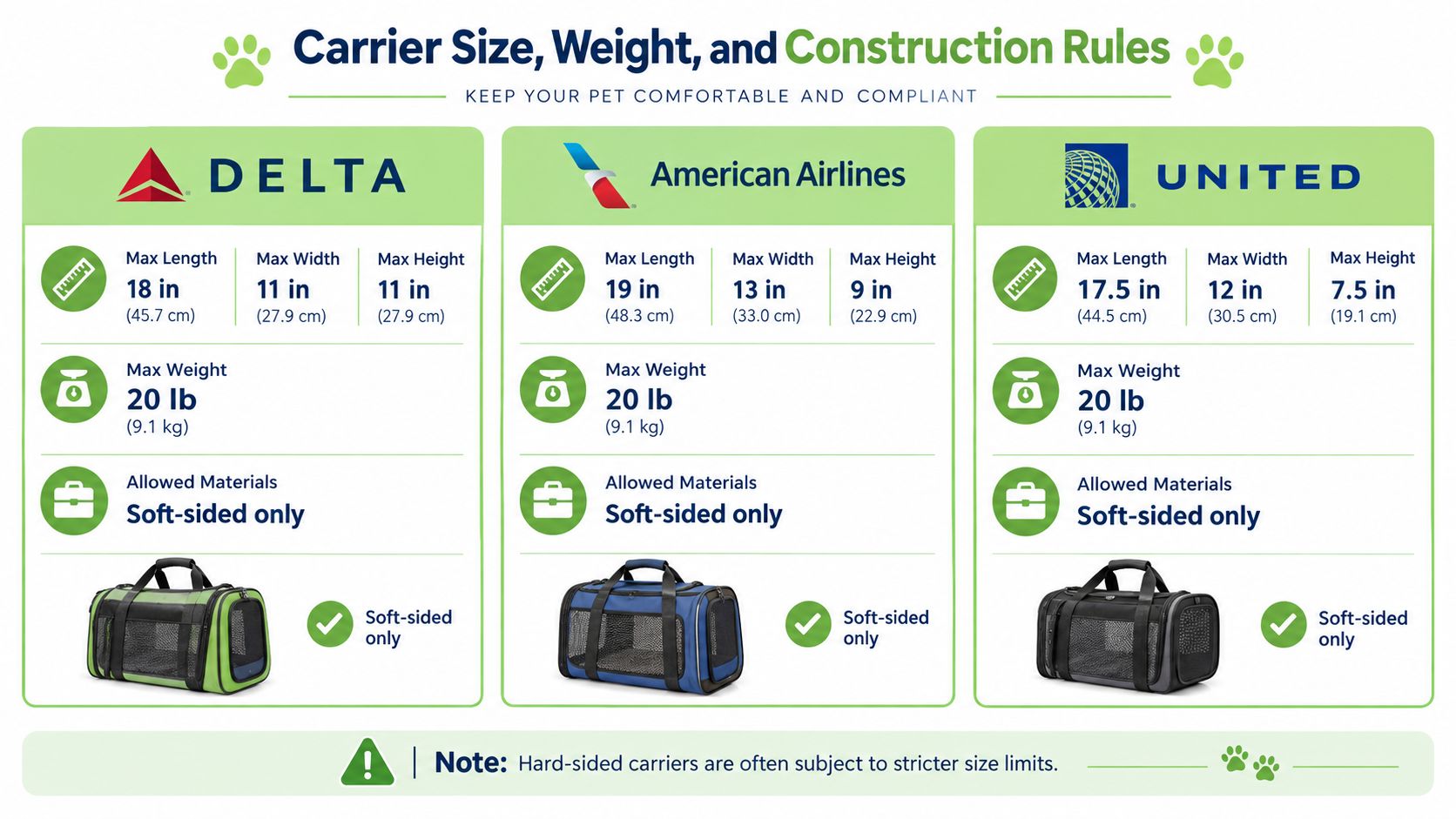
A practical shortlist for evaluating carriers:
-
Fit under the seat
If the top or sides can't compress, you're taking a gamble. -
Ventilation and closure
The carrier needs proper airflow and a fully closed structure. -
Pet posture
Your pet should be able to stand, turn around, and lie down naturally if the airline requires it.
For side-by-side sizing help before you buy, use Pet Magasin's guide to airline pet carrier size requirements.
Soft-sided is winning for a reason
One of the clearest examples is Air Canada. Starting June 1, 2025, Air Canada requires all cabin pets to be in soft-sided carriers, and the pet must be a cat or small dog, remain in a closed carrier under the seat, and be able to stand, turn around, and lie down, with no body part extending outside the carrier, according to Air Canada's pet travel policy.
That rule matters well beyond Air Canada because it reflects what many gate teams already prefer in practice. Soft-sided carriers are easier to fit under variable seat geometry.
The one-container exception people miss
If you're traveling with two compatible animals, IATA's in-cabin guidance allows a maximum of two adult animals of comparable size, up to 14 kg each, in the same container if they are compatible and used to cohabiting, under the IATA pet container requirements. That's a technical allowance, not a universal airline promise. Always ask the airline whether it honors that setup on your route.
My blunt advice: buy the carrier to satisfy the strictest airline on your shortlist, not the first airline you checked. That's how you avoid buying twice.
How to Book a Cabin Pet Spot Step by Step
Booking a pet isn't like adding a checked bag. Treat it like a separate reservation problem, because that's what it is.
Start with the airline's live pet-travel page. Don't rely on an old blog post or a third-party comparison chart. Pet rules change faster than seat maps, and airlines revise them without much fanfare.
Here's the workflow that works.
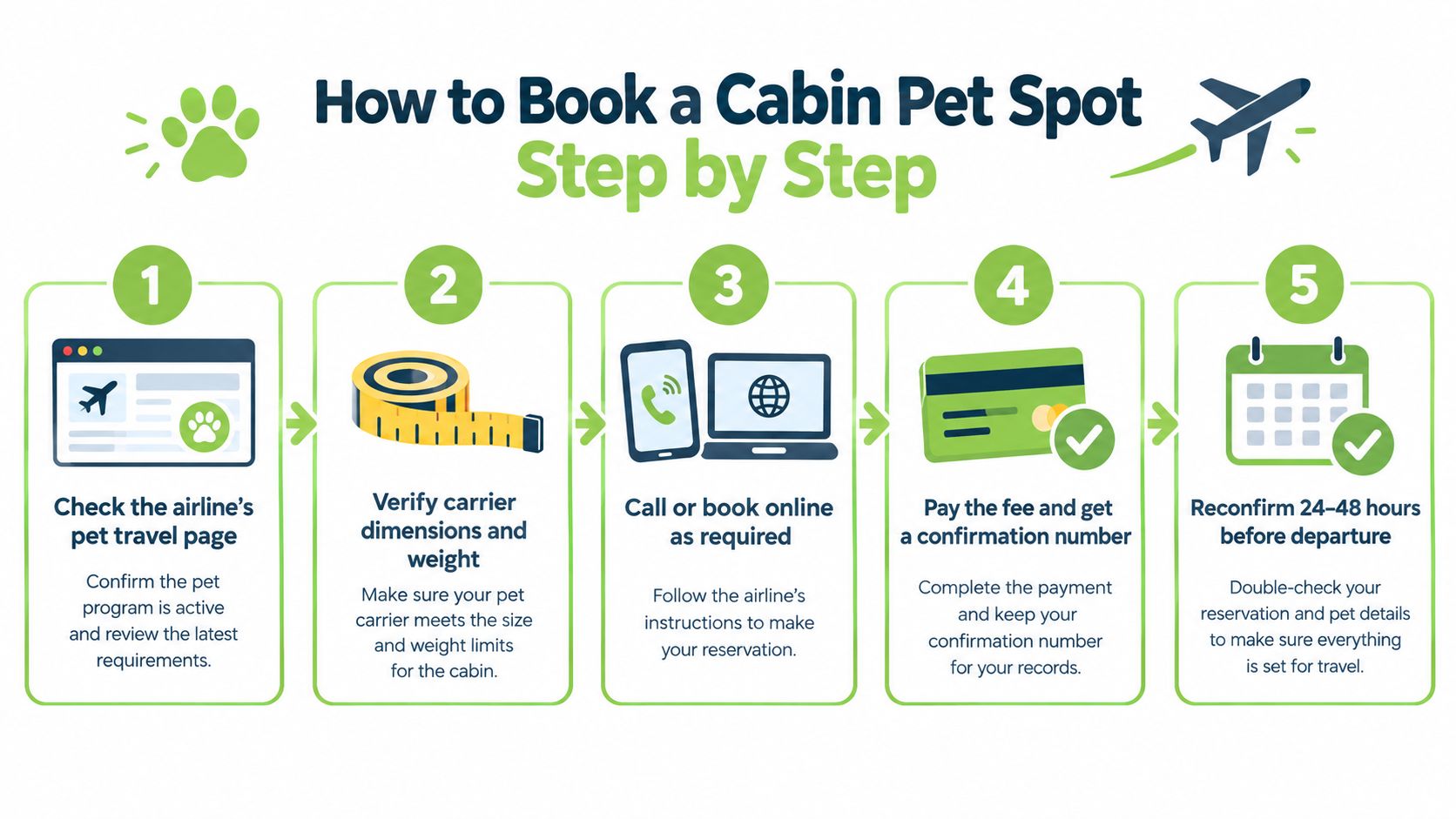
The booking order I recommend
-
Check the pet page first
Confirm the airline is actively offering in-cabin pet booking on your route. -
Match your carrier before you pay
Have the carrier dimensions ready. If the agent asks and you hesitate, you're already behind. -
Call the airline if there's any doubt
Pet space is limited and often managed separately from your ticket inventory. -
Confirm the exact flight number
Same route doesn't mean same aircraft, and same airline doesn't mean same operating rules. -
Save proof
Keep the confirmation code, agent name, and policy page screenshot or saved page.
A solid pre-booking refresher is Pet Magasin's article on how to fly with pets, especially if this is your first in-cabin trip.
What to ask the airline on the call
Don't ask, “Can I bring my dog?” Ask better questions:
- Is in-cabin pet space still available on this exact flight?
- Does this cabin class allow pets?
- Is every segment on my itinerary pet-eligible?
- Does this flight have aircraft-specific carrier limits?
- Do I need any route-specific paperwork?
Write down the agent's name and the exact flight details while you're on the call. If something goes sideways at check-in, that record helps.
Later in the process, use this visual checklist to keep your booking sequence clean.
What not to do
Don't book separate tickets on different airlines and assume the pet booking carries over. It doesn't. Don't wait until the day before travel to ask whether the carrier works. And don't assume online booking captured the pet correctly unless you have explicit confirmation.
The travelers who glide through pet check-in aren't lucky. They just verify the weak points before paying.
Route and Cabin-Class Restrictions That Trip People Up
Most “what airlines allow pets in cabin” articles fall apart. They stop at yes or no. Real failures happen because the answer was “yes, except on your cabin, your route, or your connection.”
Delta is the cleanest example. Delta allows in-cabin pets on many routes, but pets are not allowed in Delta One, Business Class, or First Class on international flights, and not on domestic flat-bed premium cabins either, according to Delta's pet policy details for agencies and travelers. That's a major restriction hidden behind an otherwise pet-permissive headline.
Common Route and Cabin-Class Restrictions
| Airline | Restricted Cabins | Restricted Routes | Workaround |
|---|---|---|---|
| Delta | Delta One, Business Class, First Class on international flights, domestic flat-bed premium cabins | Selected international and premium-heavy itineraries | Book standard eligible cabin and verify every segment before ticketing |
| Air Canada | Cabin acceptance tied tightly to soft-sided carrier compliance | Depends on flight setup and under-seat fit | Use a compliant soft-sided carrier and avoid last-minute substitutions |
| Many carriers | Premium cabins with limited under-seat geometry | Certain international legs or partner-operated flights | Choose a standard cabin and confirm the operating carrier, not just the marketing carrier |
The three restrictions that cause the most pain
Cabin class
Premium seats often have awkward footwell or seat structures that make under-seat stowage harder. If your pet must go under the seat, the cabin design matters more than the fare you paid.
Route exceptions
Long-haul international routes often carry added restrictions, especially if a destination has tighter import rules or the airline limits cabin pets on that corridor.
Operating carrier mismatches
A flight can carry one airline's code and another airline's plane and crew. That matters. The operating carrier's rules usually decide what happens at the airport.
If any leg of the itinerary breaks the chain, the whole trip can break. One “pet-friendly” first segment doesn't save a noncompliant connection.
My advice on high-friction itineraries
Be extra careful with:
-
London Heathrow
Pet entry rules can make cabin assumptions dangerous. -
Hawaii
The route and destination rules often need closer checking than mainland trips. -
Separate-ticket itineraries
These create the most preventable pet refusals.
For complicated trips, I'd rather see a traveler choose a less glamorous routing that cleanly supports the pet than a premium itinerary that looks better on paper and fails at check-in.
Travel-Day Checklist for Flying With a Pet
Travel day is not the time to improvise. By the time you reach the airport, your job is to make your pet look routine, contained, and easy for staff to process.
The night before matters more than you think. Inspect every zipper, seam, and panel on the carrier. Add an absorbent liner that won't bunch up under your pet. If the carrier has a shoulder strap and luggage sleeve, make sure nothing hangs loosely enough to annoy a gate agent or catch on an armrest.
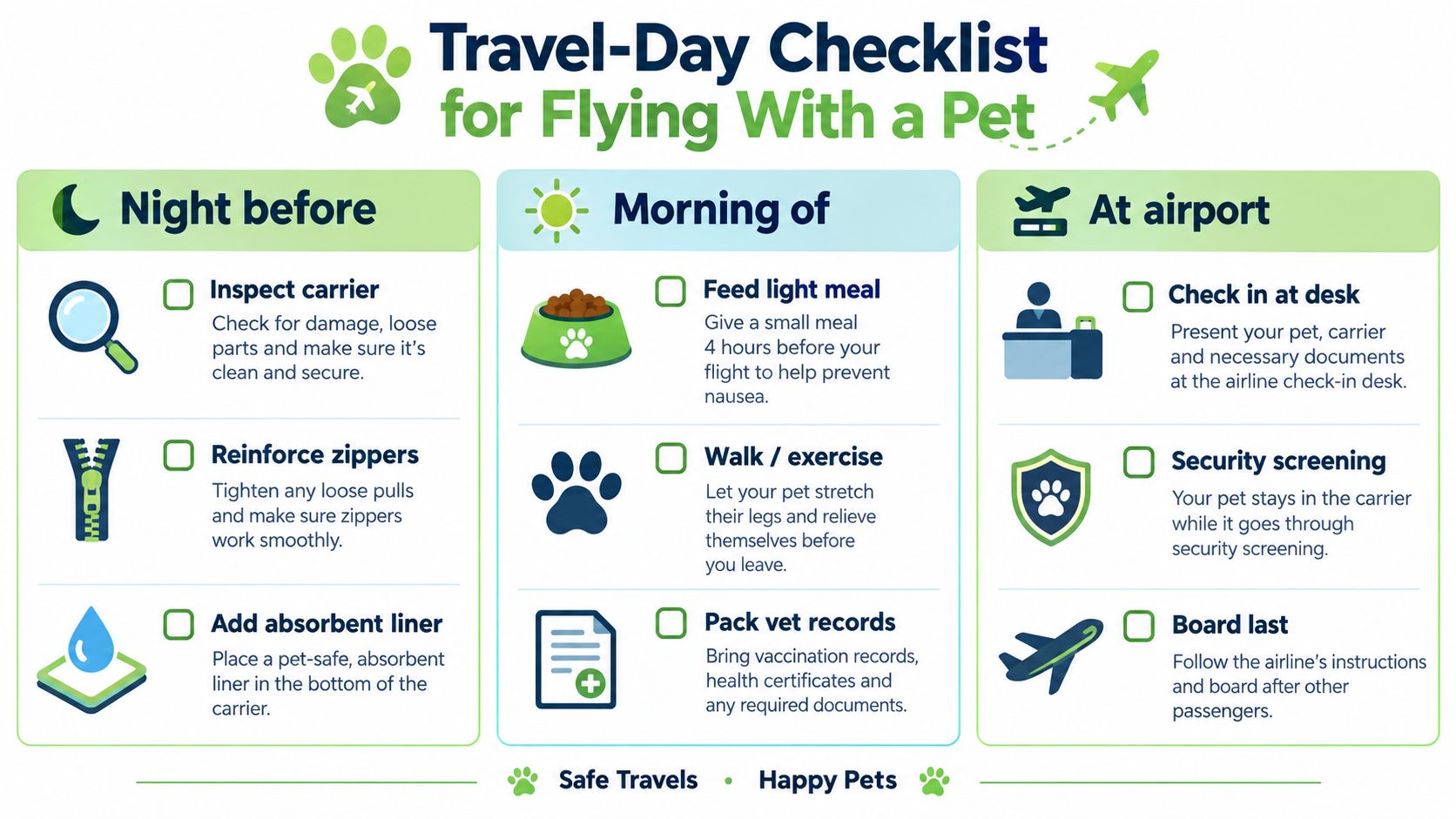
The night before
-
Inspect the carrier
Check stitching, zippers, mesh, and base support. -
Stage your documents
Keep confirmations and any required records in one folder. -
Pack for cleanup
Bring absorbent pads, wipes, and a spare liner.
The morning of the flight
Keep food light. Offer water sensibly and give your pet a calm walk before leaving for the airport. A rushed, overstimulated pet is harder to check in and harder to settle under the seat.
If your pet has never spent a quiet stretch in the closed carrier, that training should happen before travel day. The airport won't be the place to test tolerance.
At the airport and on board
A few practical moves make a huge difference:
-
Check in at the desk
Don't assume kiosk flow will handle pet verification smoothly. -
Tell the agent early
You want the pet noted and reviewed before boarding pressure starts. -
Stow cleanly
Keep the carrier fully under the seat and closed.
Keep the carrier closed for the whole flight unless airline staff instructs you otherwise.
Once you land, rehydrate your pet before heading out of the airport chaos. Then keep the return-trip confirmation handy. Plenty of travelers handle the outbound perfectly and get sloppy on the way home.
Putting It All Together for Your Next Trip
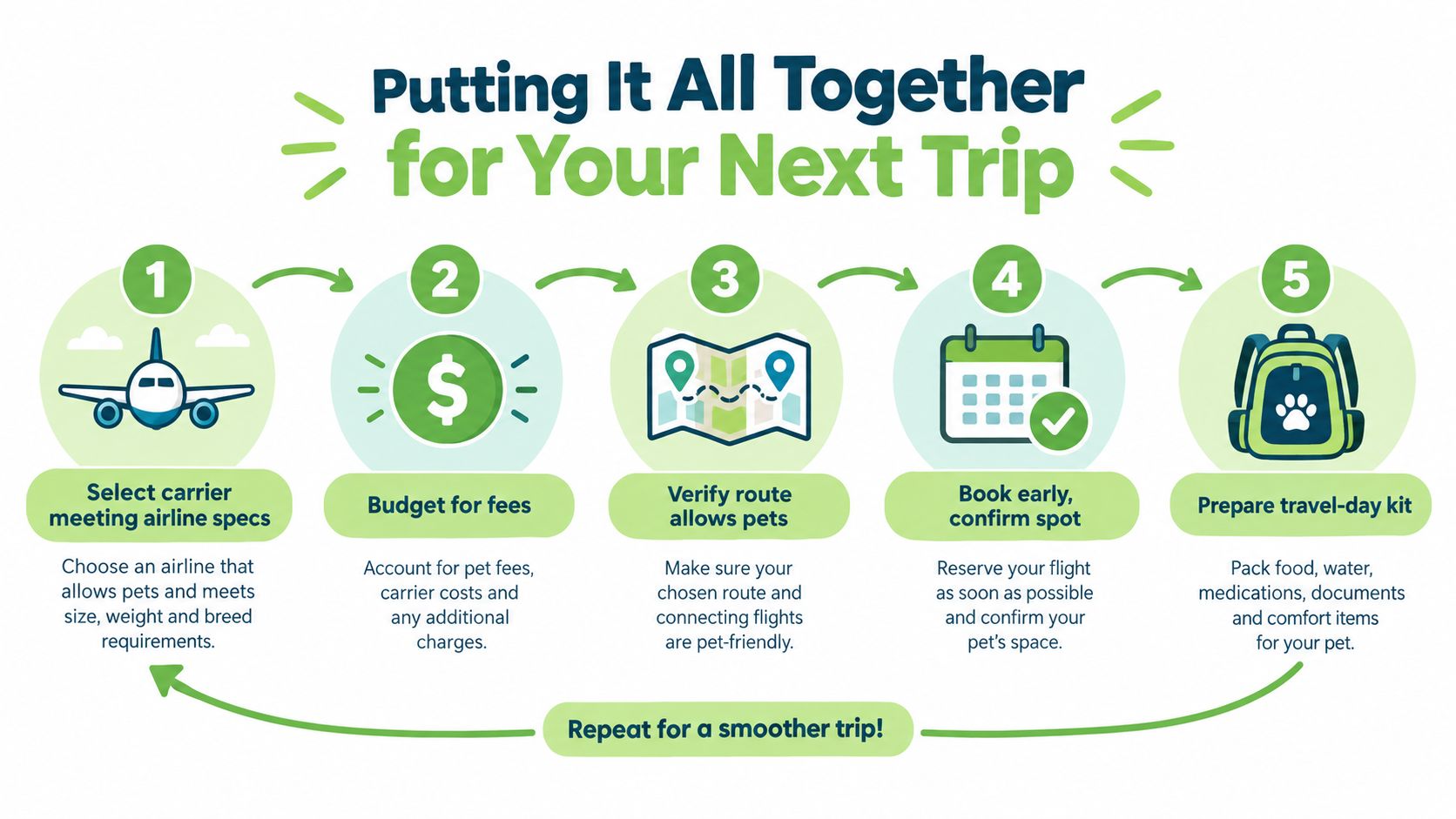
The repeatable system is simple. Start with your pet's real dimensions and your carrier's real dimensions. Then shortlist only the airlines and cabins that can physically support both.
After that, compare fees. Current summaries show commonly cited major-market cabin fees around about $95 to $150 each way, while Delta's domestic in-cabin pet fee rose to $150 one way and its international fee to $200 for tickets issued on or after April 8, 2025, based on Delta's pet travel overview. Budgeting matters, but compliance matters more. The cheapest fare becomes expensive fast if you have to rebook.
My planning framework
-
Measure first
Don't shop airlines before you know your carrier setup works. -
Match the strictest rule
Buy for the tightest cabin fit among your shortlisted airlines. -
Verify the exact flight
Route and cabin details decide whether the general policy means anything. -
Document everything
Save confirmations, names, and policy screenshots. -
Arrive with buffer time
Pet check-in takes longer when staff needs to verify dimensions or route eligibility.
One tool note before you book. If you're comparing carriers, a TSA airline-approved pet travel carrier such as the kind sold by Pet Magasin can help you start with cabin-friendly dimensions and soft-sided portability, but you still need to match it against the airline and aircraft you're flying.
The short version is this: airline lists are only the starting point. The booking survives when your carrier, cabin, route, and confirmation details all line up.
Pet Magasin helps travelers handle the part that causes most airport stress: choosing the right carrier, understanding airline fit rules, and preparing for the check at the counter. If you want practical gear and straightforward pet-travel guidance that fits this exact problem, visit Pet Magasin.

Leave a comment