


7 Essential Puppy Potty Training Tips for Success in 2025

Welcome to the exciting, and sometimes challenging, world of puppy ownership. Potty training is often the first major hurdle for every new pet parent, but with a clear plan, it doesn't have to be a stressful ordeal. Success isn't about a single magic trick; it's about executing a strategic combination of consistent routines, positive techniques, and understanding your puppy's needs. A well-executed plan prevents bad habits from forming and strengthens the bond between you and your new companion.
This guide provides actionable puppy potty training tips that you can implement immediately. We will break down the essential components of a successful housetraining journey, giving you the tools to build a strong foundation for a well-behaved dog and maintain a clean, puddle-free home. You will learn exactly how to transform this crucial training process from a potential source of frustration into a positive and rewarding experience for both you and your furry family member.
Inside this detailed listicle, we will cover the core pillars of effective potty training:
- Mastering Crate Training: How to use a crate as a safe den and training tool.
- Establishing a Consistent Schedule: How to create a predictable routine for potty breaks.
- Leveraging Positive Reinforcement: How to reward desired behaviors effectively.
- Supervision and Prevention: How to actively manage your puppy's environment to prevent accidents.
- Designating a Potty Area: How to teach your puppy where it's appropriate to go.
- Responding to Accidents: How to clean up correctly and avoid common mistakes.
- Practicing Patience: How to understand your puppy’s timeline and developmental stages.
By focusing on these practical strategies, you'll be well-equipped to navigate the housetraining process with confidence and clarity.
1. Crate Training
Use crate training to accelerate potty training by tapping into your puppy's natural denning instinct. Dogs instinctively avoid soiling their sleeping area. By introducing a crate as their personal den, you create a powerful tool that helps with house training, prevents destructive behaviors, and establishes a reliable routine. The crate serves as a management tool that prevents accidents when you cannot supervise your puppy directly, encouraging them to develop bladder and bowel control.
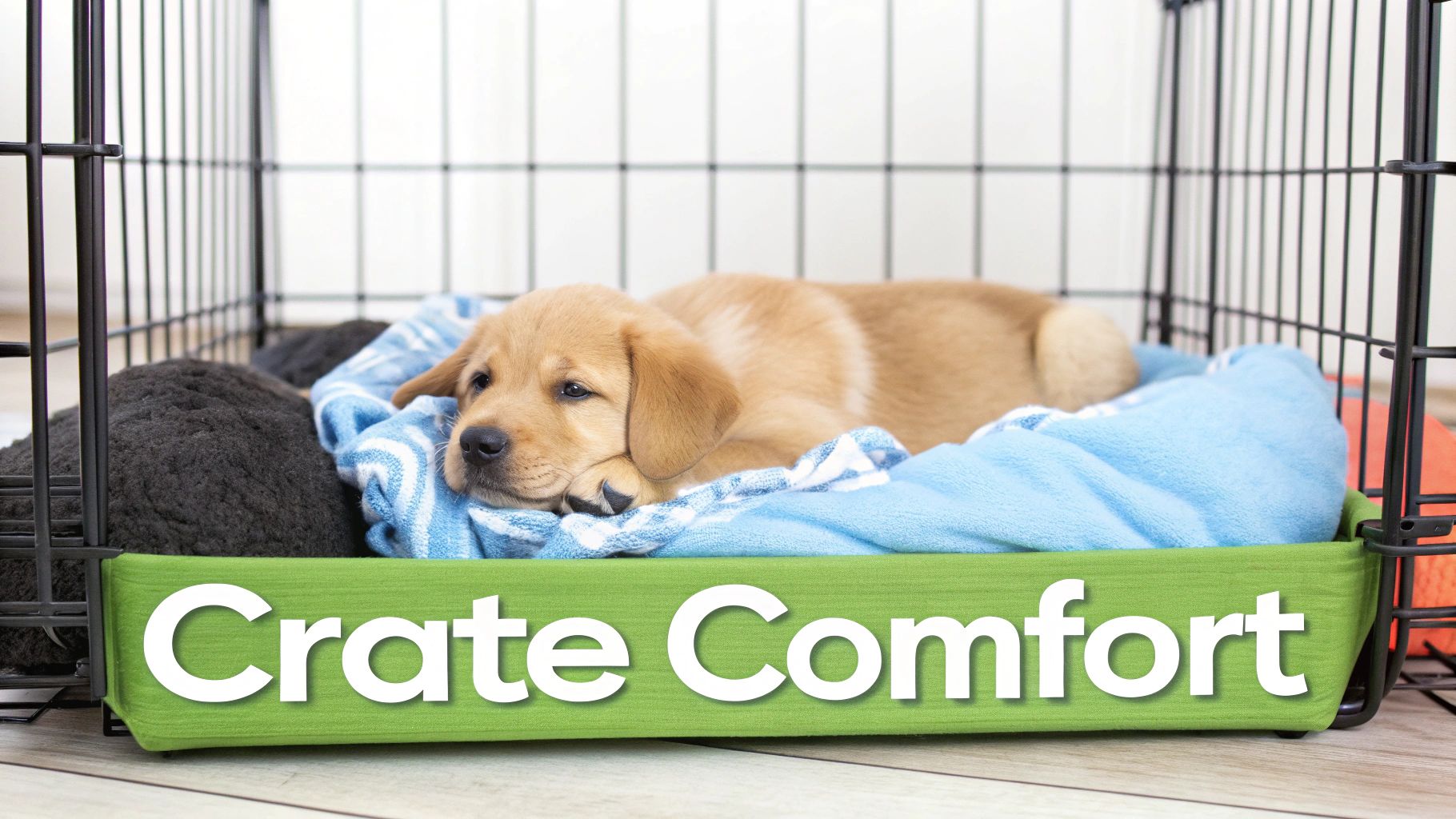
Professional dog trainers, service dog organizations, and veterinary professionals use this method because it works. It is one of the most effective ways to manage your puppy's environment and teach them self-control.
How to Implement Crate Training Effectively
To succeed, make the crate a positive and comfortable space, not a place of punishment. Your puppy must see their crate as a safe haven.
- Choose the Right Size: Select a crate that is just large enough for your puppy to stand up, turn around, and lie down. If it’s too large, they might use one end as a bathroom. Use the divider that comes with most crates, adjusting it as your puppy grows.
- Make It Inviting: Place a soft blanket or bed and a safe chew toy inside the crate. This creates a comfortable and appealing environment that encourages them to enter willingly.
- Build a Positive Association: Introduce the crate gradually. Toss high-value treats inside and praise your puppy for going in. Start feeding them their meals in the crate with the door open to build a strong positive connection.
Key Insight: Never use the crate as punishment. Sending a puppy to their crate after they've misbehaved creates a negative association, undermining your potty training efforts and causing anxiety.
Building a Crate and Potty Schedule
Consistency is the foundation of successful crate training. A puppy can typically hold their bladder for one hour for every month of age, plus one (e.g., a 3-month-old can often hold it for about four hours).
Follow this step-by-step schedule:
- Take your puppy out for a potty break immediately after letting them out of the crate in the morning.
- Take them outside after they eat, play, or wake up from a nap.
- Place them in the crate for short periods when you cannot supervise them.
- Always provide one final potty break right before bedtime and crating them for the night.
This structured routine teaches your puppy when and where to eliminate, accelerating your house-training success.
2. Establishing a Consistent Schedule
Puppies thrive on routine, and their biological rhythms are surprisingly predictable. Establish a consistent daily schedule for feeding, playing, and potty breaks to master house training. This predictability allows you to anticipate when your puppy needs to go outside, turning potty training into a proactive process rather than a reactive cleanup mission. By controlling their inputs (food and water), you gain significant control over their outputs.
This method is fundamental because it aligns with your puppy's developing digestive and urinary systems. Professional puppy daycare centers and breeders rely on strict schedules to manage groups of young dogs effectively, proving its value in creating well-behaved, house-trained pets.
How to Implement a Potty Schedule Effectively
Consistency is non-negotiable. Ensure every family member follows the same routine to avoid confusing the puppy. Your goal is to create a rhythm that your puppy’s body can adapt to.
- Map Out Key Potty Times: A puppy’s bladder and bowels are stimulated by certain activities. Always take your puppy for a potty break immediately after waking up (from a nap or in the morning), after every meal, and after a session of active play.
- Set Timed Intervals: For very young puppies (8-12 weeks), take them out every 2-3 hours. Use the rule of thumb that a puppy can hold it for the number of months they are old, plus one hour. So, a two-month-old can generally hold it for about three hours.
- Control Food and Water Intake: Feed your puppy at the same times each day. Puppies under six months should eat three meals. To prevent nighttime accidents, remove their water bowl 2-3 hours before their final bedtime.
Key Insight: Track your puppy's activities in a log or on a whiteboard for the first few weeks. Note when your puppy eats, drinks, plays, sleeps, and eliminates. This data will reveal patterns, helping you fine-tune the schedule and predict when a potty break is needed.
A Sample Puppy Potty Schedule
While every puppy is different, a structured routine teaches them that there are designated times for potty breaks. This helps build their bladder and bowel control over time.
Use this as your starting point:
- First Thing in the Morning: Take your puppy out the moment they wake up.
- After Meals: Take them out 15-30 minutes after they finish eating.
- Post-Nap and Post-Play: Take them out immediately after they wake up or right after a vigorous play session.
- Before Bedtime: Ensure one last potty break right before you put them to bed for the night.
Following a rigid schedule is one of the most powerful puppy potty training tips because it minimizes opportunities for accidents and reinforces the correct behavior through repetition.
3. Positive Reinforcement and Reward-Based Training
Use positive reinforcement to make potty training a collaborative and enjoyable experience. This method focuses on rewarding desired behaviors—like eliminating outside—with something your puppy values. Immediately offer praise, a high-value treat, or a favorite toy after they potty in the correct spot. This teaches them to associate going outside with positive outcomes, making them eager to repeat the behavior.
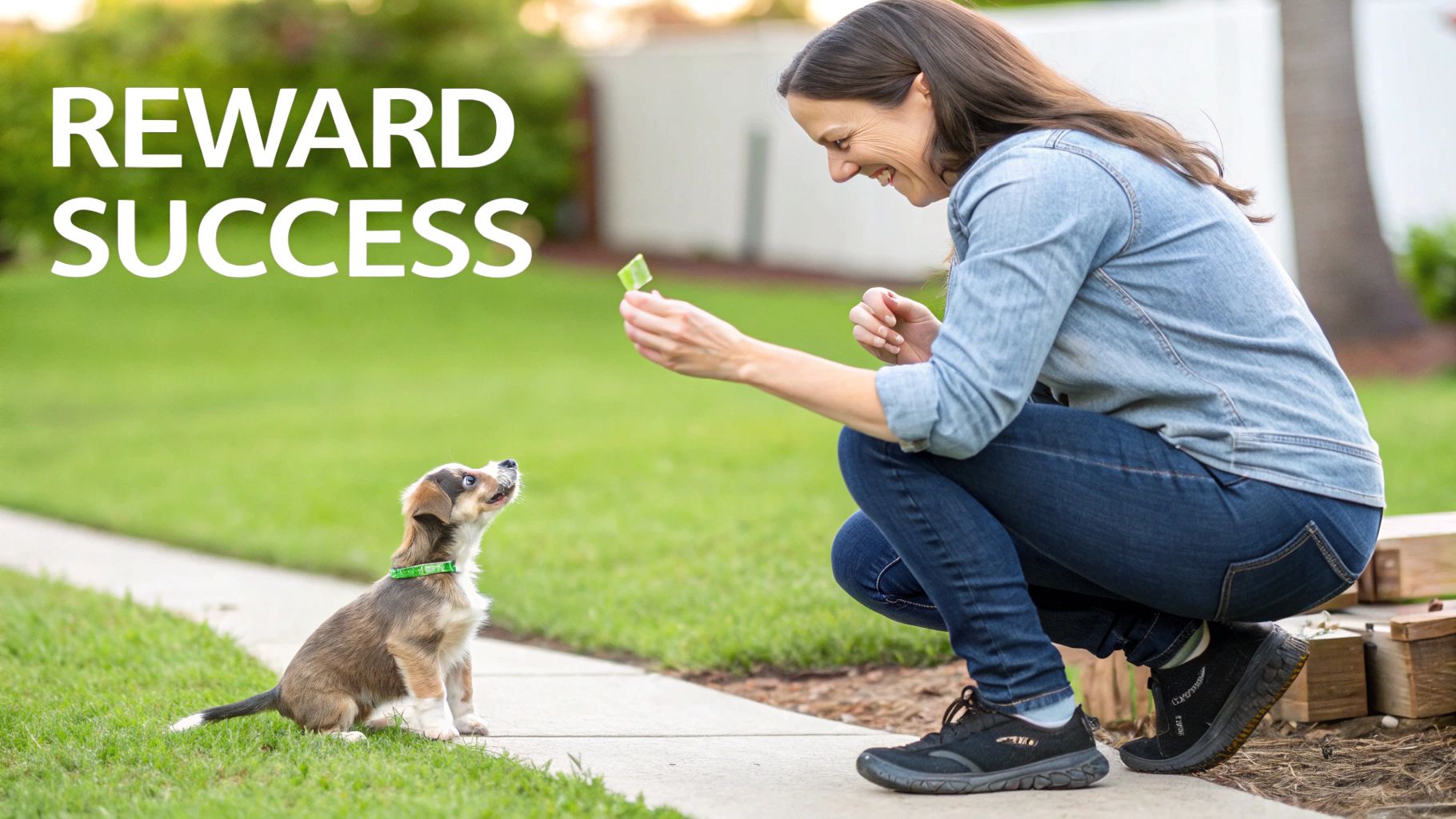
This is the gold standard for modern dog trainers and veterinary behaviorists because it builds trust and strengthens your bond. In contrast, punishment-based methods often create fear and confusion, which can sabotage your potty training efforts. A happy, confident puppy learns much faster than a scared one.
How to Implement Positive Reinforcement Effectively
The key to this method is immediate and consistent rewarding. The reward must occur within a second or two of the puppy finishing their business for them to make the correct connection.
- Choose High-Value Rewards: Use small, soft, and aromatic treats that your puppy loves and only gets during potty training. This makes the reward extra motivating. Bits of chicken, cheese, or special training treats work well.
- Pair Treats with Enthusiastic Praise: As you give the treat, use an excited, happy tone of voice. Say phrases like "Yes! Good potty!" This verbal praise will eventually become a reward in itself.
- Create a Cue Word: Start saying a cue phrase like "go potty" or "hurry up" right as your puppy begins to eliminate. After several repetitions, they will associate the phrase with the action, which allows you to prompt them to go on command.
Key Insight: The timing of the reward is everything. If you wait until you are back inside to give the treat, your puppy will think they are being rewarded for coming indoors. Always bring treats outside with you.
Building a Reward-Based Routine
Integrate positive reinforcement into your daily schedule to make it a powerful habit-forming tool. Consistency reinforces the lesson that good things happen when they potty in the right place.
Follow these steps for every successful potty trip:
- Take your puppy to their designated potty spot on a leash.
- Stand still and wait quietly for them to do their business. Do not distract them with play.
- The moment they finish, mark the behavior with enthusiastic praise and immediately give them the high-value treat.
- After the reward, let them have a few minutes of playtime outside as an additional bonus reward before heading back in.
This clear, rewarding sequence is one of the most effective puppy potty training tips because it communicates exactly what you want in a way your puppy understands and appreciates.
4. Supervision and Prevention Strategies
Actively supervise your puppy to prevent accidents before they happen. This proactive approach is built on a simple principle: if you are watching your puppy, you can intervene at the first sign they need to go outside. This eliminates the opportunity for them to make a mistake indoors and sets them up for success.
Combining constant supervision with strategic prevention is one of the most powerful puppy potty training tips because it breaks the cycle of indoor accidents. Every time a puppy successfully eliminates outside, it reinforces the correct behavior. Conversely, every accident indoors can inadvertently reinforce the wrong habit, making prevention absolutely critical.
How to Implement Supervision and Prevention Effectively
Create a controlled environment where your puppy has limited chances to have an accident. This requires being attentive and using management tools.
- Restrict Access: Use baby gates or close doors to confine your puppy to the room you are in. This prevents them from wandering off to a hidden corner to potty. The kitchen or a puppy-proofed living area are ideal choices.
- Use an Indoor Leash: Keep your puppy on a lightweight leash tethered to you while indoors. This technique keeps them within your line of sight at all times, making it easy to spot pre-potty signals.
- Learn and Watch for Signals: Identify your puppy’s specific cues that they need to eliminate. Common signs include circling, sniffing the ground intently, whining, or heading toward a door. When you see these, take them outside immediately.
Key Insight: Prevention is far more effective than correction. Punishing a puppy for an accident only creates fear and anxiety. Instead, focus on preventing the accident from occurring in the first place through diligent management.
Creating a Puppy-Proof Potty Zone
A key part of prevention is managing your puppy's space. By controlling their environment, you guide their choices and make the right behavior the easiest option.
Follow these steps to manage your puppy’s area:
- Start Small: Keep your puppy in a single, easy-to-clean room with you, like the kitchen.
- Remove Temptations: Temporarily remove area rugs or carpets that puppies may be drawn to, as the soft texture can feel similar to grass.
- Clean Accidents Thoroughly: If an accident happens, use an enzymatic cleaner specifically designed to eliminate pet odors. Standard cleaners won't break down the uric acid, and any lingering scent will attract your puppy back to the same spot.
- Expand Freedom Gradually: As your puppy becomes more reliable, slowly grant them access to more areas of the house, one room at a time.
This combination of active supervision and environmental management teaches your puppy that the entire house is their "den," not just their crate, and that the only appropriate place to potty is outside.
5. Designated Potty Area and Spot Training
Establish a designated potty area to bring predictability and clarity to the training process. This method involves teaching your puppy to eliminate in one specific spot, which streamlines cleanup, reinforces good habits, and reduces confusion. By consistently guiding your puppy to the same location, you leverage their natural tendency to return to a familiar scent, making training faster and more effective.
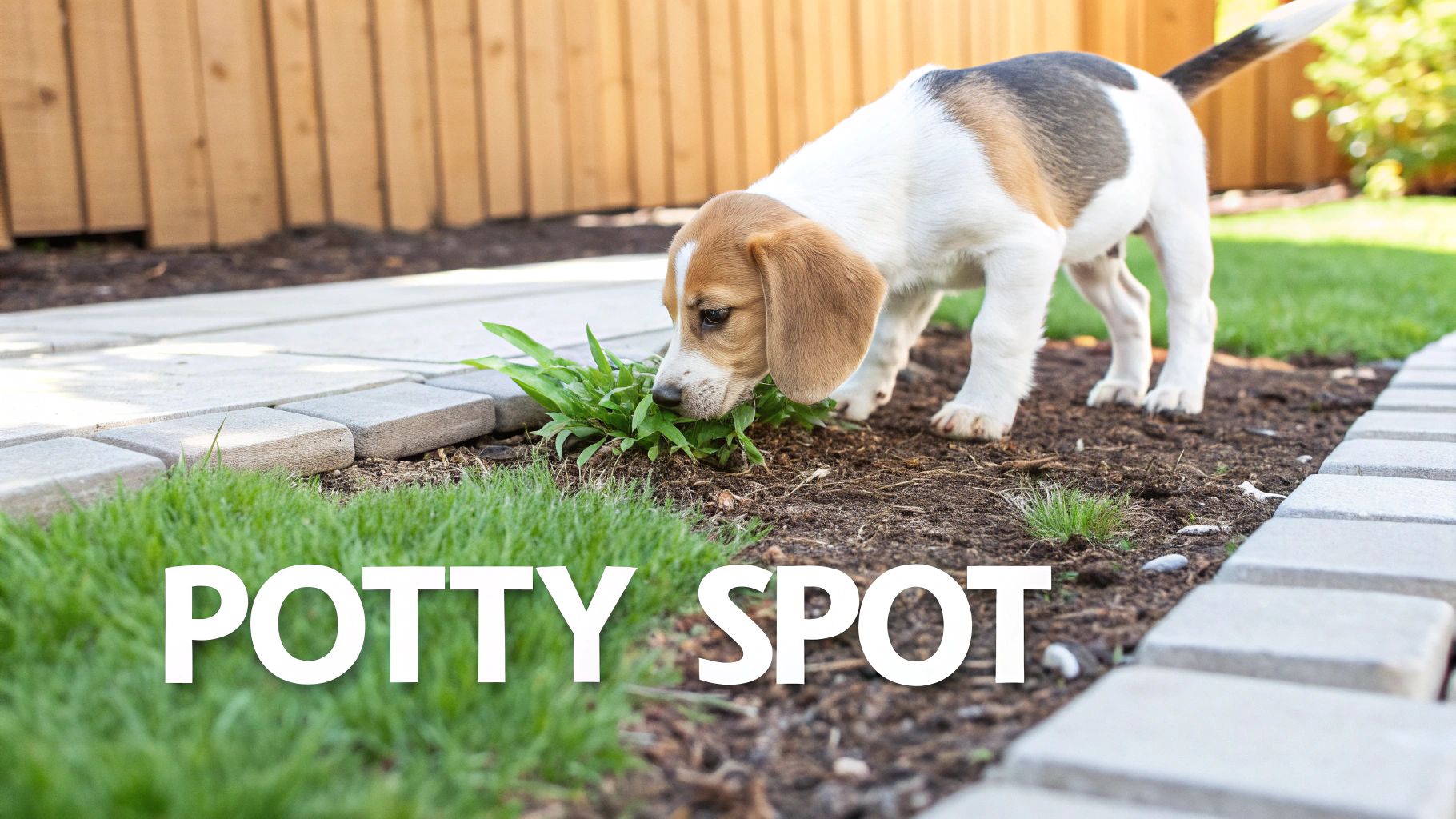
This technique is beneficial for all dog owners, from those with large yards to urban dwellers. Creating a consistent "bathroom" helps you monitor your puppy's habits and ensures they understand that the entire backyard is not a toilet. It transforms potty breaks from a random activity into a predictable, purposeful task.
How to Implement Spot Training Effectively
Success with spot training hinges on consistency. Your goal is to build a strong association between that specific location and the act of elimination.
- Choose a Suitable Spot: Select a location that is easily and quickly accessible. It should be on a surface you want your puppy to use long-term, like grass or gravel. Ensure it's a low-traffic area to minimize distractions.
- Use a Verbal Cue: Associate a specific phrase, like "go potty," with the act. Only say the cue when you are in the designated spot and you see them starting to eliminate.
- Harness Their Scent: The first few times your puppy successfully goes in the right spot, don't clean it up immediately. Their scent will act as a powerful magnet, encouraging them to use that same area again.
Key Insight: Make the potty spot for business, not for play. Keep potty breaks focused and boring until your puppy has eliminated. Once they finish, reward them with praise and then transition into a fun walk or playtime as a separate activity.
Building a Routine Around the Potty Spot
Integrate the designated spot into your daily schedule to reinforce the habit. Every potty break should follow the same pattern.
Follow this routine for every trip outside:
- Carry or leash your puppy and take them directly to the chosen spot immediately after waking up, after meals, and after playtime.
- Once at the spot, stand still and quietly repeat your verbal cue. Let them sniff and circle within that small area.
- Give them 5-10 minutes to go. If they successfully eliminate, offer enthusiastic praise and a high-value treat the second they finish.
- If they don’t go, take them back inside, supervise them closely (or place them in their crate), and try again in 15-20 minutes.
This focused approach teaches your puppy that trips to this specific spot have one clear purpose. For those living in apartments, using scented puppy pads in a designated indoor area can be an effective alternative.
6. Recognizing and Responding to Accidents
Accidents are an inevitable part of potty training. Instead of viewing them as failures, see them as learning opportunities. How you respond can either reinforce your training and build trust or create fear and set your progress back. A calm, strategic response is one of the most vital puppy potty training tips.
Veterinary behaviorists and professional trainers champion this approach because it focuses on communication and management, not punishment. Correctly handling an accident reinforces where the appropriate potty spot is, prevents the puppy from wanting to use the same indoor spot again, and keeps the training experience positive.
How to Respond to Accidents Effectively
Your reaction is critical. The goal is to clean thoroughly and calmly redirect, not to scold.
- If You Catch Them in the Act: Make a quick, surprising noise like a clap or an "Oops!" to interrupt them without being scary. Immediately lead them outside to their designated potty spot. If they finish there, praise them lavishly.
- If You Find It Later: Do not punish your puppy. They cannot connect your anger with an action they did minutes or hours ago. Scolding them or rubbing their nose in it only teaches them to fear you.
- Clean with an Enzymatic Cleaner: This is non-negotiable. Standard household cleaners will not eliminate the uric acid that signals to your puppy, "This is a bathroom!" Use an enzymatic cleaner to break down the specific proteins in urine, completely removing the scent that attracts them back to the spot. Avoid ammonia-based cleaners, as they smell similar to urine to a dog.
Key Insight: Every accident is data. It tells you there was a breakdown in your management or schedule. Instead of blaming the puppy, ask yourself: Was it too long between potty breaks? Did I miss their signals? Use this information to adjust your plan.
Turning Accidents into Training Adjustments
Consistently viewing accidents as feedback is the key to preventing them in the future. This mindset shifts the responsibility from the puppy to your management plan.
Use this framework to analyze and adjust:
- Review Your Schedule: If the accident happened just before a scheduled break, you need to take your puppy out more frequently.
- Increase Supervision: If the accident happened when the puppy was out of your sight, limit their freedom to one room or use a leash indoors until they are more reliable.
- Identify Triggers: If accidents happen after playing, eating, or waking up, become extra vigilant during these times and preemptively take them outside.
Even with consistent training, accidents can happen. When they do, it's vital to know how to clean dog pee on hardwood floors quickly and safely to protect your home while maintaining a positive training environment.
7. Patience and Understanding Developmental Milestones
One of the most crucial puppy potty training tips is to exercise patience and understand your puppy's physical limitations. Potty training is tied to physiological development. Young puppies lack full bladder and bowel control, and expecting perfection too early leads to frustration for both you and your pet. Accidents are a normal part of development, not a sign of defiance.
Veterinary professionals emphasize that recognizing your puppy is learning and growing allows you to set realistic expectations and maintain a positive, supportive training environment. This understanding is the bedrock of a successful and stress-free potty training journey.
How to Align Expectations with Puppy Development
Adjust your training approach to match your puppy's developmental stage. Give your puppy the time they need to mature physically.
- Physical Control Timeline: Most puppies don't gain reliable bladder control until they are 12 to 16 weeks old. Before this, their muscles are simply not developed enough to "hold it" for long periods.
- Breed and Size Differences: Smaller breeds, like Chihuahuas, have smaller bladders and may need up to 6-8 months to achieve full control. In contrast, some large breed puppies may grasp it closer to the 16-week mark.
- Individuality Matters: Every puppy is an individual. Progress is not always linear; setbacks can happen, especially during growth spurts or changes in routine.
Key Insight: View potty training as a developmental process, not a test of obedience. This will transform your mindset. Celebrate small victories, like a single accident-free day, and don't get discouraged by setbacks.
Building a Patient and Consistent Training Plan
Your role is to manage your puppy’s environment and routine consistently until their body can catch up with their training. Patience is an active strategy.
Use these milestones as a guide for your expectations:
- 8-12 Weeks: Expect frequent accidents. Your focus must be on a rigid schedule of potty breaks every 1-2 hours, constant supervision, and crate training.
- 12-16 Weeks: You will start to see more consistent success as physical control develops. Continue the strict schedule, but notice if your puppy begins to signal when they need to go out.
- 4-6 Months: Many puppies achieve daytime reliability, but nighttime control might still be a challenge. Maintain the routine and never punish accidents.
- 6+ Months: If a puppy over six months old continues to have frequent accidents despite consistent training, consult a veterinarian to rule out any underlying medical issues.
By maintaining a positive attitude and a consistent routine, you provide the structure your puppy needs to succeed as they grow.
7-Point Puppy Potty Training Comparison
| Method | 🔄 Implementation Complexity | ⚡ Resource & Time Requirements | ⭐ Expected Outcomes | 📊 Ideal Use Cases | 💡 Key Advantages |
|---|---|---|---|---|---|
| Crate Training | Moderate — needs correct sizing and gradual introduction | Low–moderate resources (crate, bedding); regular short sessions | Very high ⭐⭐⭐⭐ — strong accident prevention and routine establishment | When unsupervised, travel, early housetraining | Provides secure den, simplifies supervision, portable |
| Establishing a Consistent Schedule | Moderate — requires strict adherence and planning | Minimal equipment; high owner time/consistency | Very high ⭐⭐⭐⭐ — dramatically reduces indoor accidents over weeks | Owners with predictable availability; young puppies | Predictable elimination, improves digestion and routine |
| Positive Reinforcement & Reward-Based Training | Moderate — requires precise timing and consistency | Low cost (treats, attention); needs immediate owner presence | Very high ⭐⭐⭐⭐–⭐⭐⭐⭐⭐ — fastest, reliable learning with low risk | All puppies; builds confidence and bond; training classes | Encourages repeatable behavior, strengthens owner-puppy bond |
| Supervision & Prevention Strategies | High — constant monitoring and environment setup | Moderate equipment (gates, leashes); high owner attention | High ⭐⭐⭐ — prevents accidents but labor-intensive | Early training stages, high-risk puppies, home-based management | Stops mistakes before they occur, enables immediate redirection |
| Designated Potty Area & Spot Training | Low — simple routine of same location and cue | Minimal (outdoor access or pads); time for repeated outings | High ⭐⭐⭐ — strong location association, easier monitoring | Apartments, multi-dog homes, owners seeking consistency | Scent-based habit formation, simplifies cleanup and tracking |
| Recognizing & Responding to Accidents | Low — immediate actions and correct cleaners | Low–moderate (enzymatic cleaner); requires prompt response | High ⭐⭐⭐ — prevents re-soiling and fear, supports recovery | Any training stage when accidents occur | Eliminates scent cues, avoids punishment, guides plan adjustments |
| Patience & Understanding Developmental Milestones | Low implementation complexity; high long-term demand | No equipment; long-term time and mindset commitment | Moderate–high ⭐⭐⭐ — prevents unrealistic expectations, supports consistent progress | All owners; breeds with varied developmental rates | Sets realistic goals, reduces owner frustration, preserves trust |
Your Next Steps to Potty Training Mastery
You have now armed yourself with a comprehensive toolkit of proven strategies to potty train your puppy. The journey to a fully house-trained companion is built on consistency, patience, and positive reinforcement. This process is not merely about preventing messes; it is about forging a deep, communicative bond with your new family member. By implementing these actionable puppy potty training tips, you are teaching your dog one of life's most important lessons in a way that builds trust and mutual respect.
Let's distill the core principles into a final, actionable roadmap. Think of this process as a three-part harmony: proactive management, positive reaction, and persistent patience. Each element works together to create a successful outcome.
Key Takeaways: Your Core Training Philosophy
Mastering potty training comes down to embracing the role of a patient teacher.
- Consistency is Your Superpower: A predictable schedule for feeding, watering, and potty breaks is the single most effective tool you have. It regulates your puppy’s system and teaches them when to expect potty breaks.
- Prevention Beats Correction: Use crates, puppy-proofed areas, and tethers to prevent accidents before they happen. Active supervision is non-negotiable in the early stages.
- Communication is a Two-Way Street: Learn your puppy’s unique signals—a whimper, a circle, a sniff at the door—and act on them immediately. Your quick response reinforces their attempts to communicate.
- Positivity Breeds Success: Meet every successful trip outside with enthusiastic praise and high-value rewards. This makes your puppy want to do the right thing.
Your Action Plan for the Weeks Ahead
With these principles in mind, take these immediate next steps. The journey of a thousand successful potty breaks begins with a single, well-planned day.
- Draft Your Schedule (Tonight): Create a detailed potty schedule based on your puppy's age (their age in months plus one equals the hours they can realistically hold it). Post it where everyone in the household can see and follow it.
- Set Up Your "Success Zone" (Tomorrow): Designate a specific, easily accessible potty spot outside. Prepare your internal management tools: a comfortable crate, a puppy-proofed room with a washable floor, and perhaps a set of reliable washable diapers for supervised outings or overnight peace of mind.
- Stock Your Reward Arsenal: Identify what truly motivates your puppy, whether it's a tiny piece of boiled chicken, a special squeaky toy, or effusive praise. Have these ready at the door at all times.
- Embrace the Mantra: "Accidents are Data": When an accident happens, do not view it as a failure. Instead, ask yourself: "What did I miss?" Was the time between breaks too long? Did I misread a signal? Use each cleanup as a data point to refine your schedule and supervision strategy.
Ultimately, these puppy potty training tips are about more than just a clean house. They are your first major collaborative project with your new dog. Successfully navigating this challenge together builds the foundation for all future training and teaches your puppy that you are a reliable, trustworthy leader.
Ready to equip yourself with the best tools for the job? From managing inevitable accidents to keeping your puppy clean and comfortable, having the right supplies makes all the difference. Explore the premium, thoughtfully designed pet products at Pet Magasin to support your training journey and ensure you and your new best friend have everything you need to succeed. Visit Pet Magasin today to find the perfect solutions for a happier, cleaner home.

Leave a comment