
How Long Do Diapers Last for Pets: A Practical Guide

Unopened disposable diapers generally last about 2–3 years when stored properly, while a diaper worn by a pet usually lasts 3–4 hours during the day and up to 8 hours overnight. Those are two different timelines, and confusing them can lead to leaks, skin irritation, or a cupboard full of aging supplies.
You may be dealing with both questions right now. Perhaps your dog came back from a walk with a soaked diaper, and you're wondering whether the replacement pack in the closet is still reliable. Maybe you're comparing disposable convenience with washable diapers and trying to work out which option makes sense over months of daily care.
The useful answer depends on wear time, storage conditions, material quality, fit, and washing habits. Here's how to judge each timeline in practical terms, from a single change to a long-term care routine.
What Pet Owners Really Mean by How Long Do Diapers Last
A dog owner can ask “how long do diapers last?” after two very different moments. The first might be a rush through the front door after a walk, followed by the discovery of a soaked diaper and a damp trail across the kitchen floor. In that situation, the question means, “How many hours should this diaper work before I change it?”
The second question appears while sorting supplies. You find an unopened pack behind towels or in a pantry and wonder whether it's still dependable. That's a shelf-life question, not a wear-time question. The package may look perfectly intact even though the elastic, adhesive, or absorbent core has gradually lost performance.
Two timelines, two sets of risks
For actual use, a pet diaper's useful life is measured in hours. Urine volume, movement, sleep, fit, and whether the pet has diarrhea or steady leakage all affect the result. A diaper can fail early because it has sagged, shifted, or become saturated, even when the product itself is new.
For storage, the useful life is measured in months and years. Disposable diapers generally don't have a fixed expiration date, but manufacturer-guidance summaries commonly recommend using them within about 2 years of purchase, because adhesives, elastic, and absorbent materials can degrade. Healthline explains why diaper age is mainly an effectiveness concern rather than a formal safety issue.
That distinction matters for pet owners who buy in bulk. A sealed pack kept cool and dry may remain usable for years, while a pack exposed to heat, damp air, or sunlight can become less dependable sooner. Washable diapers follow a third timeline: they're reused across many changes, and their lifespan depends heavily on laundry care.
Practical rule: Judge a disposable by its current fit and absorbency, not just by the date you bought it. Judge a washable by its barrier, seams, elastic, and odor after cleaning.
Keep a pet-safe cleanup plan nearby as well. If a leak reaches flooring or bedding, guidance on non toxic cleaners for dogs can help you choose cleaning products that are appropriate around animals. The rest of your decision comes down to how long each diaper works on the pet, how storage changes disposable performance, and how care affects washable reuse.
Per-Use Wear Time for Disposable and Washable Pet Diapers
A practical starting point for most pets is to check the diaper every few hours and change it before it becomes heavy, loose, or wet against the skin. A 2024 nursing study of 47 children recorded wear periods of 3–4 hours for 48%, 1–2 hours for 32%, 5–6 hours for 18%, and 7–8 hours for 2%. The same study cited 4 hours during the day and 8 hours at night as hygiene-based reference points. Read the study text for its recorded wear-time distribution.
Those figures aren't a promise for every dog or cat. Puppies, senior pets, heavy wetters, and animals with diarrhea may need much earlier changes. A pet that drinks more than usual, moves constantly, or produces a steady stream of urine can overwhelm the same diaper that works comfortably for a sleeping animal.
| Diaper Type | Daytime Use | Overnight Use | Heavy Incontinence |
|---|---|---|---|
| Disposable | Usually about 3–4 hours | Up to 8 hours if the pet sleeps and the diaper remains dry against the skin | Check more often and change as soon as it becomes heavy, wet, or unstable |
| Washable | Often a similar practical window, depending on pad thickness and material | May work through sleep if absorbency and fit are sufficient | Use added absorbency and inspect frequently, with earlier changes when saturated |
What shortens the window
A washable diaper's inner layer makes a noticeable difference. Microfiber absorbs quickly, while bamboo and hemp can offer greater capacity but may absorb at a different rate. A thicker pad usually holds more, but too much bulk can create gaps around the legs or waist.
The type of output matters just as much. Steady dripping may gradually fill the absorbent core, while diarrhea can soil the diaper and skin immediately. Activity can pull the diaper out of position, and a male dog may need a different design or more careful placement than a female dog.
Fit matters as much as brand. The waistband should sit securely without rubbing, the leg openings should contact the body without pinching, and the absorbent area should align with the urine stream. A correctly sized diaper usually stays functional longer than a loose diaper with a larger-looking capacity.
Shelf Life and Storage Tips for Unopened Disposable Diapers
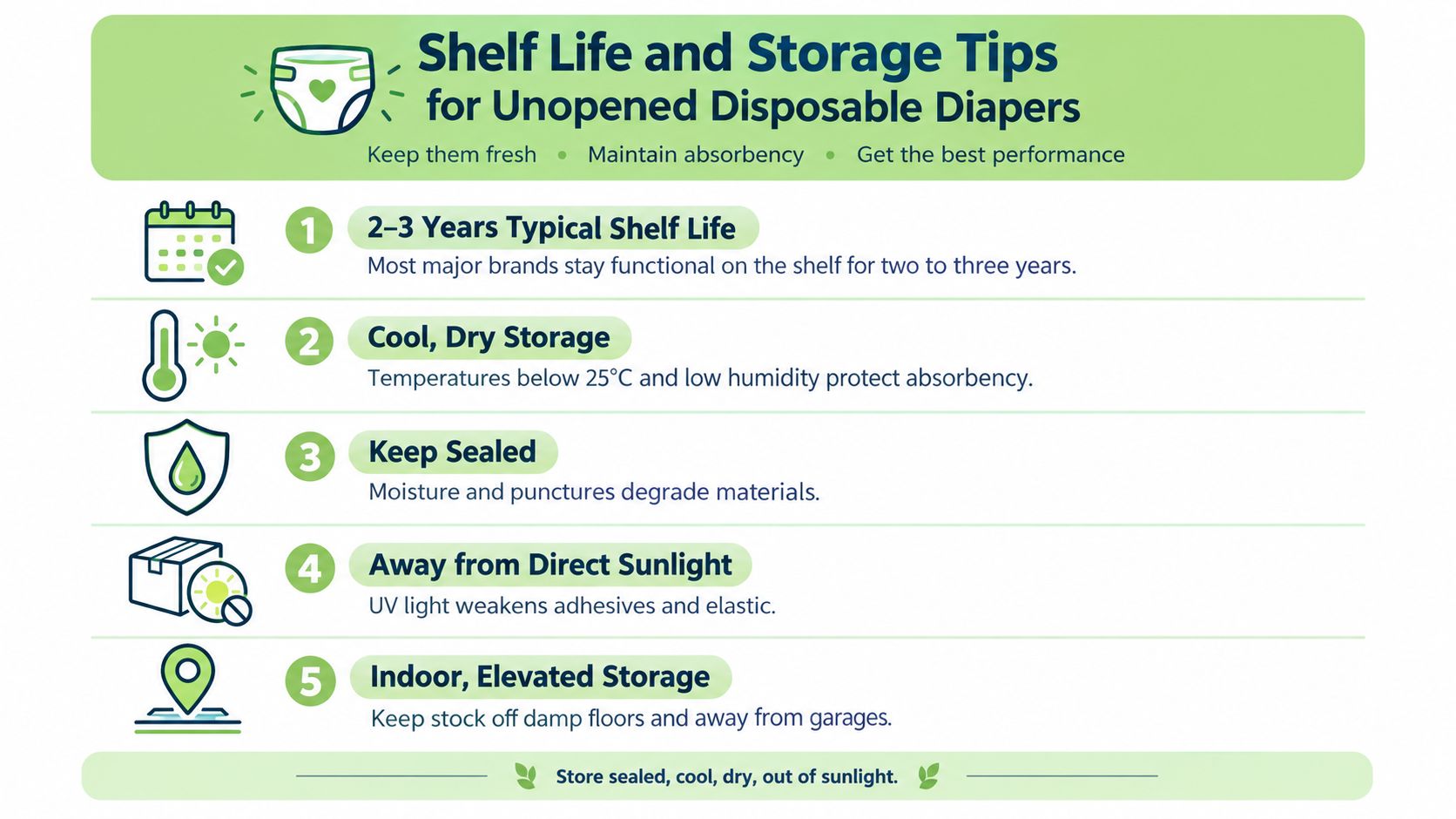
Most sealed disposable diapers are best treated as a 2–3-year stock item, not an unlimited reserve. Manufacturer guidance summarized by Pampers' quality and safety information says unopened diapers can typically last up to 3 years when stored properly, while opened packs are best used within 12 months. Heat and humidity can shorten that functional window.
The materials explain why. A disposable diaper combines paper, polymers, elastic, adhesive, and superabsorbent material. Ambient moisture can affect the absorbent core before you notice visible damage, while heat can weaken elastic and adhesive. The diaper may still look clean and unused, yet it may leak sooner or fit less securely.
Choose the storage location carefully
Use the original packaging whenever possible. Independent summaries of manufacturer guidance recommend a cool, dry, dark place, because sunlight, humidity, and heat can weaken tabs, elastic, and absorbency. LoveToKnow's storage guidance also recommends keeping unused diapers protected from environmental exposure.
A hallway closet or indoor cabinet is usually safer than a bathroom, basement, garage, or vehicle. Keep packs away from radiators, water heaters, windows, and damp floors. If you open a pack, close the packaging tightly or place the remaining diapers in a sealed plastic bin.
Buying a bulk pack on sale isn't automatically a problem. It becomes a problem when the stock sits in a hot car, absorbs moisture in a garage, or remains open near a steamy bathroom. For travel, carry only what you'll use soon and protect the rest from temperature swings.
Before relying on older stock, inspect one diaper. Look for yellowing, a musty odor, brittle or stretched elastic, weak tabs, and an absorbent core that feels clumpy or unusually stiff. These signs indicate reduced performance, not necessarily dangerous spoilage.
Caring for Washable Pet Diapers to Maximize Their Lifespan
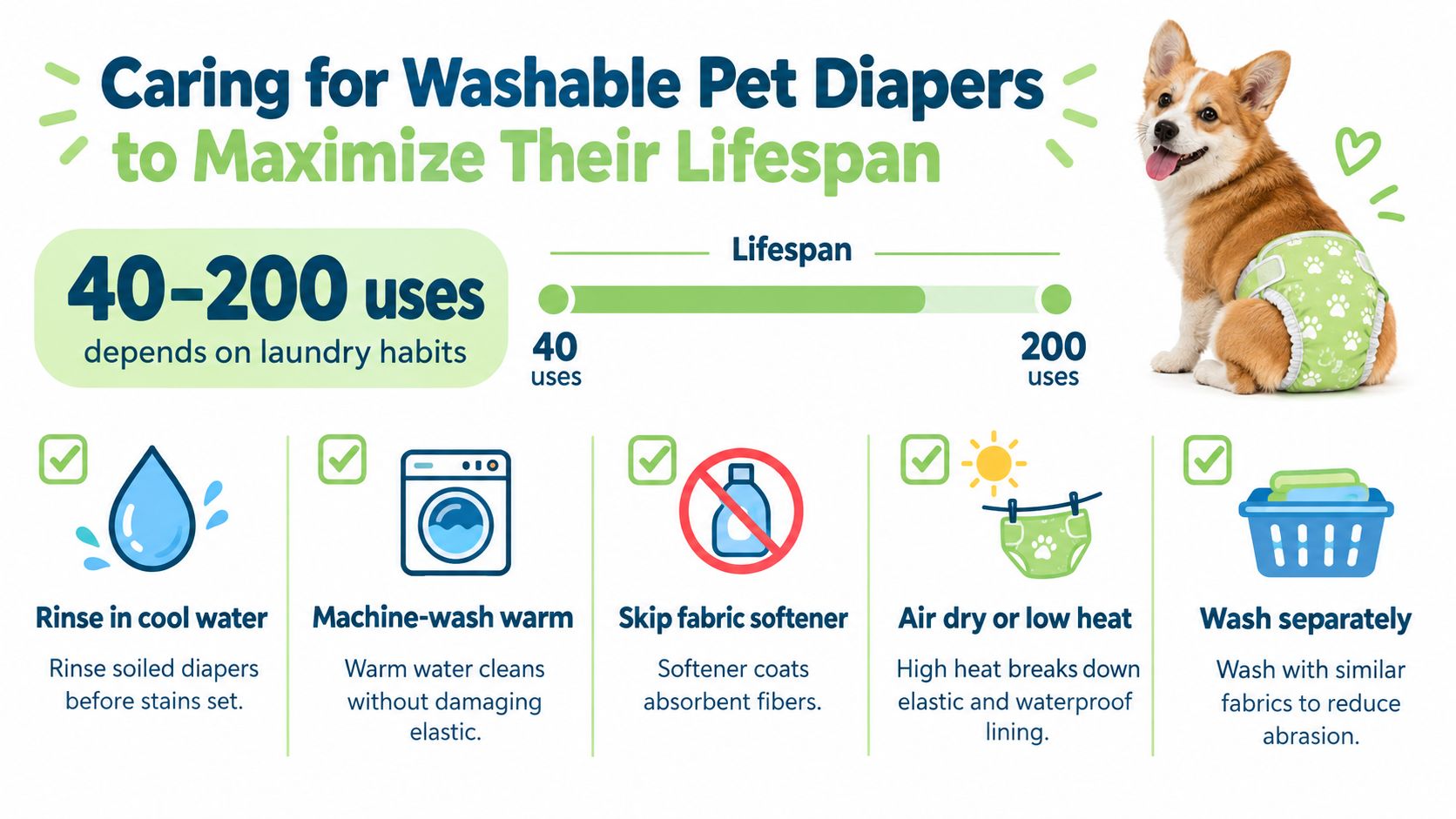
Washable pet diapers can last 40–200 uses, depending largely on how you rinse, wash, dry, and rotate them. This washable diaper care guide is useful for building a routine that protects absorbency and the waterproof layer.
A routine that protects the fabric
Start with a cool-water rinse when the diaper is soiled. Letting urine, feces, or residue sit in the fibers makes cleaning harder and can encourage persistent odor. After rinsing, machine-wash in warm water with a pet-safe, fragrance-free detergent.
Avoid fabric softener. It coats absorbent fibers and can reduce their ability to take in moisture. Skip chlorine bleach as well, since harsh treatment can weaken elastic and waterproof layers. For stains, use an enzyme cleaner suited to the fabric rather than scrubbing aggressively.
Drying deserves equal attention. Use low heat or hang-dry the diaper. High heat can damage elastic and cause the waterproof PUL backing to separate from the fabric, leaving a cover that looks acceptable but no longer blocks leaks.
Rotation prevents one diaper from doing all the work
Keep 8–10 washable diapers per pet in rotation if daily use requires frequent changes. A larger rotation gives each diaper time to dry fully and reduces the stress placed on any single cover.
Check Velcro tabs regularly for lint buildup. Inspect seams every few months, especially around the waist and legs, where repeated stretching exposes weak stitching. A simple sequence keeps the work manageable:
- Rinse: Remove residue before it dries.
- Wash: Use warm water and fragrance-free detergent.
- Dry: Choose low heat or air-drying.
- Rotate: Spread wear across the whole supply.
- Inspect: Remove damaged diapers before they cause a leak.
Signs It Is Time to Replace a Pet Diaper
A diaper usually gives warning before it fails completely. The first clues are often touch and smell, not a dramatic tear. If the diaper feels loose, stays damp, or smells musty after washing, treat that as a performance issue rather than waiting for another accident.
Check the fit and fastening points
Replace a washable diaper when the elastic no longer hugs the waist or legs. Sagging creates gaps, and gaps let urine escape even when the absorbent pad still has capacity. Velcro tabs that curl, collect permanent lint, or stop holding securely also make the diaper unreliable.
Look at the absorbent core. Noticeable thinning, fraying, holes, or recurring leaks soon after application indicate that the material no longer provides dependable protection. In a washable diaper, a waterproof lining that peels, cracks, or crinkles like cellophane has likely delaminated.
Smell and skin condition matter
A persistent musty odor that survives washing signals that the fibers may no longer release moisture properly. Independent guidance on diaper shelf life and aging identifies odor, yellowing, weaker elastic, and less reliable tabs as signs of reduced performance.
For disposables, watch for a clumpy gel texture, torn side tabs, or yellowed adhesive that no longer feels tacky. Don't keep using a diaper that traps moisture against the skin. Redness, rash, or repeated odor can appear before the product looks dramatically worn, and replacing the diaper is safer than trying to stretch its remaining use.
Cost Per Use Comparing Disposable and Washable Diapers
Cost-per-use math is simple once you separate the purchase price from the number of changes. A 30-pack of mid-range disposable dog diapers costs about $20, which works out to roughly $0.67 per diaper. A $20 washable diaper used 80 times costs about $0.25 per use.
| Factor | Disposable Diapers | Washable Diapers |
|---|---|---|
| Example purchase | $20 for 30 diapers | $20 for one diaper |
| Example use basis | One change per diaper | 80 uses |
| Approximate cost per use | $0.67 | $0.25 |
| Convenience | No washing and easy disposal | Requires rinsing, washing, drying, and rotation |
| Best fit | Travel, occasional use, unpredictable changes | Routine incontinence and repeated daily use |
The washable option reaches the stated example's break-even point at around use 30, because the purchase cost has then been spread across enough changes to fall below the disposable per-use price. This disposable-versus-reusable cost comparison can help you build the same calculation around your own supplies.
Multiply by your actual routine
A pet needing three changes a day uses supplies very differently from a pet wearing one diaper overnight. At three daily changes, disposables disappear quickly and the repeated purchases become the main cost. At one overnight change, convenience may carry more weight, especially if washing is difficult.
Disposables also offer practical value. They're easy to pack, don't require access to a washing machine, and work well for occasional accidents or transit days. Washables require an upfront purchase and a consistent laundry routine, but they can reduce repeated spending and the volume of discarded material.
The environmental timeline is also different. Conventional disposable diapers can persist in landfills for centuries, with estimates commonly around 500 years because plastic backings and superabsorbent polymers resist microbial degradation. EBSCO's overview of disposable diapers in landfills explains why disposal life is far longer than wear time.
Practical Recommendations for Travel and Incontinence Care
Travel works best when you plan changes around the journey rather than waiting for the diaper to fail. For road trips and flights, pack one disposable diaper per 4–5 hours, plus two spares per day, in a labeled zip pouch. Keep them away from heat and moisture, and carry a portable scent-disposal system for used products.
An insulated bag can protect spare diapers from temperature swings, particularly when luggage may sit in a hot vehicle. Don't place your entire supply in an exposed cargo area if you can keep it in the passenger compartment. Add pet-safe wipes, barrier cream, and a backup collar to a small first-aid kit so your dog can't easily lick an irritated area.
Build a routine for chronic incontinence
Owners managing ongoing incontinence may find a 6–8 diaper rotation practical. That gives soiled washables time to air out before laundering and reduces the temptation to reuse a damp diaper. Add a waterproof mattress protector, and provide doggy-door access when appropriate so the pet can move outside without delay.
Record your dog's typical output before departure. Note when the pet usually urinates, how quickly a diaper becomes heavy, and whether activity changes the pattern. That record gives you a realistic change interval instead of relying on a package claim.
For hotels, request a room with a washer-dryer when possible and bring enough washable diapers to rotate every other day. A waterproof laundry bag keeps used items separate from clean supplies. If you need a compact way to organize diapers, wipes, creams, and waste bags, you can browse Urban Totes diaper bags for a dedicated carry option.
Match the system to the trip
Switching to disposables for transit days can simplify airports, long drives, and unfamiliar stops. At your destination, you can return to washables if laundry access and storage are convenient. Multi-pet households should color-code diaper bands so supplies don't get mixed between animals with different sizes or needs.
For dogs with recurring urine leakage, sizing and positioning deserve special attention. A correctly measured waist and a design intended for incontinence are more useful than just choosing the largest absorbent product. Pet owners can also review this practical guide to a dog diaper for incontinence when planning a daily routine.
Check the diaper during every major transition, including after sleep, exercise, meals, and arrival at a new place. Change immediately after bowel movements. The goal isn't to force every diaper to last as long as possible. It's to keep the pet dry, protect the skin, prevent avoidable leaks, and use each product for the job it can reliably handle.
Pet Magasin offers washable pet diapers, TSA airline-approved travel carriers, and grooming supplies that support practical day-to-day and travel care. Visit Pet Magasin to compare reusable diaper options, check sizing guidance, and choose supplies that fit your pet's routine.

Leave a comment