
How to Conduct a Cat Litter Review That Solves Your Biggest Problems

Trying to find the right cat litter can feel overwhelming. The secret isn't finding a "perfect" litter—it's using a smart cat litter review framework to find the perfect match for your cat and your home. The ideal choice balances your cat’s preferences with your household’s needs, focusing on three key factors: odor control, clumping, and low tracking. This guide provides an actionable plan to help you choose the right product and solve your litter box issues for good.
Why a Smart Cat Litter Choice Is Non-Negotiable
Choosing cat litter isn't just another shopping task; it directly impacts your cat’s health, your home's air quality, and your budget. The market is saturated with options, from traditional clay to advanced silica gels and various biodegradable materials, making it easy to get lost.
This guide is your roadmap to cutting through that noise.
The right litter encourages consistent litter box use, preventing frustrating and hard-to-solve behavioral problems. For you, it means a home that smells fresh and less time spent on cleanup. We'll provide a clear-cut method to evaluate any litter like an expert, focusing on what truly makes a difference in daily life.
The Growing Demand for High-Performance Litter
The cat litter industry is a powerhouse for a reason. Valued at USD 8.63 billion globally, it's projected to climb to USD 15.07 billion. North America commands nearly 40% of total revenue, driven by owners demanding more effective, specialized products. You can read the full research about cat litter market trends to see the innovation firsthand.
This growth highlights a crucial shift: owners are no longer settling for the cheapest option. They are actively seeking solutions for specific household challenges.
Actionable Insight: Treat your litter choice like a strategic decision. A single-cat household in a large, well-ventilated house has different needs than a multi-cat family in a compact apartment. Mismatching the product to the environment is the #1 cause of litter box frustration.
What This Guide Will Help You Do
Our goal is to equip you with the skills to conduct your own effective cat litter review. We’ll cover different materials, key performance indicators, and a step-by-step testing process.
By the end of this guide, you will be able to:
- Analyze the primary litter types: Make informed comparisons between clumping clay, silica gel crystals, and biodegradable options like corn, wheat, and wood.
- Evaluate critical performance factors: Learn to objectively measure odor control, clumping strength, dust levels, and tracking to distinguish a top-tier litter from a mediocre one.
- Select the right litter for your specific situation: Get actionable recommendations for common scenarios like multi-cat households, small apartments, and cats with health sensitivities.
Let's begin the process of finding a litter that keeps both you and your cat content.
The Core Performance Metrics of Any Good Litter
Beyond the marketing claims and colorful packaging, what truly defines a superior cat litter? An effective cat litter review isn't about brand loyalty; it's about real-world performance under pressure.
Think of it like inspecting a house. You don't just admire the curb appeal. You check the foundation, the plumbing, and the roof. For cat litter, odor control is the foundation, clumping is the plumbing, and dust/tracking is the overall structural integrity. Mastering this evaluation is critical, as litter is one of the most essential pet wellness products for your cat's daily life.
Here is a practical checklist to help you identify which litters deliver on their promises and which fall short.
Odor Control: Your First Line of Defense
For most cat owners, odor control is the non-negotiable, make-or-break factor. If a litter fails to manage odor, no other feature matters. Effective odor control isn't achieved by masking smells with heavy perfumes—which can deter cats—but by neutralizing them at the source.
The primary culprit is ammonia, produced when bacteria break down urea in cat urine. Different litters employ distinct strategies to combat it.
- Absorption: Materials like silica gel crystals act as super-absorbent sponges. They lock moisture and odor-causing molecules inside their porous structure, keeping the litter box environment fresh for longer.
- Encapsulation: This is the specialty of clumping clay (sodium bentonite). It rapidly absorbs liquid to form a hard, tight seal around urine, physically trapping the odor source so it cannot escape.
- Neutralization: Some litters incorporate additives like activated carbon or baking soda. These ingredients work chemically to bind with and neutralize ammonia molecules, eliminating the smell itself rather than just containing it.
Actionable Insight: A litter with superior odor control gives you a buffer, ensuring your home smells fresh even if you miss a day of scooping.
Clumping Performance: The Secret to Effortless Cleaning
If you’ve ever had to scrape a sticky, sludgy mess from the bottom of a litter pan, you understand the value of a solid clump. Top-tier clumping means the litter forms firm, self-contained clumps that can be lifted out easily and entirely.
The Perfect Clump Test: A perfect clump is rock-solid. It shouldn't crumble when scooped, adhere to the box, or leave behind small, soiled fragments. This not only simplifies cleanup but also ensures you remove all waste, which is vital for maintaining hygiene and controlling long-term odors.
When evaluating clumping, assess two factors. First, speed: does the litter clump quickly enough to prevent urine from sinking to the bottom? Second, strength: does the clump maintain its integrity during scooping, or does it disintegrate into smaller, contaminated pieces that are impossible to remove fully?
Dust Levels: A Critical Health and Cleanliness Factor
The dust cloud that billows from a bag of litter isn't just an annoyance; it's a health risk for both you and your cat. Inhaling fine particulates can exacerbate asthma and allergies. For cats, especially brachycephalic (flat-faced) breeds, it can contribute to respiratory issues.
A low-dust formula is essential. While no litter is truly 100% dust-free, the best options use granules that have been screened to eliminate fine particles. As a rule, heavier materials like premium clay or crystal litters tend to produce less dust.
Actionable Insight: To test for dust, pour the litter from a height of two feet into an empty box. A quality low-dust product will settle almost immediately with minimal visible airborne particles. A poor-quality one will create a lingering cloud.
Tracking: Containing the Mess
Finally, tracking—when litter granules hitch a ride on your cat’s paws and get scattered throughout your home—is a major source of frustration. While you can't eliminate it entirely, your choice of litter can significantly reduce it.
Several granule characteristics influence tracking potential:
| Granule Characteristic | Impact on Tracking | Actionable Takeaway |
|---|---|---|
| Size and Weight | Larger, heavier granules track less | They are less likely to cling to fur or be kicked out of the box. |
| Shape | Smooth, rounded pellets are better | They are less prone to getting lodged between a cat's paw pads. |
| Texture | Lighter, finer textures track more | They adhere easily to fur and are carried further from the box. |
Litters with larger, heavier pellets—such as recycled paper or some wood-based products—tend to track far less than fine-grain clay or corn litters. A high-quality litter mat placed at the box exit is also an essential tool in your anti-tracking arsenal. These four pillars—odor control, clumping, dust, and tracking—are the definitive measures of a litter's worth.
Comparing The Most Popular Litter Materials
Choosing the right cat litter starts with understanding the raw material. The material itself dictates performance across the board—from odor control and clumping ability to dust levels and tracking. It's like selecting building materials; you wouldn't use drywall for a foundation, and you shouldn't choose a litter without knowing its inherent strengths and weaknesses.
Let's analyze the most common materials to see how they perform in a real-world cat litter review. We'll break down the pros, cons, and practical applications of each to help you align the right product with your specific needs.
The three primary performance factors you will constantly balance are odor control, clumping, and dust. It is rare for a single litter to excel in all three categories.
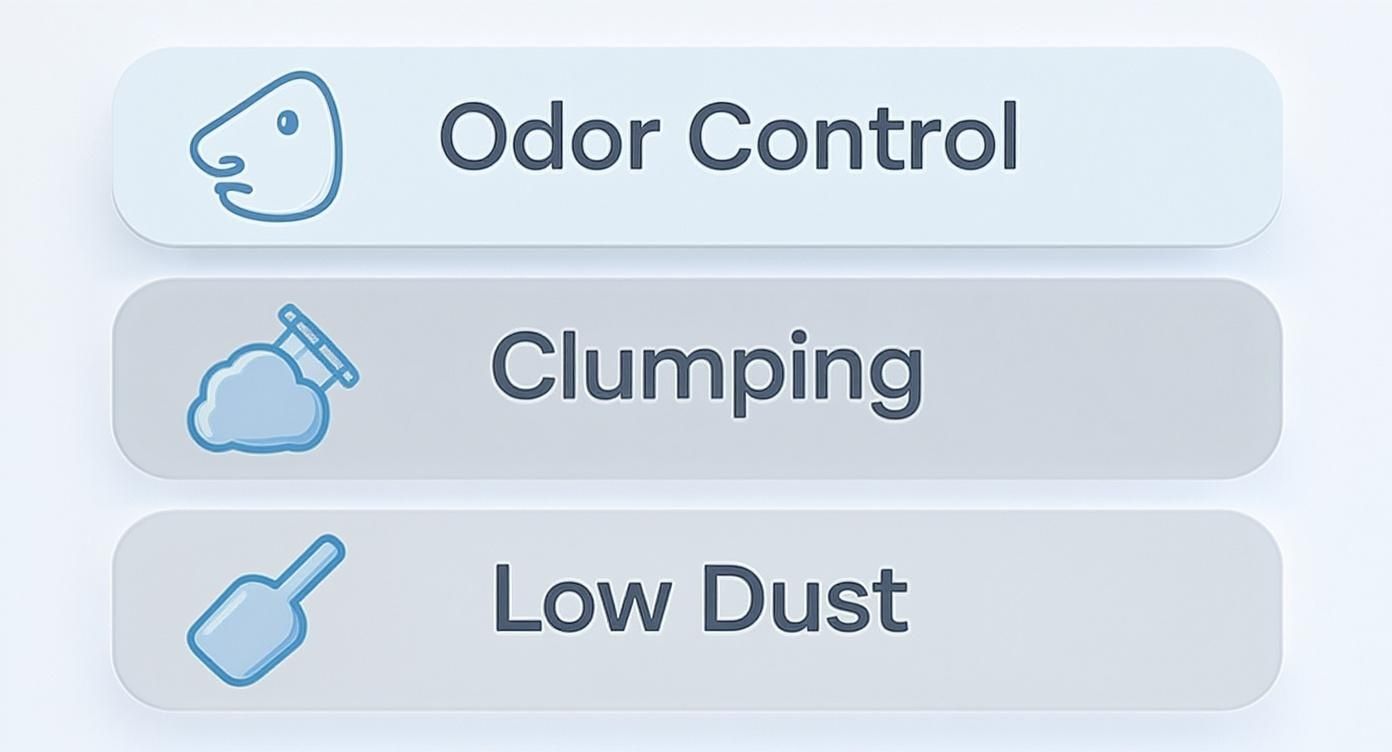
Actionable Insight: Understand that you are typically making a trade-off. A litter that forms indestructible clumps might be dusty, while an ultra-absorbent, low-dust option might not clump at all. Identify your top priority and choose accordingly.
Clay Litter The Industry Heavyweight
Clay is the traditional, go-to material. It continues to dominate the market, but it comes in two distinctly different forms.
Clumping Clay (Sodium Bentonite)
This is the modern standard for a reason. Sodium bentonite is a highly absorbent clay that swells and agglomerates when it contacts liquid. This action forms solid, easily scoopable clumps around your cat's waste.
- Pros: Exceptional odor control through waste encapsulation, simplifies daily cleaning, generally cost-effective.
- Cons: Bags are heavy and difficult to handle, can produce significant dust, and is sourced via strip-mining, which raises environmental concerns.
Actionable Takeaway: For busy households prioritizing convenience and effective waste removal, the performance of clumping clay is hard to beat.
Non-Clumping Clay
This is the original-style litter, typically made from clays like calcium bentonite. It functions as a simple absorbent, soaking up urine until it becomes saturated. At that point, the entire box must be changed.
- Pros: Extremely low upfront cost, familiar texture for many cats.
- Cons: Poor odor control once saturation begins, requires frequent full-box changes, and is just as heavy and dusty as clumping varieties.
Actionable Takeaway: While seemingly economical, the need for frequent full replacements can make non-clumping clay more expensive and labor-intensive over time.
Silica Gel Crystals The Absorbency Powerhouse
Silica gel litter is composed of porous sodium silicate sand beads that can absorb up to 40 times their weight in liquid.
Each crystal functions as a micro-sponge, soaking up urine and trapping odor molecules inside while allowing water to evaporate. This unique mechanism means you only need to scoop solid waste and stir the crystals daily.
Actionable Insight: Silica gel's primary advantage is longevity. One bag can last a single cat for up to a month, drastically reducing the frequency of full litter box changes. This makes it an excellent choice for users of automatic litter boxes.
The main drawbacks are the texture—some cats dislike the sharp feel of the crystals—the higher initial price, and the crackling noise it makes during absorption, which can startle timid cats.
Biodegradable Litters The Eco-Conscious Choice
For those prioritizing sustainability, biodegradable litters offer an excellent alternative. Made from renewable resources like corn, wheat, wood, and paper, they decompose naturally and reduce landfill waste. This category has seen significant growth in recent years.
Eco-friendly litters now represent an estimated 20-30% of the market in North America and Europe, reflecting a major shift in consumer values. You can read more about these cat litter findings and the data behind this trend.
Here's a breakdown of popular eco-friendly options:
- Corn: Typically lightweight with good clumping ability and natural odor control. Its fine texture can lead to increased tracking.
- Wheat: Uses natural starches for clumping and odor neutralization. It offers a soft texture but may form softer, stickier clumps than clay.
- Wood: Available as pellets or granules, often from pine, which provides a natural scent that helps mask odors. Pellet versions are excellent for minimizing tracking, but most wood litters do not clump.
- Paper: Made from recycled newspaper, this option is soft, absorbent, and virtually dust-free, making it ideal for cats post-surgery or with respiratory issues. However, its clumping and odor control capabilities are generally weaker.
Your choice will depend on balancing budget, your cat’s preferences, and your priorities—be it convenience, performance, or environmental impact.
To simplify your decision, use this scorecard to compare how different materials perform against our key criteria.
Performance Scorecard For Different Litter Materials
This table provides a rating from 1 (Poor) to 5 (Excellent) to help you quickly compare the most popular litter types.
| Material | Odor Control | Clumping | Low Dust | Low Tracking | Cost |
|---|---|---|---|---|---|
| Clumping Clay | 4 | 5 | 2 | 2 | 4 |
| Non-Clumping Clay | 2 | 1 | 2 | 3 | 5 |
| Silica Crystals | 5 | 1 | 4 | 4 | 2 |
| Corn | 4 | 4 | 3 | 2 | 2 |
| Wheat | 3 | 3 | 3 | 3 | 2 |
| Wood (Pellet) | 4 | 1 | 5 | 5 | 3 |
| Paper | 2 | 1 | 5 | 4 | 3 |
Remember, these are general ratings; performance can vary significantly between brands. Use this as a starting point to narrow down which material best suits your needs.
How to Test Cat Litter Like a Pro
Forget marketing claims. The only way to know if a cat litter truly works is to conduct your own structured cat litter review at home. This process isn't complicated—it simply requires consistent observation and a methodical approach. By testing it yourself, you gather real-world data on performance, not just promises.
This section provides a simple, step-by-step protocol for testing any litter. You'll learn how to introduce it to your cat safely and how to objectively measure the factors that matter: clumping, dust, and tracking.
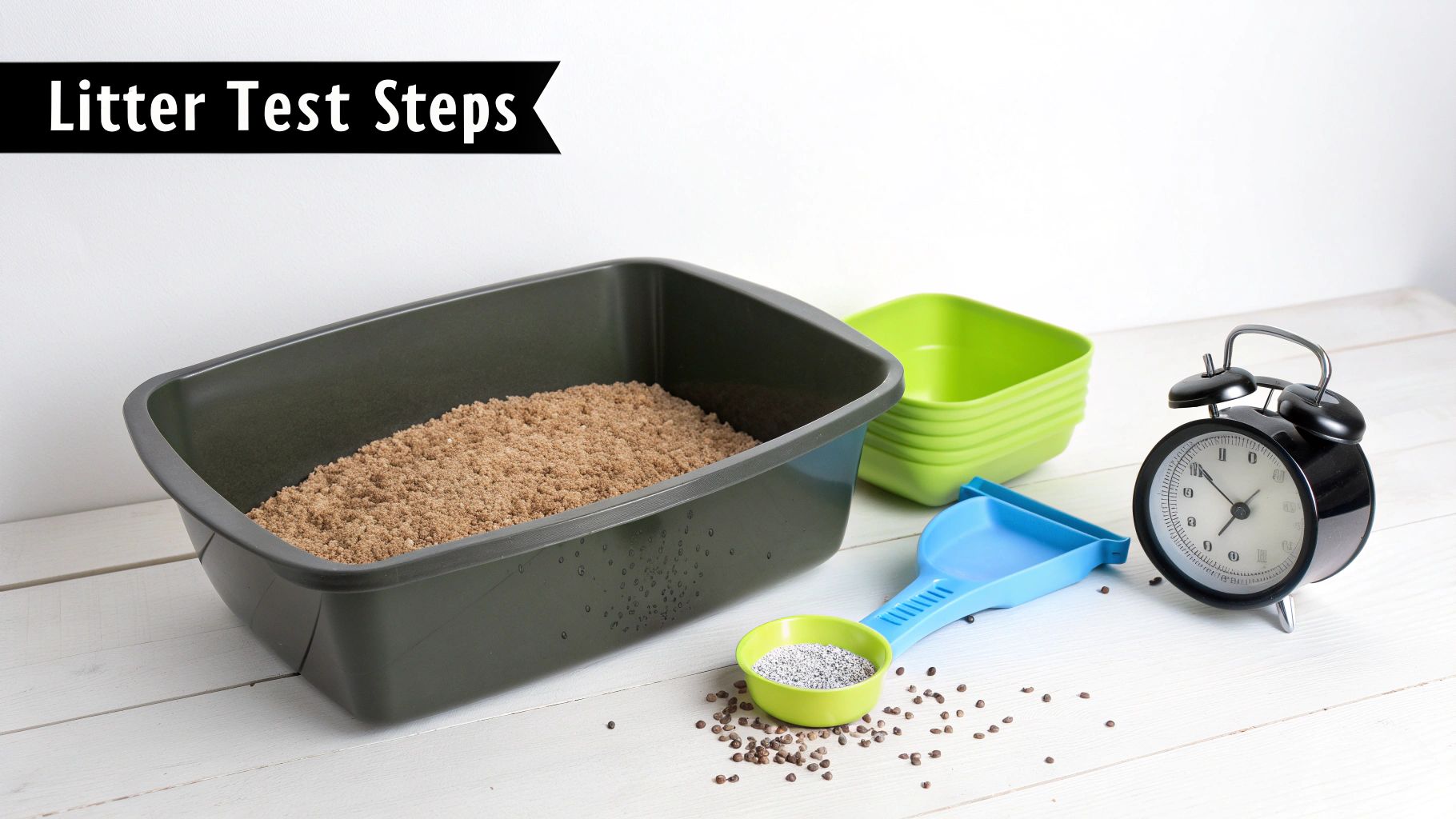
Step 1: Execute a Safe Introduction
Cats are creatures of habit, and an abrupt change to their litter box can cause stress and avoidance. The key is a gradual transition over approximately one week.
Begin by mixing a small amount of the new litter with their current brand. A ratio of 25% new to 75% old is a safe starting point. Every two days, increase the proportion of the new litter until the old litter is fully phased out. This allows your cat to acclimate to the new scent and texture.
Actionable Insight: Monitor your cat’s behavior closely during the transition. If you observe hesitation or accidents, slow the process down. Your cat's comfort and consistent box use are the primary goals.
Step 2: The 48-Hour Observation Period
Once your cat has accepted the new litter, the real evaluation starts. Allow at least 48 hours of normal use before drawing any conclusions. This initial period provides critical insight into its day-to-day performance, especially odor control.
During these two days, focus on these key indicators:
- Immediate Odor Control: How does the area smell immediately after use? Does the litter neutralize odor quickly, or does it linger?
- Clump Formation: Are clumps forming on the surface, or is urine soaking through to the bottom of the pan before clumping occurs?
- Cat's Reaction: Is your cat using the box normally? Note any signs of hesitation or discomfort.
This 48-hour baseline reveals how the litter will perform under typical household conditions. For more practical advice, you can explore other product guides for pet owners that cover a wide range of pet care topics.
Step 3: Conduct Your Performance Tests
After the initial observation, it's time for a more systematic evaluation. These simple tests will help you objectively score each litter on its core performance metrics.
The Dust Test
Pour the litter from a height of approximately two feet into a clean, empty litter box. Observe the air. A superior low-dust litter will settle almost instantly with a negligible poof. A dusty litter will create a visible cloud that hangs in the air for several seconds.
The Clump Strength Test
To simulate cat urine, mix 1/4 cup of water with one teaspoon of salt. Pour this solution into one spot in the litter and wait 30 minutes for a clump to form. Then, attempt to scoop it.
- Does it lift out cleanly as a single, solid unit?
- Does it fragment into smaller, soiled pieces?
- Does it stick to the scoop or the bottom of the box?
A solid, non-adherent clump is the hallmark of an effective, easy-to-clean litter.
The Tracking Test
This is a simple visual assessment. After several days of use, inspect the area around the litter box. Clear a three-foot radius and check it daily. How far are the granules traveling? Is a litter mat containing most of it, or are you finding litter in distant parts of the house?
Step 4: Score And Compare
Finally, use a simple scoring system to keep your results organized and make comparisons between brands objective and easy. Create a scorecard and rate each litter from 1 to 5 for each category.
| Performance Metric | Brand A Score (1-5) | Brand B Score (1-5) | Notes |
|---|---|---|---|
| Odor Control | Effectiveness over 48 hours. | ||
| Clump Strength | Integrity of the test clump during scooping. | ||
| Low Dust | Amount of airborne dust during pouring. | ||
| Low Tracking | Extent of litter spread outside the box area. | ||
| Cat Acceptance | Cat's willingness to use the new litter. | ||
| Total Score |
By following this structured approach, you can move beyond marketing hype and conduct a reliable cat litter review of your own, ensuring you find the best match for both your cat and your home.
Finding the Best Litter for Your Situation
Let's be clear: there is no single "best" cat litter. The optimal choice is highly specific to your living situation, your lifestyle, and your cat's individual needs. Think of it less as a one-size-fits-all commodity and more like a tailored solution. What works perfectly in one home can be a complete failure in another.
This section provides targeted recommendations for the most common challenges cat owners face. By matching litter properties to your specific needs, you can move beyond a generic cat litter review and find a product that genuinely solves your most persistent litter box problems.
For Small Apartments and Odor-Sensitive Homes
In a small living space, there is no place for litter box odors to hide. When your living room is just steps away from the litter box, superior odor control is not a luxury—it's a necessity.
Your goal is to find a litter that actively traps and neutralizes ammonia on contact, rather than masking it with perfumes.
- Top Recommendation: Your best options are silica gel crystals or a premium clumping clay fortified with activated carbon.
- Why They Work: Silica crystals have a porous structure that traps odor molecules and locks them away. Litters with activated carbon use a similar principle of adsorption to neutralize smells instantly. Both are high-performance solutions for maintaining fresh air in a confined space.
Actionable Insight: When space is limited, the performance of your cat litter directly impacts your quality of life. Investing in a high-performance, odor-absorbing litter is one of the most effective upgrades you can make for your home.
For Multi-Cat Households
Managing a litter box for multiple cats presents a unique challenge. The box experiences double or triple the use, demanding a litter that can withstand a heavy workload without degrading into a contaminated mess.
Your top priorities must be rock-solid clumping and durability. Weak clumps that break apart during scooping will contaminate the remaining clean litter, leading to odor issues and a box that is impossible to maintain.
- Top Recommendation: A hard-clumping sodium bentonite clay litter is the most reliable choice for a multi-cat environment.
- Why It Works: This type of clay forms extremely durable clumps upon contact with liquid, effectively encapsulating waste. This facilitates complete removal, ensuring the remaining litter stays fresh for the next cat—a critical factor in preventing territorial disputes and out-of-box behaviors.
For Homes with Allergies or Long-Haired Cats
If your household includes allergy sufferers or a long-haired cat breed like a Persian or Maine Coon, you face a dual challenge: dust and tracking. Fine dust particles can trigger allergic reactions and asthma, while small litter granules become trapped in fur and are transported throughout your home.
The solution is a litter made from large, heavy particles that resist becoming airborne and are less likely to adhere to fur.
- Top Recommendation: Low-dust pellet litters made from materials like recycled paper or dense wood are excellent choices.
- Why They Work: The large, heavy pellet shape is less prone to creating dust clouds or being kicked far from the box. These materials are also significantly less likely to get caught in the long fur between a cat's paw pads, which dramatically reduces tracking. For more ways to keep your cat comfortable and your home clean, exploring a range of specialized supplies for your cat can provide additional solutions.
Expert Tips for a Cleaner Litter Box
Selecting a high-performance litter is the first step, but it’s only half the solution. Even the best litter requires a consistent maintenance routine to function effectively. Getting the most value from your chosen product—and every positive cat litter review—comes down to simple, regular upkeep.
First, establish the proper depth. Aim for an even layer of two to three inches of litter across the entire box. This depth is crucial: it allows your cat to dig and bury their waste, a natural behavior that promotes a sense of security. More importantly, it ensures clumping litters have enough material to form solid clumps before urine can reach the bottom of the pan, preventing the formation of hard-to-scrape sludge.
Creating a Consistent Cleaning Schedule
The ideal scooping frequency depends on your litter type and the number of cats using the box. For all clumping litters, scooping at least once daily is the minimum standard. This removes the primary source of odor from your home before it can permeate the air and keeps the litter environment clean and inviting for your cat.
For non-clumping types, like silica crystals or wood pellets, you must still remove solid waste daily. It is also beneficial to stir the litter to redistribute saturated material, extending its lifespan.
Actionable Insight: View daily scooping not just as a chore, but as a quick health check. The litter box provides a direct window into your cat's well-being. It is the easiest way to detect changes in urination or defecation habits, which are often the first indicators of a medical issue.
Even with diligent daily scooping, a full reset is necessary. With clumping litter, plan to completely empty, scrub, and refill the box with fresh litter every two to four weeks. For non-clumping varieties, this full change is required more frequently—often weekly—once the material has reached its absorption capacity.
Reading Your Cat’s Signals
Your cat will often communicate their dislike for a litter long before you notice performance issues. Watch for these behavioral red flags:
- Hesitation or Perching: If your cat balances precariously on the edge of the box instead of placing all four paws inside, it's a strong indication they find the texture uncomfortable.
- Quick Exits: A cat that eliminates and then bolts from the box without attempting to bury their waste is likely eager to escape an unpleasant smell or texture.
- Accidents Elsewhere: This is the most urgent signal. A cat that begins eliminating right next to the box is clearly communicating that there is a significant problem with the litter or the box itself.
Of course, accidents can still happen. For those moments, having the right cleaning supplies is essential. An enzymatic cleaner is vital for completely neutralizing pet stains and odors. You can find excellent recommendations for the best carpet spot cleaner for cats to help you manage any messes effectively.
Frequently Asked Questions About Cat Litter
Even with the perfect litter, questions and issues can arise. This section addresses some of the most common concerns to help you maintain a harmonious litter box environment for your cat.
How Do I Switch My Cat to a New Litter?
Cats are sensitive to changes in their environment, especially their bathroom. A sudden, complete change of litter can cause stress and lead to box avoidance. The key to a successful switch is a gradual, week-long transition.
- Days 1-2: Begin by mixing 25% of the new litter with 75% of their current litter.
- Days 3-4: Increase the ratio to a 50/50 blend of new and old.
- Days 5-6: Move to 75% new litter and only 25% of the old.
- Day 7: Fill the box entirely with 100% new litter.
This slow introduction allows your cat to acclimate to the new scent and texture at their own pace, minimizing the risk of rejection.
Is Scented or Unscented Litter Better?
The overwhelming consensus among veterinarians and feline behaviorists is to choose unscented litter. A cat's sense of smell is approximately 14 times stronger than a human's. The artificial perfumes found in scented litters, which may seem pleasant to us, can be overpowering and offensive to a cat.
What smells "fresh" to a human can be a major deterrent for a cat. A strong, artificial scent is often enough to cause litter box aversion. A better strategy is to select a litter that uses natural, unscented odor neutralizers like activated carbon or baking soda.
Have more questions about pet care? You can find extensive information and answers in our detailed Pet Magasin FAQ section.
At Pet Magasin, we’re focused on providing high-quality, affordable supplies that make owning a pet a more joyful and less stressful experience. You can discover the perfect products for your furry family member by visiting us at https://www.petmagasin.com.

Leave a comment