
The Best Pet Grooming Scissors for a Perfect At-Home Cut

Grooming your pet at home doesn't have to be complicated. To get started, you just need a few key tools: a pair of straight scissors for general trimming, some curved scissors for tricky spots, and a set of thinning shears to blend it all together.
Choosing a quality kit, ideally made from durable Japanese stainless steel, gives you the sharp, reliable tools you need to make grooming safe and stress-free. Let's walk through how to choose the right scissors and use them like a pro.
Why the Right Scissors Are a Game-Changer for Home Grooming
Grooming is more than a haircut—it’s essential for your pet’s health. Using the wrong scissors, like dull craft or kitchen shears, will pull their fur, cause discomfort, and risk accidental injury. This turns what should be a bonding moment into a stressful ordeal.
Think of it this way: you could try to chop an onion with a butter knife, but it’s going to be a slow, frustrating mess. A sharp chef's knife, however, glides right through, making the job easy and precise. The best pet grooming scissors are your specialized tools, designed to make every cut safe, clean, and efficient.
Building Your At-Home Grooming Toolkit
You don't need a drawer full of gadgets. A well-chosen kit can handle almost any grooming task. To ensure you're prepared, look for a set that includes these three essentials:
- Straight Scissors: These are your workhorses. Use them to set the length and shape on large, flat areas like the back and sides.
- Curved Scissors: These are critical for safely trimming contoured areas. Use them around paws, faces, and hindquarters where a straight blade is awkward and unsafe.
- Thinning Shears: This is your tool for a flawless finish. Use them to soften scissor marks, blend different fur lengths, and remove bulk without shortening the coat.
Starting with a complete set means you have the right tool for each specific job, which is the key to safe and effective grooming. To see how these fit into a complete setup, check out our guide on the best grooming tools for dogs.
Actionable Tip: Investing in proper grooming scissors isn't just a purchase; it's a commitment to your pet's comfort and safety. Sharp, well-made tools prevent painful pulling and reduce the risk of injury, turning grooming from a stressful event into a moment of connection.
The Link Between Good Tools and a Happy Pet
Your confidence as a groomer directly impacts how your pet feels. When you work with tools that feel comfortable and cut cleanly, you are calmer and more precise. Your pet senses that calm energy, which helps them relax and trust the process.
This guide will give you actionable insights into choosing and using pet grooming scissors. We’ll cover the different types, what makes a quality pair (from the blade steel to the handle design), and how to select the perfect set for you and your pet.
A Breakdown of Essential Grooming Scissor Types
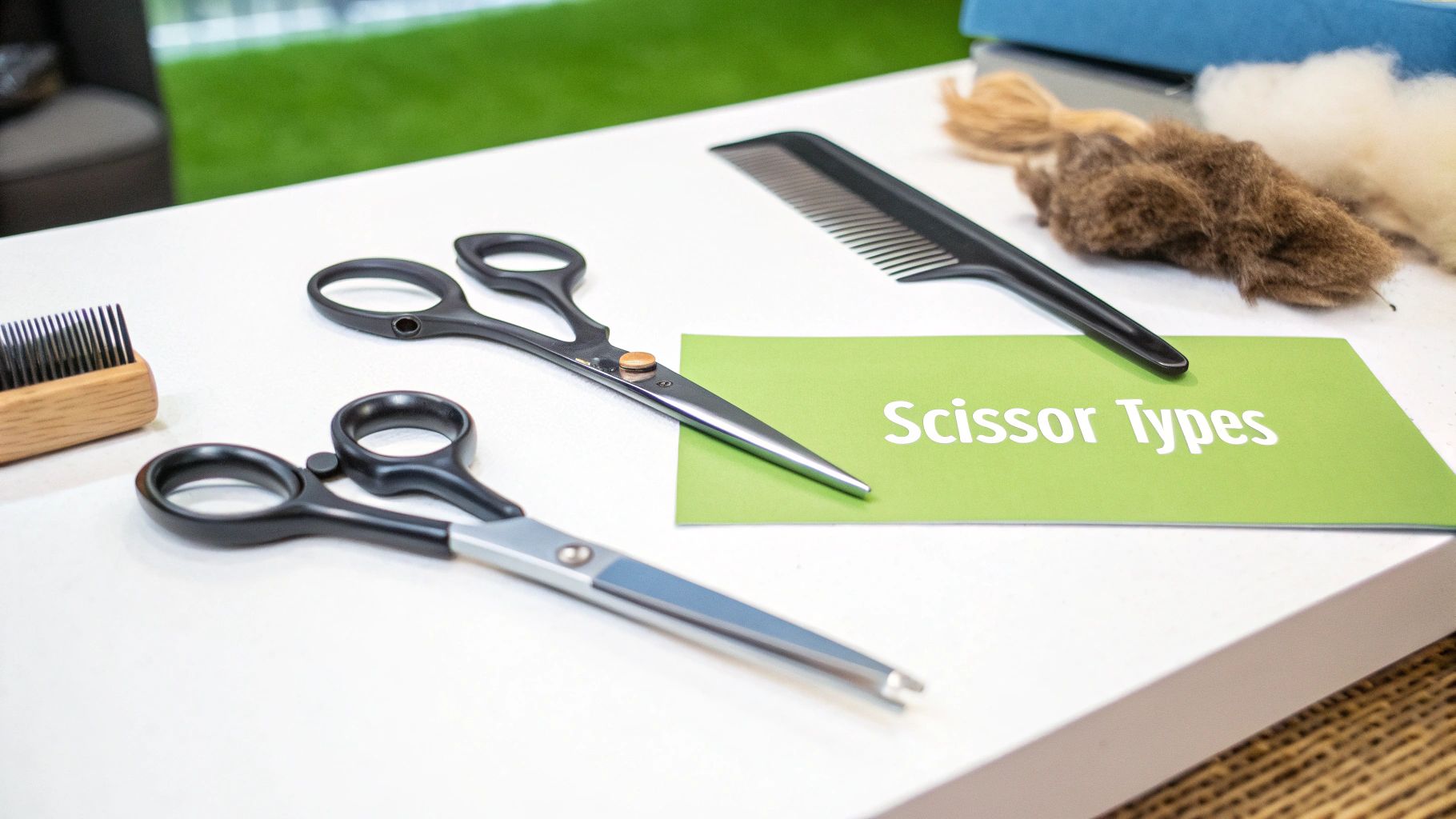
Choosing the right pet grooming scissors is like assembling a toolkit for any craft. A chef doesn’t use one knife for everything, and a groomer needs more than a single pair of scissors for a safe, polished, professional-looking result.
Each scissor type has a specific job. Learning when to use each one is the first step toward grooming your pet with confidence. The three pillars of any grooming kit are straight scissors, curved scissors, and thinning shears. Let's break down the practical application of each.
Straight Scissors: The Foundation of Every Haircut
Think of straight scissors as the primary shaping tool in your grooming arsenal. Their job is to remove length, create clean lines, and establish the overall shape of the coat. If you’re trimming the fur on your dog’s back, sides, or legs, this is the pair you'll reach for first.
Actionable Insight: For a smooth, even cut on the body, comb the fur up and away from the skin, then cut parallel to the body. Avoid pointing the scissor tips directly at the skin. This technique is essential for creating the crisp lines needed for breeds like Poodles or Schnauzers.
While perfect for flat surfaces, their straight design makes them clumsy and unsafe for contoured areas. That’s why they are just one piece of the puzzle.
Curved Scissors: For Precision and Safety
This is where curved scissors become indispensable. Their blades are designed to follow the natural curves of your pet’s body, making them the safest and most effective choice for trimming rounded areas.
Use curved scissors for these specific tasks:
- Paws: Safely trim the fur around and between paw pads by using the curve to cut away from the skin.
- Faces: Shape the fur around the muzzle, eyes, and ears with precision. The curved blade helps you follow the contours without the risk of sharp, straight points.
- Sanitary Areas: The rounded design is essential for safely tidying up the tail and hindquarters.
Safety First: A good pair of curved scissors isn't just a recommendation; it's a non-negotiable for safety. The design itself helps minimize the risk of accidentally poking your pet, giving you peace of mind when working on delicate spots.
Trying to use straight scissors in these areas is like trying to draw a circle with a ruler—it's awkward and you risk creating harsh, unnatural lines. Curved scissors flow with your pet’s anatomy for a smooth, natural finish.
Thinning Shears: The Secret to a Professional Finish
Thinning shears, sometimes called blending shears, are the tool that elevates a haircut from amateur to professional. One blade is solid while the other has teeth, meaning they only cut a fraction of the fur with each snip.
Their main job isn't to remove length, but to perfect the cut. Use thinning shears to soften harsh scissor lines, blend where short fur meets long fur, and remove excess bulk without shortening the coat. This is particularly effective for double-coated breeds like Golden Retrievers, where you need to thin the undercoat without damaging the topcoat.
The market for these specialized tools is growing, projected to hit USD 230 million by 2032, largely because of their ability to create a seamless, professional finish at home.
Actionable Insight: To blend a line left by your straight scissors, hold the thinning shears at a 45-degree angle to the fur and make one or two light snips. Comb the area and repeat if needed. This technique erases any "choppy" look. Pet Magasin’s premium thinning shears are designed for this exact purpose.
Which Grooming Scissors Do You Need?
| Scissor Type | Primary Use | Best For Breeds Like | Pet Magasin Example |
|---|---|---|---|
| Straight Scissors | Removing length, setting straight lines, general body trimming | Poodle, Schnauzer, Shih Tzu | Grooming Scissors Kit (Includes straight scissors) |
| Curved Scissors | Trimming around paws, face, ears, and other curved areas safely | Any breed, especially those with rounded features like a Bichon Frise | Grooming Scissors Kit (Includes curved scissors) |
| Thinning Shears | Blending, softening harsh lines, removing bulk without shortening | Golden Retriever, German Shepherd, Pomeranian, Collie | Premium Thinning Shears |
Having all three types on hand equips you for any grooming task, ensuring you can keep your pet looking sharp and feeling great.
What to Look For in High-Quality Grooming Scissors
The difference between a smooth, safe trim and a stressful hack-job often comes down to the quality of your scissors. A great pair feels balanced in your hand and glides through fur without snagging. A poor-quality pair will pull hair, leave choppy lines, and dull quickly.
When you're shopping, focus on these key features. From the steel in the blades to the design of the handles, every detail plays a role in performance and safety.
The Heart of the Scissors: Material and Blade Edge
The foundation of any good scissor is its material. Look for Japanese 440C stainless steel, which is praised as the industry standard. This high-carbon steel is incredibly hard, allowing it to hold a razor-sharp edge for longer. It’s also resistant to rust and corrosion, a crucial feature for tools you'll be washing often.
The design of the blade's edge determines how it cuts. You’ll generally encounter two types:
- Convex Edge: This is the sharpest edge available, honed to a razor-fine finish. It provides a silky-smooth, precise cut that’s ideal for fine finishing work. Professionals prefer this edge, but it requires careful handling.
- Beveled Edge: This is a durable, rugged workhorse edge. While not as smooth as a convex edge, it's more forgiving and stands up well to thicker coats and general-purpose grooming. This makes it an excellent choice for at-home groomers.
For most at-home use, a high-quality beveled edge made from 440C steel offers the perfect balance of sharpness, durability, and easy maintenance.
Finding the Right Scissor Length and Size
Scissor length isn't a "one size fits all" feature. Measured from the tip to the end of the finger ring, the length dictates the tool's best use. Longer blades cover more area for faster bodywork, while shorter blades offer more control for detail work.
A 7-inch scissor is a versatile all-rounder, long enough for efficient body trims on medium-to-large dogs while still being manageable. For delicate areas like the face, ears, and paws, a shorter scissor (around 4.5 to 5.5 inches) is the safer and more precise choice.
Actionable Tip: Match your scissor length to the task. Use a long blade for the body and switch to a short, rounded-tip blade for the face and paws. Using a long blade near your pet’s eyes is a major safety risk.
This is why many grooming kits, like the Pet Magasin Grooming Scissors Kit, include scissors of different lengths, equipping you with the right tool for both broad strokes and fine details.
The Importance of Ergonomics and Adjustability
Grooming can take time, and uncomfortable scissors can cause hand fatigue and cramping, reducing your control. This is where ergonomics matter. Look for scissors with an offset or crane handle design, where one handle is longer than the other. This allows for a more natural hand position, reducing strain on your wrist and thumb.
Another key feature is an adjustable tension screw. This dial lets you customize the scissor's action.
- Actionable Check: If the blades are too loose, they may fold or bend the fur instead of cutting it. If they are too tight, your hand will fatigue quickly.
- How to Adjust: A properly tensioned scissor should close smoothly with minimal effort. Adjust the screw until you find the sweet spot for your comfort and the type of fur you're cutting.
This small adjustment gives you total control, turning a simple tool into a precision instrument tailored to you.
Matching Scissors to Your Pet's Coat and Your Skill
The right grooming scissors for a Poodle's tight curls are different from those for a German Shepherd's thick double coat. Success comes from matching the tool to your pet’s fur and your own comfort level. Using the wrong scissors can leave a choppy finish, make the job harder, and be unsafe for your pet.
Tailoring Tools to Coat Type
Every coat type presents a unique challenge. A wiry terrier coat requires a tough, sharp blade, while a silky Yorkie coat will show every scissor mark if you're not careful.
Here’s a quick action plan for different coats:
- Thick or Double Coats (German Shepherd, Golden Retriever): Your primary tool is thinning shears. Use them to remove dense undercoat without cutting the topcoat, which helps prevent mats and improve air circulation. A pair of long, sturdy straight scissors is also needed for shaping.
- Curly or Wiry Coats (Poodle, Terrier): Sharp, precise tools are essential to prevent snagging. Use straight and curved scissors with a sharp beveled or convex edge to cut clean lines and navigate tight curls.
- Fine or Silky Coats (Shih Tzu, Yorkie): This fur shows every imperfection. Use small, ultra-sharp scissors for precision. Rounded-tip safety scissors are non-negotiable for trimming around the face and eyes, where even a small slip is dangerous and noticeable.
"The biggest mistake I see people make is trying to use one pair of scissors for everything. A Shih Tzu’s facial hair needs a totally different level of safety and precision than a Golden Retriever's shaggy mane. Always grab the right tool for the specific part of the body you're working on."
Aligning Scissors with Your Skill Level
The razor-sharp shears a professional uses might not be the best choice for a beginner. Let your skill level guide you toward tools that build confidence while keeping your pet safe.
This decision tree helps you choose the right scissors based on material, blade edge, and size.
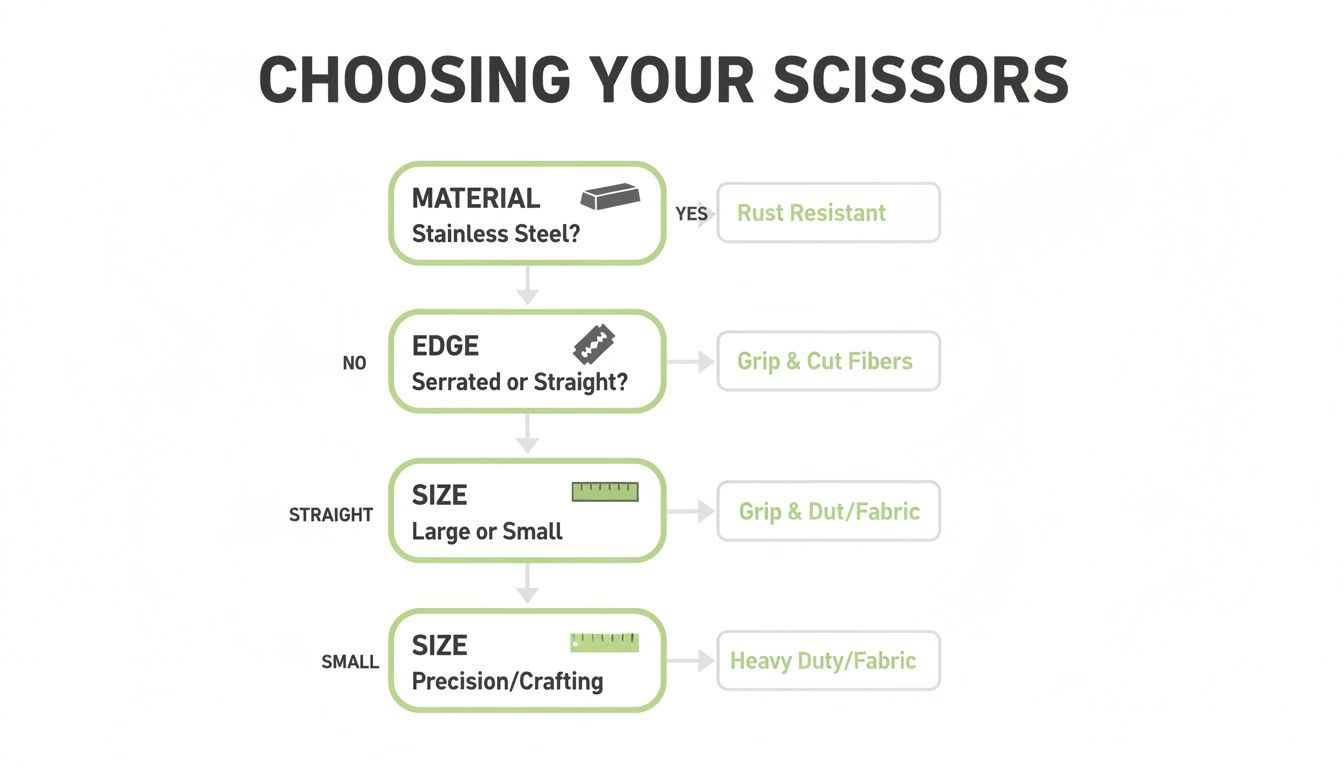
As you can see, beginners should start with more forgiving tools. As your skills grow, you can upgrade to more specialized, high-performance scissors for a polished finish.
For the Beginner Groomer
If you're just starting out, your priorities should be safety and control. Choose tools that are forgiving and help you learn without risking an accident.
Here's your beginner's shopping list:
- Safety-Tipped Scissors: Scissors with rounded or ball tips are a must-have. They drastically reduce the risk of poking your pet, giving you peace of mind when trimming around the face, ears, and paws.
- Beveled Edge Blades: These durable blades provide a clean cut without needing a surgeon's steady hand. They are more forgiving than ultra-fine convex edges, making them perfect for learning.
- Shorter Lengths: Start with a smaller pair of scissors, around 6 inches. They offer more control and are easier to maneuver, which will boost your confidence.
For the Experienced Home Groomer
Once you've mastered the basics, you can upgrade to equipment that offers greater precision and efficiency to achieve a salon-quality look.
Consider upgrading to these features:
- Convex Edge Blades: These razor-sharp blades glide through fur for the smoothest possible finish. They are perfect for detailed finishing work but require a steady, practiced hand.
- Ergonomic Handles: For longer grooming sessions, offset or crane handles are essential. They reduce hand and wrist strain by promoting a more natural grip, giving you better comfort and control.
- Longer Scissors: For larger dogs, a longer pair of straight scissors (7-8 inches) improves efficiency. You can create long, straight lines along the body with fewer snips, saving time and effort.
Mastering Grooming Safety and Proper Scissor Care
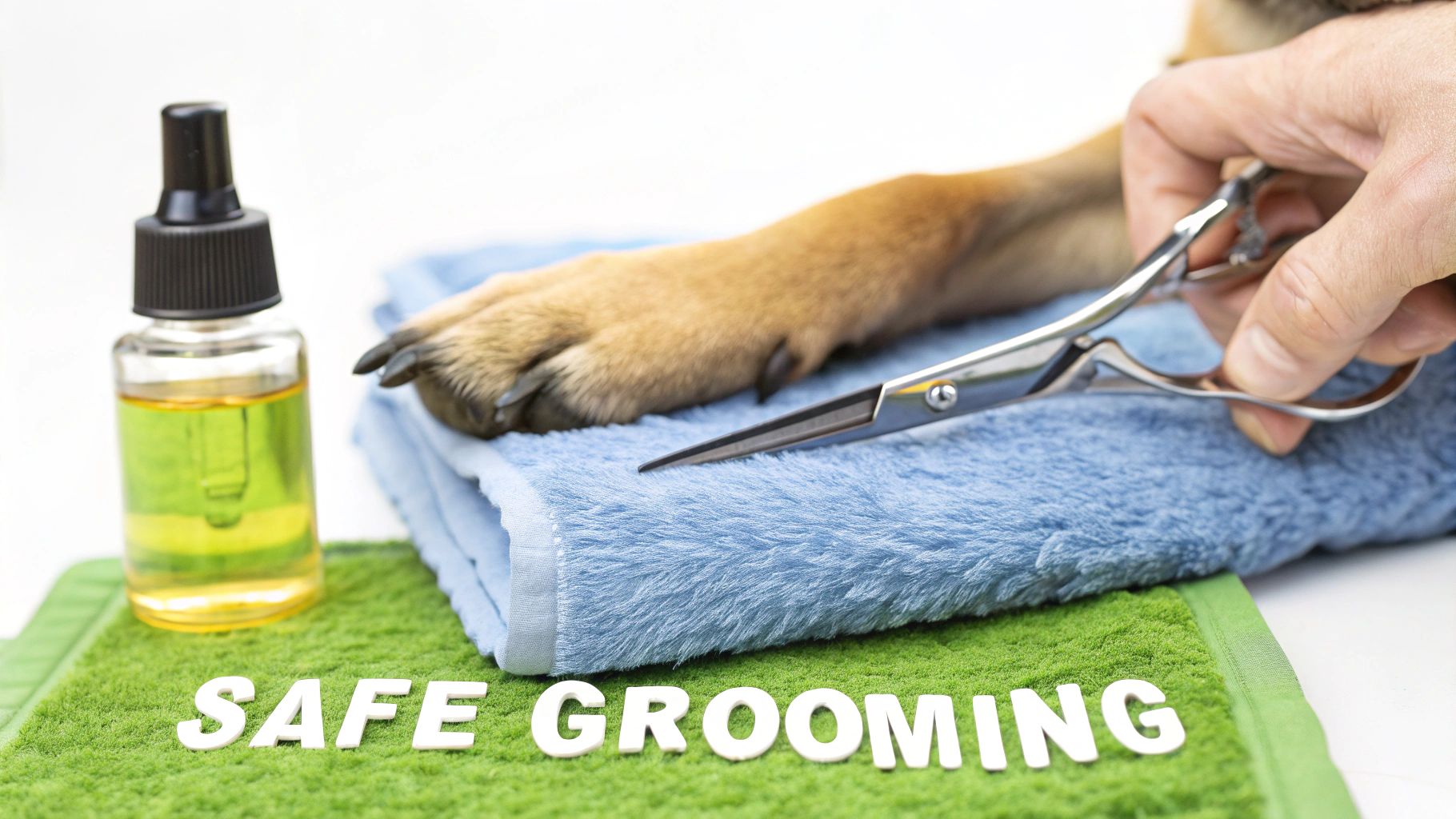 Even the best scissors are only as good as the person holding them. Buying a quality tool is the first step; mastering safe techniques and proper care is what truly makes the difference. A well-maintained scissor cuts cleanly, while safe habits build trust with your pet.
Creating a Safe Grooming Environment
Before you start, set the stage for a calm session. A relaxed pet is a still pet. Secure your pet on a non-slip surface, like a rubber mat on a sturdy table, to help them feel stable.
Groom in a well-lit area so you can see exactly what you’re doing. Minimize distractions by choosing a quiet time without other pets or children around. Your calm energy will help your pet relax.
The Golden Rule of Grooming: Always keep your fingers or a comb between the scissor blades and your pet's skin. This physical barrier is the single best way to prevent accidental nicks, especially if your pet moves unexpectedly.
Crucially, never attempt to cut out dense mats with scissors. It's nearly impossible to see where the matted fur ends and the skin begins, making this a common cause of serious injury. Use clippers or a dedicated de-matting tool for tight mats.
Best Practices for Handling Scissors
Proper technique is all about maximizing safety and control. These habits will improve the quality of your trim and your pet’s comfort.
Follow these steps for maximum control:
- Master the Grip: Place your thumb and ring finger in the finger holes. Rest your other fingers on the shank for extra stability. This grip offers far more control than using your index and middle fingers.
- Cut Parallel to the Skin: Never point the tips of your scissors directly toward your pet's body. Angle the blades to be parallel with the skin's surface, as if you're skimming over the coat. This simple habit drastically reduces the risk of poking them.
- Only Cut Clean, Dry Fur: Always brush and comb the coat thoroughly before trimming. Cutting dirty or tangled fur will dull your blades instantly and can pull painfully on their skin.
Adopting these practices will turn grooming from a risky chore into a safe, controlled routine. For more tips, our complete guide on how to groom your dog at home offers a wealth of information.
A Simple Scissor Maintenance Routine
Your grooming scissors are a precision instrument. A few minutes of care after each use will keep them working perfectly for years. Neglecting them leads to rust and dullness, which results in a poor haircut and an unhappy pet.
Follow this easy three-step routine:
- Step 1: Clean Thoroughly: After grooming, use a soft, dry cloth to wipe all hair and debris from the blades, paying special attention to the pivot screw area. For stubborn residue, use a cloth lightly dampened with rubbing alcohol.
- Step 2: Dry Completely: Moisture is the enemy of high-carbon steel. Ensure your scissors are 100% dry before storing them. The pivot point is where rust often starts, so give it extra attention.
- Step 3: Oil the Pivot Point: Apply a single drop of high-quality scissor oil directly on the pivot screw. Open and close the blades several times to work the oil into the joint, then wipe any excess oil from the blades.
Always store your clean, oiled scissors in a protective case to shield them from humidity and accidental damage. This ensures they remain sharp, safe, and ready for your next grooming session.
Got Questions About Pet Grooming Scissors? We’ve Got Answers.
Even after choosing the right tools, you might have a few questions. Getting clear, practical answers will give you the confidence you need for a successful at-home groom. Let's tackle some of the most common queries.
How Often Should I Get My Scissors Sharpened?
For the average home groomer trimming their pet every 4-6 weeks, professional sharpening is typically needed only once every 1-2 years. Your scissors will tell you when it's time. If they begin to fold or bend the fur instead of making a clean, crisp cut, they're dull. Following a consistent cleaning and oiling routine after each use will significantly extend the life of the blade's edge.
Can I Just Use My Own Hair Scissors on My Dog?
It’s tempting, but this is a firm no. Scissors designed for human hair are not built to handle a dog's coat, which is often much coarser and thicker. Using human shears will dull the blades quickly and, more importantly, can snag and pull your pet's fur, causing pain and discomfort. The best pet grooming scissors are specifically engineered with the right blade tension and edge to cut animal fur safely and efficiently.
What's the Right Way to Use Thinning Shears?
Thinning shears are fantastic for blending, but improper use can create patchy spots. The key is to use a light touch and never cut too close to the skin.
Pro Tip: The secret to using thinning shears is to keep them moving. Never make more than one or two snips in the exact same spot. This ensures you are gradually removing bulk for a natural, seamless look.
Follow these steps for a perfect finish:
- Comb the fur in the direction it grows.
- Lift a small section of hair with your comb, moving it away from the body.
- Make one or two quick snips about midway down the hair shaft.
- Comb through the area to check the result before making another cut.
This slow-and-steady approach prevents you from removing too much fur at once, leaving your pet with a professionally blended coat.
Ready to achieve that perfect at-home groom with tools you can trust? The Pet Magasin grooming kits are designed with safety, quality, and your pet’s comfort in mind. Explore our collection and find the perfect set to make every grooming session a success. Shop now at Pet Magasin.

Leave a comment