
Discover the best airline approved dog carrier for stress-free flights

So, you're looking for the best airline-approved dog carrier and hoping to find one magical carrier that every single airline will accept. The truth is, there's no such thing as a "universally approved" carrier. Instead, airlines require a specific set of features to keep your dog safe, secure, and comfortable while flying in the cabin with you.
Your Guide to Flying with a Dog in the Cabin
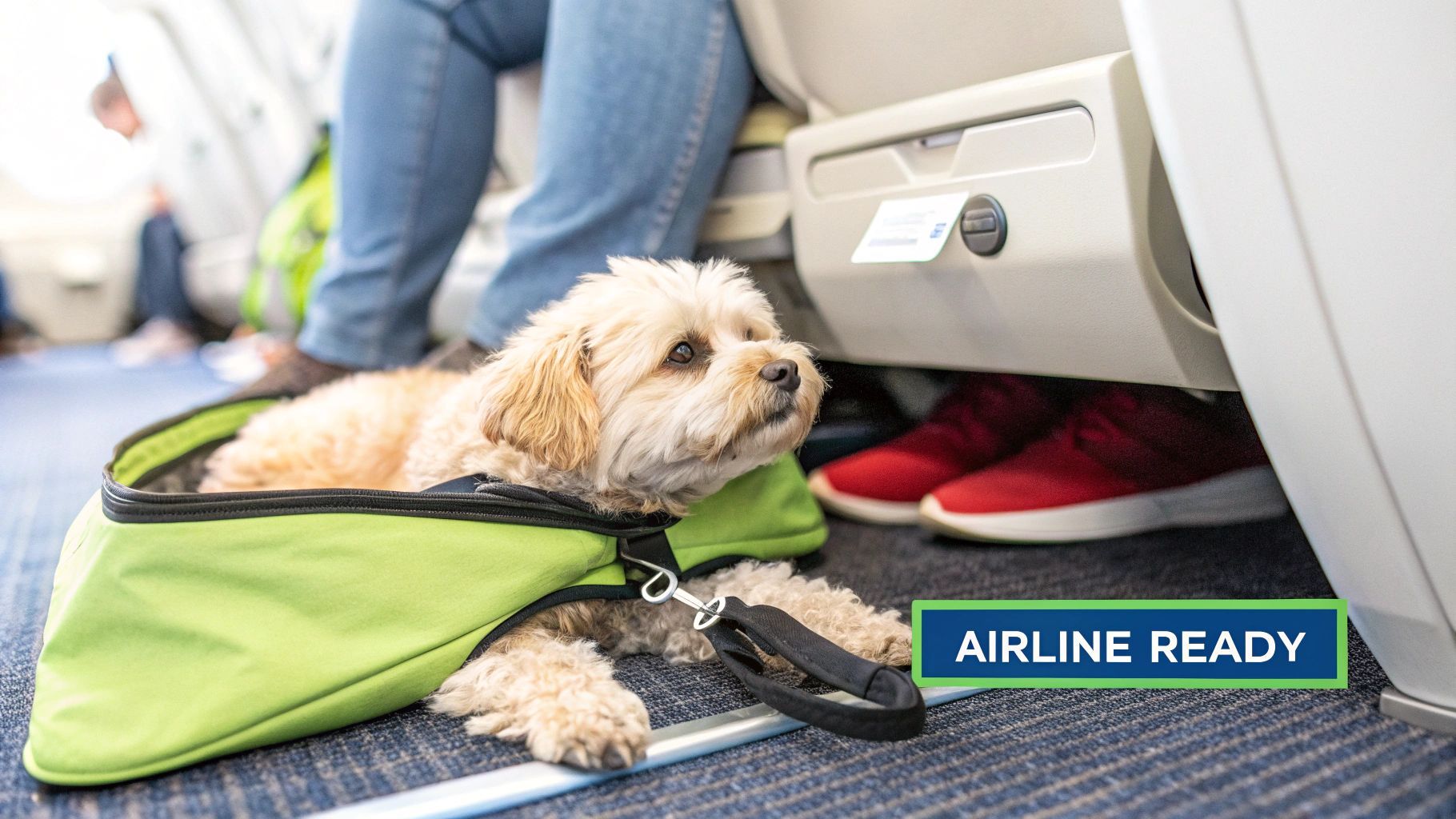
Taking your dog on a flight can be a surprisingly smooth experience, but your success starts with picking the right carrier. This guide is designed to cut through the noise and turn the vague term "airline approved" into a practical checklist you can use right now. Follow these steps, and you'll walk up to that check-in counter with total confidence.
The core principle is simple: "airline approved" isn't an official stamp or certification. It's a list of common-sense features. Mastering these fundamentals is your first step toward a hassle-free trip for you and your furry copilot.
Core Features of an Approved Carrier
While every airline has its own specific rules, they all agree on a few non-negotiable features. Any carrier you choose absolutely must be:
- Well-Ventilated: Ensure your dog gets proper airflow. Look for carriers with mesh windows on at least three sides.
- Leak-Proof: A waterproof bottom is a mandatory feature to contain any accidents.
- Secure: Prioritize escape-proof locking zippers and a sturdy frame to prevent any in-flight jailbreaks.
- Properly Sized: Measure your dog to ensure they have enough room to stand up, turn around, and lie down naturally.
More people are choosing to travel with their pets. In the United States alone, nearly 2 million pets fly on commercial planes every year, and about 33% of dog owners now bring their companions along for the ride. This boom in pet travel makes it more important than ever to know the rules before you show up at the airport.
Actionable Tip: Treat your dog's carrier as their ticket and passport rolled into one. If it doesn't have the right features, you and your pup might not even make it past the check-in desk, no matter how much you paid for their spot.
Quick Checklist for an Airline Approved Carrier
To simplify your shopping, use this quick-glance table of absolute must-haves. If a carrier you're considering doesn't tick every one of these boxes, it's not the right choice for your flight.
| Essential Feature | Action: What to Look For |
|---|---|
| Sufficient Ventilation | Confirm mesh panels on 3+ sides to guarantee fresh air and prevent overheating. |
| Leak-Proof Bottom | Check for a fully waterproof base to contain messes and comply with airline rules. |
| Secure, Locking Zippers | Test the zippers. Ensure they have a locking mechanism to stop clever dogs from escaping. |
| Sturdy, Pliable Frame | Choose a carrier that is strong enough to protect your dog but flexible enough to fit under a seat. |
| Correct Dimensions | Measure your dog first, then buy a carrier that fits under the seat while allowing comfortable movement. |
Checking off these basics is the best way to start. Once you've got the carrier sorted, looking into other Essential Flight Essentials can help make the whole journey even more comfortable for both of you. Getting this foundation right will set you up for a smooth, stress-free trip from takeoff to touchdown.
Decoding Airline Rules and TSA Procedures
Figuring out airline pet policies can feel overwhelming. The most important thing to understand is that "airline approved" is not an official, one-size-fits-all certification. It’s a general guideline, and the gate agent always has the final say.
Think of it like a dress code. The invitation might say "smart casual," but the host ultimately decides if your outfit is appropriate. Your dog’s carrier is the same—it has to meet the airline's specific "dress code" to get on the plane. Your task is to ensure it does.
The Airline Rulebook: Dimensions and Weight
The two biggest hurdles are the carrier's size and total weight. Every airline has slightly different under-seat measurements, but major carriers like United and Delta generally require dimensions around 18"L x 11"W x 11"H. Soft-sided carriers are your best bet here, as their flexibility allows them to compress slightly to fit.
Weight limits are just as strict and almost always include your dog and the carrier combined. This typically maxes out between 20 to 25 pounds. Action step: Before you book your ticket, visit your specific airline’s website and find their pet policy page. Confirm the exact dimension and weight limits, as they will not bend these rules at check-in. To save time, you can find a directory of specific airline pet transport information here.
Must-Have Safety Features for In-Cabin Carriers
Size and weight aren't the only criteria. Airlines enforce strict rules about the carrier's features to ensure your pup is safe and secure throughout the flight.
Here are the non-negotiables to look for:
- Three-Sided Ventilation: Airflow is critical. Choose a carrier with mesh on at least three sides to keep your dog cool and comfortable.
- Leak-Proof Bottom: Accidents can happen. A waterproof floor is mandatory to contain any messes and maintain cabin hygiene.
- Secure Zippers: Prevent an escape at 30,000 feet. Look for carriers with locking zippers that a clever pup can't nudge open.
Pro Tip: The gate agent’s job is to ensure the safety and comfort of every passenger—including your pet. When you arrive with a carrier that clearly meets all safety requirements, you make their job easier and ensure your check-in is smooth.
Getting Through the TSA Security Checkpoint
For many pet owners, the TSA security line is the most stressful part of the journey. Knowing exactly what to do will make it easier for both of you. Remember, you will have to take your dog out of the carrier.
Follow this step-by-step process:
- Prepare in Line: Before you reach the front, remove your dog's collar, leash, and harness to avoid setting off metal detectors. Hold your pet securely.
- Carrier Goes Through the X-Ray: Place the empty carrier on the conveyor belt to go through the X-ray scanner, just like your carry-on luggage.
- You and Your Dog Walk Through: Carry your dog in your arms and walk through the metal detector. Your pet will never be put through an X-ray machine.
- Settle and Repack: After clearing security, step aside to a quiet area and carefully place your dog back into their carrier. Take a moment to ensure they are comfortable before heading to your gate.
When you're calm, your dog is more likely to stay calm. And while these rules might seem like a lot, the basic principles are the same for most pets. If you're traveling with a feline friend, you might also want to check out our guide on choosing an airline-approved cat carrier.
How to Measure Your Dog for a Perfect Carrier Fit
Getting your dog into an airline-approved carrier is one thing, but making sure it's the right one is crucial. A perfect fit is non-negotiable. If the carrier is too big, it won't fit under the seat. If it's too small, your dog will be uncomfortable, and the airline will reject it on the spot.
Treat the carrier as your dog’s private cabin for the flight—it should be cozy, not cramped. Every airline follows the same core rule: your dog must be able to stand up, turn around, and lie down comfortably. This isn't just a suggestion; it's a rule that gate agents will enforce.
Taking Your Dog’s Measurements Accurately
To get this right, you’ll need a soft measuring tape and a patient dog. Do not guess—a few minutes of measuring now will save you from major stress at the airport. You only need two simple measurements.
Here’s how to measure your pup correctly:
- Measure the Length: With your dog standing, measure from the tip of their nose to the base of their tail (not the tip of the tail). Write this number down.
- Measure the Height: While they are still standing, measure from the floor to the top of their head or the tips of their ears—whichever is higher. This is their standing height.
Once you have these two measurements, add two to four inches to both numbers. This additional space is the key. It provides the wiggle room your dog needs to reposition and stretch, which is exactly what airlines require.
The whole point is to capture your dog’s natural standing size so the carrier doesn't feel like a straitjacket.
Why Soft-Sided Carriers Often Win for In-Cabin Travel
With your dog's measurements in hand, you'll need to choose between a soft-sided or hard-sided carrier. For in-cabin travel, a soft-sided carrier is almost always the superior choice. Its greatest advantage is flexibility. The space under airline seats can be unpredictable, but a soft carrier has some give, allowing it to compress slightly to fit without harming your dog.
Actionable Insight: A soft-sided carrier provides a crucial buffer. If the under-seat space is an inch shorter than your carrier, a hard-sided model will be rejected. A soft one, however, can often be gently compressed into place, saving your travel plans.
Hard-sided carriers have zero flexibility. Their dimensions must be an exact match for the airline's allowance, leaving no room for error. This rigidity makes them a risky choice for in-cabin travel, increasing your chances of being turned away at the gate. To dive deeper into specific airline requirements, use our guide on airline pet carrier size requirements.
Ultimately, taking a few precise measurements and choosing a carrier with built-in flexibility is your ticket to a smooth check-in. It’s a simple step that guarantees your best friend has a safe and comfortable spot for the journey.
Comparing Carrier Materials and Safety Features
Once you've confirmed the airline rules and measured your dog, it's time to inspect what the carrier is actually made of. This is what guarantees your dog's safety and comfort on travel day. It’s like buying a car—you wouldn't just pick a color. You'd check the safety ratings, airbags, and overall build quality.
Apply the same logic here. Look past the design and focus on the functional features that will keep your pup secure, from the chaotic airport terminal to being tucked under the seat.
Soft Sided vs Hard Sided Carriers
For in-cabin travel, your primary choice is between a soft-sided and a hard-sided carrier. While large plastic crates are essential for cargo, a soft-sided carrier is almost always the better option for bringing your dog on board with you.
Soft carriers, typically made from durable fabrics like nylon or polyester, offer one huge advantage: flexibility. This allows them to compress just enough to fit under seats, which often have inconsistent dimensions. A hard carrier has zero wiggle room. If it's half an inch too tall, it won't fit, and you could be grounded.
Practical Takeaway: Think of a soft-sided carrier like a duffel bag and a hard-sided one like a rigid suitcase. You can always maneuver a duffel bag into a tight overhead bin, but a suitcase either fits perfectly or not at all. That flexibility is a lifesaver for in-cabin travel.
This is why starting with the right measurements for your dog is so critical before you even think about carrier type. Get the height and length right, and you're set up for success.
Soft-Sided vs Hard-Sided Carrier Showdown
To make the choice crystal clear, here is a breakdown of the pros and cons of each carrier type for in-cabin flights.
| Feature | Soft-Sided Carrier | Hard-Sided Carrier |
|---|---|---|
| Flexibility | Excellent. Can compress to fit under various seat sizes. | None. Rigid structure; either fits perfectly or not at all. |
| Weight | Lightweight. Easier to carry through the airport. | Heavier. Can be bulky and more difficult to manage. |
| Comfort | Cozy. Often has plush, padded interiors. | Less Cozy. Hard plastic interior can be less comfortable. |
| Storage | Good. Usually includes pockets for treats, toys, and papers. | Limited. Typically has no external storage options. |
| Best For | In-Cabin Travel. The gold standard for flying with your pet. | Cargo Travel. Required for pets flying in the cargo hold. |
Ultimately, for bringing your dog into the cabin, a soft-sided carrier gives you the best shot at a smooth, stress-free boarding experience.
Non-Negotiable Safety Features to Prioritize
So, you've decided on a soft-sided design. Now, it's time to get selective about safety features. Not all carriers are created equal, and a few key details distinguish a secure haven from a potential escape pod.
Here’s your checklist of what to look for:
- Claw-Proof Mesh: Your dog will likely paw at the windows. Choose a carrier with high-quality, rubberized mesh that resists tearing to maintain ventilation and keep your dog securely inside.
- Locking Zippers: A standard zipper is no match for a determined dog's nose. You need zippers that clip together or have a locking mechanism to prevent escapes mid-flight.
- Waterproof Base: Accidents happen. A solid, leak-proof bottom is an airline requirement for a reason—it contains messes and prevents them from ruining the travel day for everyone.
- Internal Safety Tether: This is a critical feature. It's a short leash inside the carrier that clips to your dog’s harness, stopping them from bolting the moment you open the carrier in a busy airport.
Top-tier brands are really stepping up their game. Companies like Diggs and Sleepypod have even earned 5-star crash test ratings from the Center for Pet Safety (CPS), which shows a serious commitment to keeping pets safe. These premium carriers often add thoughtful touches like trolley sleeves that slide over your luggage handle, making the trek through the airport so much easier. You can find more great tips on top-rated carriers over on Passpaws's blog.
The Pet Magasin Airline Approved Dog Carrier was built with exactly these priorities in mind. It brings together durable, lightweight materials with claw-proof mesh and secure zippers to create a safe, comfy space for your dog. With its padded interior and a tough, waterproof base, it meets the highest standards for both airline rules and your own peace of mind. By focusing on these proven safety features, you can find the best airline approved dog carrier that truly protects your furry family member.
Preparing Your Dog for a Stress-Free Flight
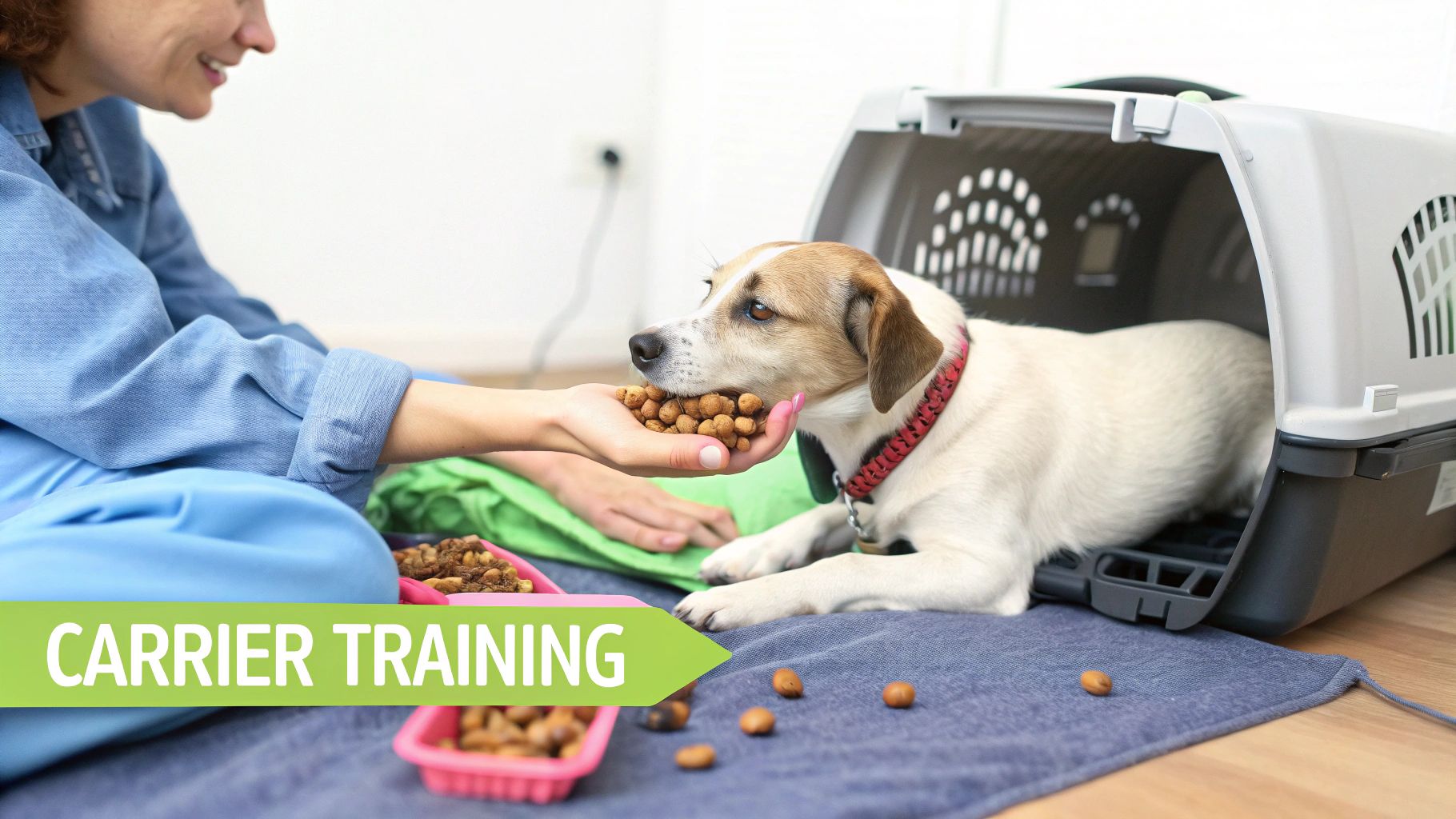
Even the most perfect airline-approved carrier is useless if your dog is terrified of it. Introducing a new carrier on travel day is a recipe for anxiety. The secret to a peaceful flight is to train your dog to see the carrier as their own safe space, not a scary cage.
This process is called carrier desensitization. Start at least a few weeks before your trip. Approach it like teaching a new trick—it requires patience, consistency, and positive reinforcement. Rushing this process is the biggest mistake you can make.
Creating a Positive Association
First, transform the carrier from a strange object into a cozy den. The key is to ensure every interaction your dog has with it is positive. Never force them inside. Let them explore it on their own terms.
Place the carrier in your living room with the door open. Toss a soft blanket inside with a few high-value treats or a favorite toy to make it inviting. For the first few days, just leave it there. Let your dog's curiosity do the work.
The moment you see your dog sniff or step inside, praise them enthusiastically! This builds the positive connection that shows them the carrier is a great place to be.
A Step-by-Step Training Plan
Once your dog is comfortable going in and out of the carrier, you can begin a more structured training plan. Go slowly and always end on a positive note.
- Close the Door Briefly: With your dog inside, close the door for just a second, then immediately open it and give them a treat. Gradually increase the duration, always rewarding them for staying calm.
- Lift the Carrier: Once they are relaxed with the door closed for a minute, gently lift the carrier a few inches, then set it back down. Reward them for not panicking.
- Simulate Movement: Next, carry them around the house. Progress to short car rides with the carrier buckled securely. This helps them acclimate to the motion they will experience during travel.
The Goal: Build your dog's confidence one small step at a time. Each successful stage proves that the carrier is a safe, predictable space. This confidence is what will get you through travel day without a hitch.
Your Dog’s Pre-Flight Packing Checklist
Having your dog's essentials ready will make the airport experience much smoother. Pack a dedicated "doggy bag" to keep everything organized and accessible.
Use this checklist to pack smart:
- Health Documents: Bring a copy of your dog’s vaccination records and any required health certificates from your vet.
- Leash and Harness: You'll need these for security and potty breaks. Never attach a leash to a collar inside the carrier; always use a harness for safety.
- Collapsible Bowls: These are perfect for food and water on the go—easy to pack and use.
- Puppy Pads: Line the carrier bottom with a pad for easy cleanup in case of an accident.
- Familiar Comfort Items: A small toy or blanket that smells like home can be incredibly reassuring for your dog.
- Necessary Medications: If your dog takes medication, keep it clearly labeled and easily accessible.
This preparation makes the entire journey less stressful. For more pro tips, check out our complete guide on how to travel with pets.
Top Questions About Airline Dog Carriers Answered
Even after doing your homework, you might still have a few questions. That's completely normal. Let's tackle the most common concerns so you can walk into the airport feeling prepared and confident.
Think of this as your final pre-flight check to ensure a smooth trip.
Can My Carrier Be Slightly Larger Than the Rules State?
This is a common question and highlights why soft-sided carriers are ideal for in-cabin travel. Airlines know these carriers have some flexibility. If your soft carrier is an inch or two over the stated dimensions, you can often gently compress it to fit under the seat.
As long as it can be stowed safely and your dog still has room to move comfortably, gate agents are usually reasonable. This does not apply to hard-sided carriers. For those, the measurements must be exact. Actionable Tip: If you are unsure, call the airline's customer service ahead of time to confirm.
Should I Sedate My Dog Before a Flight?
The American Veterinary Medical Association (AVMA) and most veterinarians give a firm no. Sedatives and tranquilizers can be dangerous for dogs at high altitudes, impairing their ability to regulate body temperature and maintain balance.
Expert Advice: Sedation may seem like an easy fix for anxiety, but the health risks are serious. The safest approach is to acclimate your dog to their carrier through positive training well before your travel date.
If your dog has severe travel anxiety, consult your vet. They can discuss safer, non-sedative anti-anxiety options that are approved for air travel.
Is One Carrier Good for Both Cabin and Cargo?
No, you cannot use the same carrier for both. The requirements for in-cabin and cargo travel are completely different.
- In-Cabin Carriers: These are almost always soft-sided, designed to be lightweight, flexible, and small enough to fit under a seat. Their purpose is to be a cozy den.
- Cargo Crates: These must be IATA-compliant, hard-sided kennels made from rigid plastic with a metal door. They are secured with metal nuts and bolts—not plastic clips—to ensure they cannot break open during transit.
Always purchase a carrier specifically designed for how your dog will be traveling. Using the wrong type is against airline rules and compromises your pet’s safety. It's all about using the right tool for the job.
Ready to fly with confidence? Pet Magasin offers a range of thoughtfully designed, TSA airline-approved pet carriers that prioritize safety, durability, and your pet's comfort. Explore our collection and find the perfect travel solution for your furry family member at https://www.petmagasin.com.

Leave a comment