


Your Guide to Airline Approved Pet Carrier Size

Flying with your pet should be an exciting journey, but figuring out the right carrier can be a major hurdle. The most common airline approved pet carrier size for in-cabin travel is 18 inches long x 11 inches wide x 11 inches high. These dimensions are your key to ensuring the carrier fits safely under the seat in front of you.
Getting a Handle on Airline Pet Carrier Rules
To ensure a smooth trip, your first action is to secure an airline-approved carrier. Think of it as your pet's boarding pass; getting the size right is non-negotiable for their safety and your peace of mind. Arriving with a carrier that's too big is the top reason travelers are denied boarding with their pets.
The core rule is simple: the carrier must fit completely under the airplane seat. This space is surprisingly small and can vary between aircraft. Airlines enforce this strictly because a carrier that doesn't fit becomes a safety hazard during takeoff and landing. Your primary task is to find a carrier that meets this fundamental requirement.
Why Carrier Compliance Is a Bigger Deal Than Ever
The landscape of pet air travel has shifted significantly. Following the U.S. Department of Transportation's update to the Air Carrier Access Act in 2021, the special allowance for emotional support animals (ESAs) was eliminated. This change saw the number of ESAs on flights plummet from over 250,000 in 2018 to a fraction of that today.
This has put a spotlight on standard in-cabin pets, increasing demand for these limited spots. In response, major carriers like Delta, United, and American have solidified their carrier size limits around the 18x11x11 inch benchmark. Airline data is direct: 92% of denied pet boardings stem from oversized carriers. Conversely, carriers that meet the size requirements have a 98% approval rate. Your most effective action is to check specific airline pet travel policies on their official sites before booking.
The single most important action you can take for a smooth check-in is to arrive with a carrier that meets your airline's specific size and construction requirements. This eliminates guesswork and virtually guarantees your pet can fly with you.
In-Cabin vs. Cargo: What's the Difference?
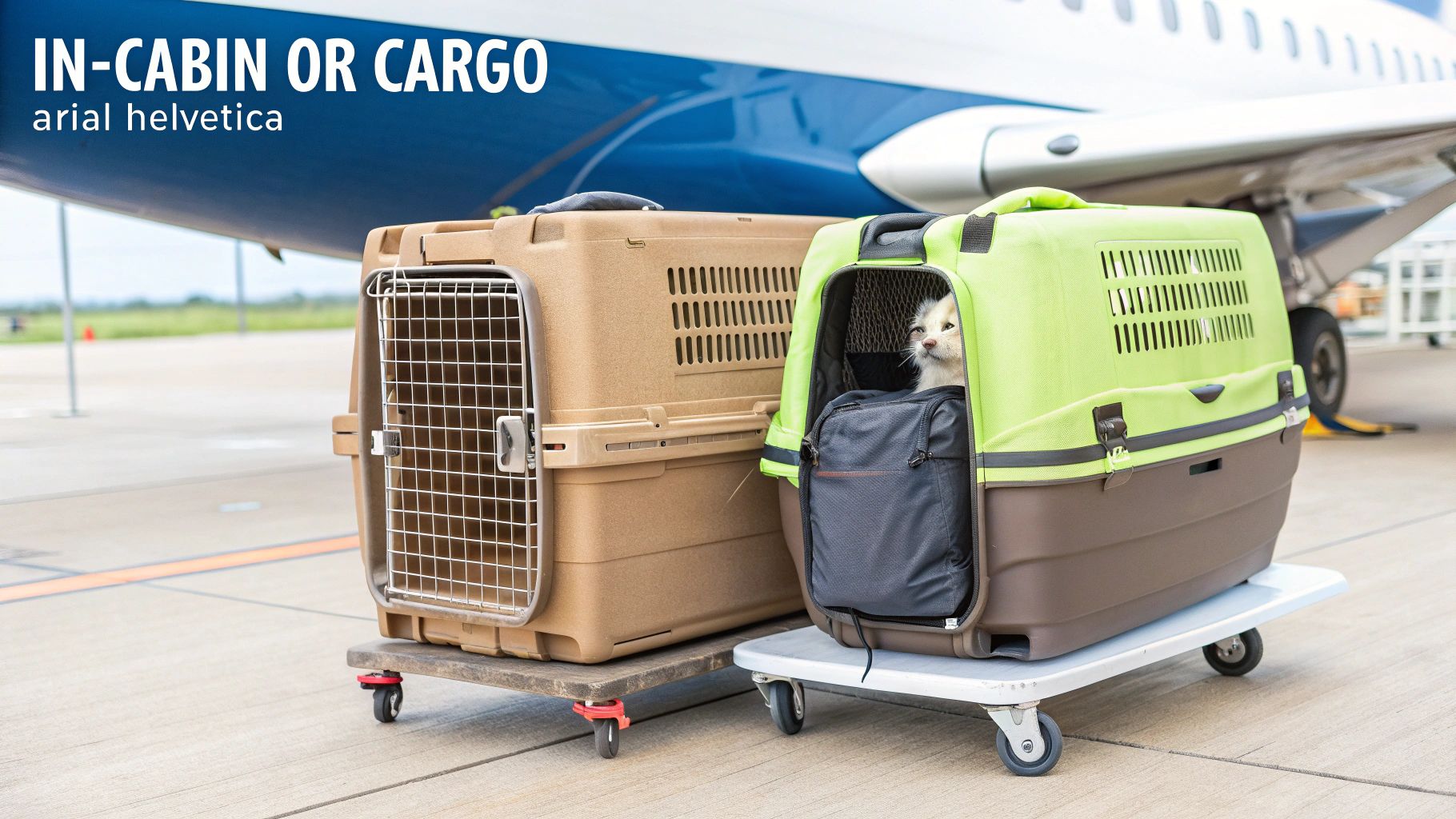
Your first decision is where your pet will fly: in the cabin with you or in the cargo hold. This choice dictates the type of carrier you need.
- In-Cabin Carriers: These are designed for smaller pets, typically under 20 pounds, who can travel in the passenger area. Your best bet is a soft-sided carrier, as its flexibility helps it fit under various seat configurations.
- Cargo Kennels: For larger pets, cargo is the only option. These pets travel in a pressurized, temperature-controlled hold. You must use a hard-sided, durable kennel that meets standards set by the International Air Transport Association (IATA).
For in-cabin travel, mastering the airline approved pet carrier size is your main objective. This guide will give you the actionable steps to measure your pet, choose the right carrier, and ensure your companion is cleared for takeoff.
Quick Reference for Major US Airline Carrier Size Limits
While "18x11x11" is a reliable guideline, you must verify the exact dimensions with your airline before you fly. This table provides an at-a-glance reference for maximum soft-sided carrier dimensions on major U.S. airlines.
| Airline | Maximum Dimensions (L x W x H in inches) | Common Pet Weight Limit |
|---|---|---|
| Alaska Airlines | 17 x 11 x 9.5 | Varies by flight |
| American Airlines | 18 x 11 x 11 | Varies (carrier must fit) |
| Delta Air Lines | 18 x 11 x 11 | Varies (carrier must fit) |
| JetBlue | 17 x 12.5 x 8.5 | 20 lbs (pet + carrier) |
| Southwest Airlines | 18.5 x 13.5 x 9.5 | Varies (carrier must fit) |
| United Airlines | 17.5 x 12 x 7.5 | Varies (carrier must fit) |
These dimensions are for soft-sided carriers, which offer some flexibility. Hard-sided carriers have smaller allowances. Your final step is always to confirm on the airline's website, as policies can change.
How to Measure Your Pet for the Perfect Carrier
Choosing the right carrier starts with measuring your pet—this is the most critical step for ensuring a safe and approved journey. A few minutes with a measuring tape now will prevent the stressful scenario of being turned away at the airport.
The airline's primary rule is that your pet must be able to stand up, turn around, and lie down comfortably inside the carrier. This is a strict requirement for their welfare and for passing check-in. An improperly sized carrier can cause significant stress, negatively impacting your pet's travel experience.
The Two Essential Measurements You Need
To get this right, you only need two measurements. Follow these steps to avoid any issues.
-
Length: Use a soft measuring tape to measure your pet from the tip of their nose to the base of their tail. Do not include the tail in this measurement.
-
Height: With your pet standing, measure from the top of their head (or the tips of their ears if they stand erect) straight down to the floor.
Once you have these numbers, apply this practical rule.
Actionable Tip: Add two to four inches to both the length and height measurements. This buffer ensures your pet has adequate room to reposition comfortably during the flight, making the carrier a secure space rather than a cramped box.
This simple process is all it takes to get started. Measure your pet, find a carrier that fits those expanded dimensions while staying within airline limits, and you're ready to fly.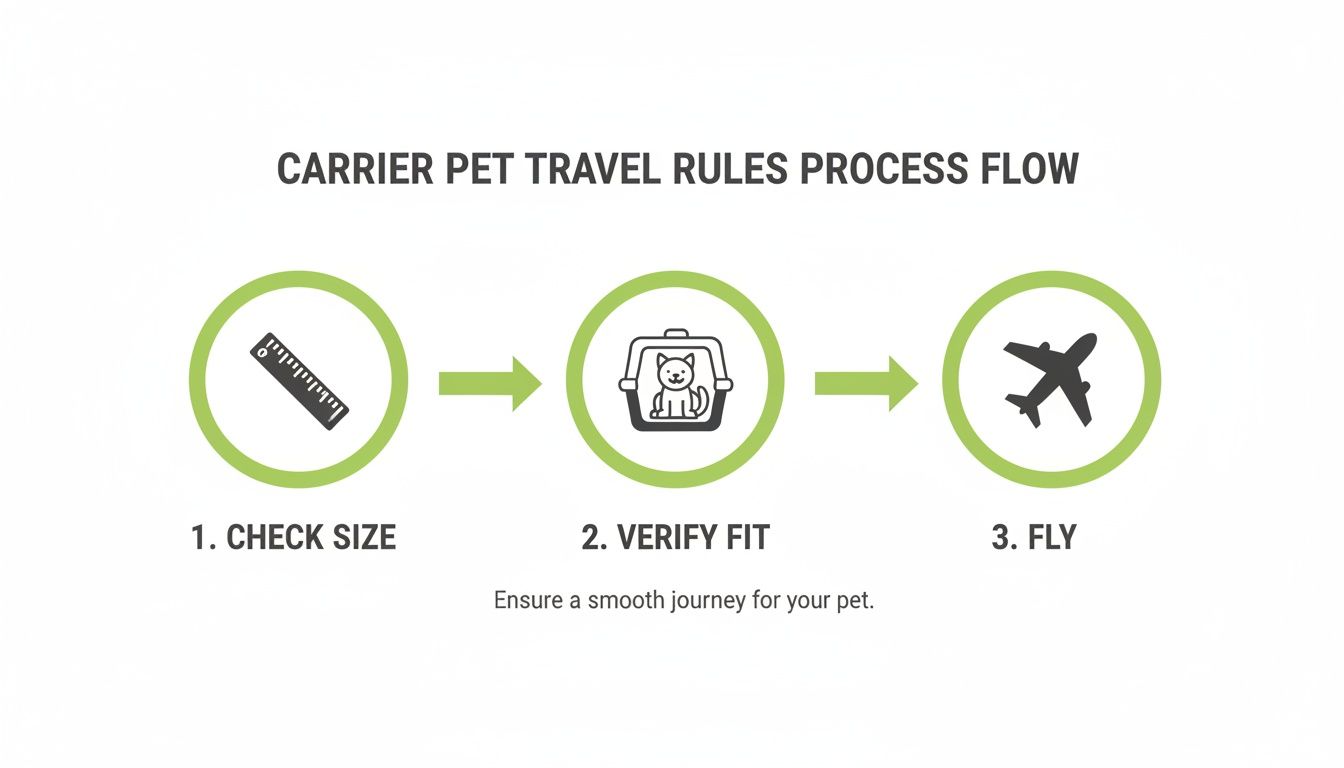
As the infographic shows, a smooth flight comes from solid preparation, which begins with accurate measurements and confirming a comfortable fit.
Tips for Measuring an Energetic Pet
If your pet won't stay still, use these practical techniques to get accurate measurements.
- Use the Two-Person Method: Have one person hold and distract your pet with a toy or treat while the other quickly takes the measurements.
- Mark a Wall: Position your pet alongside a wall and lightly mark their height and length (from nose to tail base). Let them go, then measure the distance between your marks.
- Take Multiple Measurements: Measure at least twice to confirm your numbers are accurate before you start shopping for a carrier.
- Keep it Positive: Use a calm voice and offer treats and praise. Your goal is to make the measuring process a stress-free experience.
These numbers will directly determine the airline approved pet carrier size you need to purchase. Taking the time to be precise is the best way to ensure a smooth check-in and a comfortable flight for your pet. For larger dogs requiring a hard-sided kennel, these measurement rules are just as crucial. You can get more details in our guide on choosing the right kennel for a dog.
Choosing Between In-Cabin and Cargo Travel
Deciding where your pet will fly is the most significant choice you'll make. This decision is based on your pet's size, temperament, and airline regulations. Each option has specific rules that directly impact the airline approved pet carrier size and type you'll need to buy.
In-cabin travel offers the most peace of mind, as your pet remains with you. You can monitor them and offer reassurance, which is ideal for nervous travelers. However, this option is exclusively for small pets, typically those weighing under 20 pounds including their carrier.
For in-cabin travel, a flexible, soft-sided carrier is the most practical choice. Its ability to compress slightly makes it easier to fit under various seat designs, which is a mandatory safety requirement.
When Cargo is the Only Option
For larger pets, the cargo hold is the only available option. Modern cargo holds are pressurized, climate-controlled environments designed for the safe transport of live animals.
Unlike soft in-cabin carriers, cargo travel demands a tough, hard-sided kennel compliant with IATA standards. To be approved, your cargo kennel must have these features:
- Solid Construction: It must be made from rigid plastic, wood, or metal.
- Secure Hardware: The top and bottom must be secured with metal nuts and bolts, not plastic clips.
- Single Metal Door: The door must be a single piece of welded or cast metal with a secure latch.
- Adequate Ventilation: The kennel must have ventilation on at least three sides.
These rules are strictly enforced to ensure the kennel can withstand transport without risk of your pet escaping.
The Evolution of Cargo Safety
Concerns about cargo travel are understandable, but regulatory changes have drastically improved safety. In May 2005, the U.S. Department of Transportation (DOT) began requiring airlines to report all pet travel incidents. This transparency revealed significant issues with older, insecure kennels.
In response, by 2010, major airlines like Delta and United implemented stricter rules, mandating that all cargo kennels be secured with metal hardware and supplemental cable ties. These actions significantly reduced pet escape incidents. You can learn more about the history of pet travel safety improvements on DryFur.tv.
Your decision is driven by your pet's size. If they can fit comfortably in a carrier under the seat, choose in-cabin travel. For larger pets, your most critical action is to select an IATA-compliant cargo kennel to ensure their safety.
Whether your pet flies in the cabin or cargo, your responsibility is to choose a carrier that meets all airline requirements. Understanding the distinction between the two enables you to make the right choice for a safe journey.
Navigating Specific Airline Carrier Policies
While general guidelines are helpful, a stress-free flight depends on knowing the specific rules of your airline. A minor difference in the approved pet carrier size can be the difference between a smooth check-in and being denied boarding.
The single most important rule of pet travel is to always double-check the airline's official website before you fly. Policies are subject to change, and the only information that matters on travel day is the airline's current regulations.
A Closer Look at Major US Airline Policies
Here’s a practical breakdown of in-cabin pet carrier policies for major airlines. Note the subtle but crucial differences.
Delta Air Lines
Delta's policy is clear and favors soft-sided carriers for their flexibility.
- Maximum Dimensions: 18" L x 11" W x 11" H
- Actionable Insight: The carrier must fit under the seat, and space varies by aircraft. Check Delta’s website for the under-seat dimensions for your specific flight to be certain.
United Airlines
United provides different dimensions for soft and hard carriers, highlighting the importance of choosing the right type.
- Maximum Dimensions (Soft-Sided): 18" L x 11" W x 11" H
- Maximum Dimensions (Hard-Sided): 17.5" L x 12" W x 7.5" H
- Actionable Insight: United requires your pet to be able to stand up and turn around after the carrier is placed under the seat. Test this at home.
American Airlines
American's rules vary significantly by aircraft, making it critical to check your flight details.
- Maximum Dimensions (Soft-Sided): 18" L x 11" W x 11" H
- Maximum Dimensions (Hard-Sided on Mainline Flights): 19" L x 13" W x 9" H
- Actionable Insight: If your flight is on a smaller American Eagle regional jet, the under-seat space is reduced. You must confirm the smaller size limit for these flights.
Southwest Airlines
Southwest offers a more generous size allowance but is extremely strict about enforcement.
- Maximum Dimensions: 18.5" L x 13.5" W x 9.5" H
- Actionable Insight: The carrier must fit completely under the seat with no part extending into the aisle. To be safe, consider purchasing Southwest's branded carrier, which is guaranteed to comply.
The key takeaway is that dimensions are not universal. A carrier approved for Southwest may be too large for United. Your action is to buy a carrier that meets the specific dimensions of the airline you are flying.
Domestic vs International Airline Carrier Policies at a Glance
International pet travel introduces another layer of complexity. Regulations for a flight to London are different from a flight to Los Angeles. Expect stricter documentation, different fees, and varying size limits.
Use this table to understand the key differences you need to plan for.
| Policy Aspect | Typical US Domestic Airlines (e.g., Southwest, Alaska) | Typical International Airlines (e.g., Lufthansa, British Airways) |
|---|---|---|
| Carrier Size | Consistent focus on under-seat fit (approx. 18"x11"x11"). | Can vary widely. Some airlines impose stricter height or combined pet-and-carrier weight limits. |
| Fees | Flat fee, usually $95 - $125 each way. | Often higher and can vary by destination, sometimes calculated by weight or size. |
| Documentation | Usually a recent health certificate. | Requires extensive paperwork: an international health certificate, proof of specific vaccinations, microchip, and sometimes an EU Pet Passport. |
| Booking Process | Book online or by phone; spots are first-come, first-served. | Often requires a direct phone call. Pet reservations take longer to confirm due to verification processes. |
This highlights the need for advanced planning for international trips. Start your research and preparations months ahead of your flight to ensure you have all required documents and a compliant carrier.
The Global Standard for Pet Carrier Sizes
Airline-specific rules generally align with a global standard of 18x11x11 inches (46x28x28 cm) for in-cabin carriers. This dimension is based on IATA guidelines and is designed to fit under a standard passenger seat.
This standard is reflected across most airlines. Delta uses 18x11x11 inches for soft carriers, suitable for pets up to 20 lbs. Southwest allows 18.5x13.5x9.5 inches but strictly enforces the under-seat fit. United and American Airlines recommend 18x11x11 inches for soft carriers. Data from 2024 shows that over 85% of in-cabin pet approvals depend on meeting these precise measurements.
For more detailed information, you can find a breakdown of airline pet carrier dimensions on TravelReadyPets.com.
Selecting the Best Airline Approved Carrier
You have the rules and your pet’s measurements. Now it's time to choose the carrier. This is an investment in your pet's safety and your own peace of mind.
A good carrier is a secure, comfortable space, not just a container. The right features will ensure airline compliance while providing a calming environment for your pet.
Non-Negotiable Features for In-Cabin Carriers
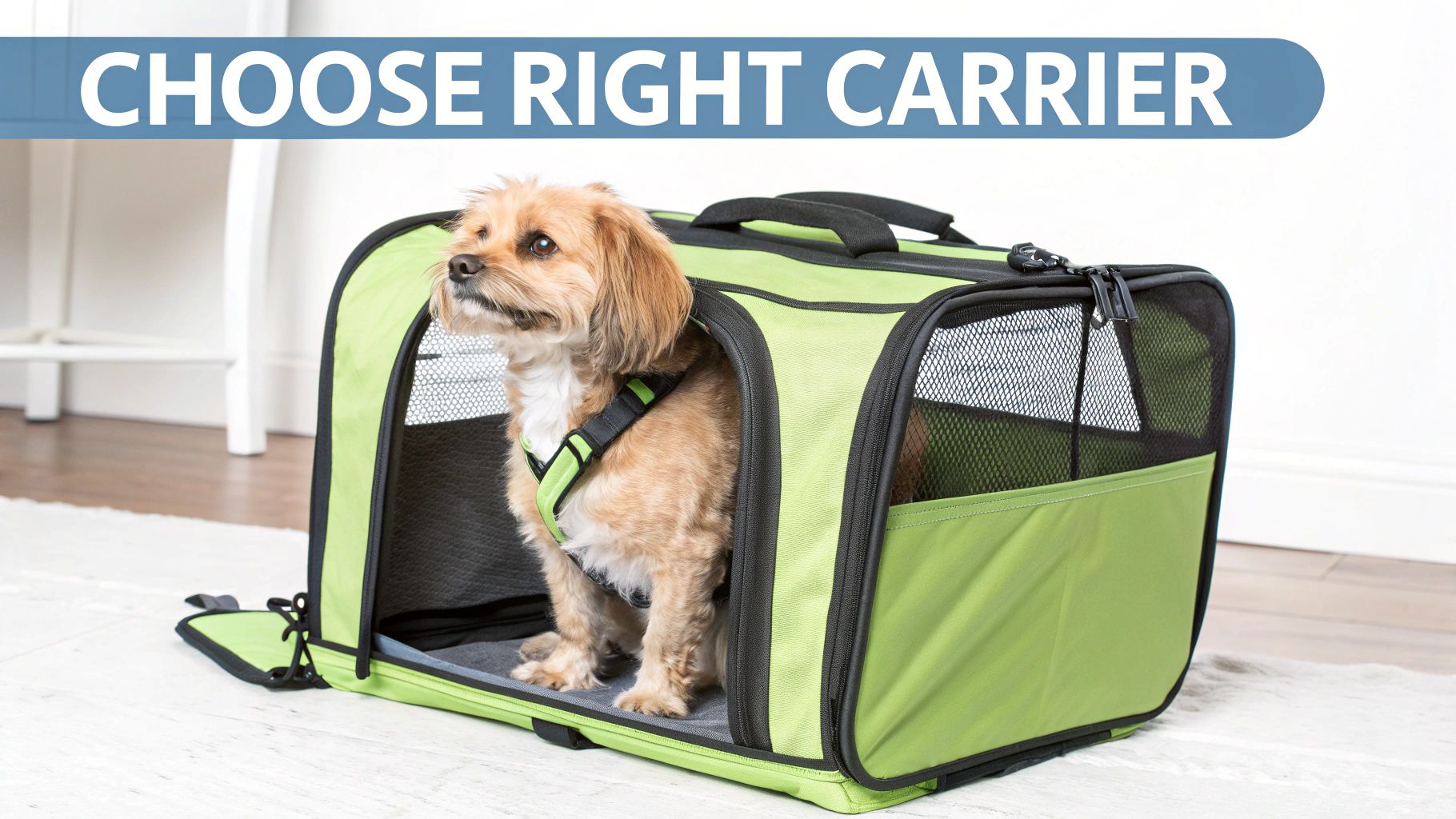
When shopping, focus on these essential features to ensure safety, durability, and airline approval.
-
Durable, Chew-Proof Mesh: Look for strong, claw-proof mesh on at least two sides. This provides essential ventilation and prevents escapes.
-
A Solid, Leak-Proof Bottom: Accidents can happen. A waterproof base contains messes and keeps the cabin clean. Look for carriers with a removable, washable pad for easy cleanup.
-
Secure, Locking Zippers: Standard zippers can be opened by a determined pet. Choose a carrier with locking zippers that clip or fasten shut, providing critical security.
-
A Padded, Comfortable Interior: The carrier should be a comfortable space. A soft, padded interior with a fleece or sherpa lining makes it more inviting and reduces travel stress.
Why Soft-Sided Carriers Are Often the Best Choice
For in-cabin travel, a soft-sided carrier is your most strategic choice. While hard kennels are necessary for cargo, the flexibility of a soft carrier is a major advantage for fitting under an airplane seat. Its ability to compress slightly can be the deciding factor in tight spaces.
Airlines recognize this and often recommend them. A soft-sided carrier that meets the airline approved pet carrier size gives you the highest probability of a perfect fit on any aircraft.
Think of choosing a carrier like packing a functional suitcase—it must be durable, practical, and right for its environment. A well-designed carrier with these features is your ticket to a smooth travel day.
Common Mistakes to Avoid When Buying a Carrier
Knowing what to avoid is as important as knowing what to look for. Steer clear of these common errors to make a smart purchase. For a detailed review, see our guide on the best pet carriers for air travel.
A frequent mistake is ignoring the carrier's weight. Airlines often have a combined weight limit for the pet and carrier, usually around 20 pounds. A heavy carrier can quickly use up this allowance. Always check the product weight before you buy.
Another error is prioritizing style over function. A fashionable carrier is useless if it lacks proper ventilation or secure zippers. Focus on safety and comfort first. As you browse, you might also explore pet luggage options that balance style with your pet's needs. The ultimate goal is a carrier that will keep your companion safe and secure for many trips to come.
Your Pre-Flight Checklist for Smooth Travels
A compliant carrier is essential, but a truly stress-free journey requires preparation. A prepared pet is a calm pet, and that process starts weeks before you leave for the airport. Use this actionable checklist to prepare yourself and your pet for takeoff.
Your first step is to acclimate your pet to the carrier. Start this process at least two to three weeks before your trip. Place the carrier in a common area of your home with the door open. Add a favorite blanket, toy, or treats inside to encourage exploration.
The goal is to create a positive association. Once your pet enters willingly, begin closing the door for short periods while you are present. Gradually increase the duration until they are comfortable relaxing inside. This transforms the carrier from an unfamiliar object into their personal safe space.
Packing Your Pet’s Carry-On Bag
Your pet needs an essentials bag for the journey. Packing a small "go-bag" will keep them comfortable and allow you to handle any situation that arises.
Here is your packing list:
- Absorbent Pads: Line the carrier with a fresh pad and pack extras for quick changes in case of an accident.
- A Familiar Toy or Blanket: The scent of home is a powerful comfort in a new environment. Choose a soft toy without small parts.
- Collapsible Water Bowl: Bring an empty bowl through security and fill it from a water fountain in the terminal to keep your pet hydrated.
- Small Bag of Treats or Kibble: Use treats to reward good behavior or as a distraction during delays.
Navigating the Airport and Flight
On travel day, your calm demeanor is crucial, as your pet will mirror your energy. Arrive at the airport with ample time to avoid feeling rushed.
At the TSA checkpoint, you will remove your pet from the carrier. You will carry or walk them through the metal detector while the empty carrier passes through the X-ray scanner. Never allow your pet to be sent through the X-ray machine.
Once you board, place the carrier securely under the seat in front of you, where it must remain for the entire flight. You can offer reassurance or a treat through the mesh, but for safety, your pet must stay inside the carrier at all times.
A prepared traveler is a confident one. By following this checklist, you address everything from your pet's emotional comfort to the logistics of airport procedures and required paperwork.
Finally, do a final check of your documents. Ensure you have your pet’s health certificate (usually required within 10 days of travel), proof of rabies vaccination, and any other paperwork required by your destination. For a complete overview, read our guide on how to travel with pets. For your own planning, you may also find these comprehensive international travel preparation tips useful.
Common Questions About Pet Carrier Sizes
When you're getting ready to fly with your pet, a few common questions always pop up about carrier sizes. Let's clear up some of the most frequent concerns so you can travel with peace of mind.
What Happens If My Pet Carrier Is a Little Too Big?
Pushing the size limits is a gamble you don't want to take. If your carrier is even slightly too large, you could be turned away right at the gate. The crew has to make sure every carrier can slide completely under the seat in front of you—it's a strict safety rule for takeoff and landing.
It’s always smarter to go with a carrier that you know is compliant. Even if it seems a bit snug, as long as your pet has enough room to stand up and turn around, you're good to go.
Can I Put Two of My Pets in the Same Carrier?
This one really comes down to the specific airline's rules. Some, like Southwest, might give you the green light for two very small puppies or kittens from the same litter in one carrier, provided they have enough space and don't exceed the weight limit.
But that’s more the exception than the rule. Most major airlines have a firm one-pet-per-carrier policy. The best approach? Assume it's one pet per carrier unless you call the airline and get explicit permission beforehand. It'll save you a major headache at the check-in counter.
Are Soft-Sided Carriers More Forgiving on Size?
Absolutely. This is where soft-sided carriers really shine. Their flexible material means you can often squish them down a bit to fit into tight under-seat spaces, even if they're technically a hair over the official dimension limits.
This is a big reason why many airlines not only recommend them but also list slightly larger maximum dimensions for soft carriers versus hard-sided ones. That little bit of give can make all the difference.
For a carrier that combines safety, comfort, and an airline-compliant design, explore the travel solutions we offer at Pet Magasin. Find the perfect fit for your furry co-pilot right here: https://www.petmagasin.com.

Leave a comment